Introduction
This chapter covers studies of radar capabilities and limitations as they may be related to the apparent manifestation of unidentified flying objects. The studies were carried out by the Stanford Research Institute pursuant to a contract with University of Colorado (Order No. 73403) dated 23 June 1967, under sub-contract to the U.S. Air Force.
The preceding chapter of this report, entitled "Optical Mirage - A Survey of the Literature," by William Viezee, covers optical phenomena due to atmospheric light refraction.
As they became available other information and interim results of these studies were informally communicated to the University of Colorado study project in accordance with the referenced contract.
The purpose of this chapter is to provide a basic understanding of radar, the types of targets it can detect under various conditions, and a basis upon which specific radar reports may be studied. Studies of specific UFO incidents were performed by the Colorado project (see Section III, Chapter 5).
At first consideration, radar might appear to offer a positive, non-subjective method of observing UFOs. Radar seems to reduce data to ranges, altitudes, velocities, and such characteristics as radar reflectivity. On closer examination however, the radar method of looking at an object, although mechanically and electronically precise, is in many aspects substantially less comprehensive than the visual approach. In addition, the very techniques that provide the objective measurements are themselves susceptible to errors and anomalies that can be very misleading.
In this chapter we will consider how the radar principle applies to detection of targets that may be or appear to be UFOs, and attempt to establish the criteria by which such apparent manifestations must be judged in order to identify them. Since we make no assumptions regarding the nature of UFOs we limit ourselves to describing the principles by which radars detect targets and the ways in which targets appear when detected. In a word, we can only specify the nature of radar detection of targets in terms of physical principles, both in regard to real and actual targets and in regard to mechanisms which give rise to the apparent manifestation of targets. It is hoped that these specifications will assist in the review of specific instances as they arise. Even in cases where radar may identify target properties that cannot be explained within the accepted frame of understanding of our physical world, the authentic observation of a target having such properties will shed little or no light on its nature beyond the characteristics observed, and it will therefore remain unidentified.
Radar Systems
RADAR is an acronym for RAdio Detection And Ranging. It is a device for detecting certain types of targets and determining the range to the target. The majority of radars are also capable of measuring the azimuth and elevation angles of targets.
Radars operate on three fundamental principles:
- that radio energy is propagated at uniform and known velocity;
- that radio energy is normally propagated in nearly straight lines, the direction of which can be controlled or recognized; and
- that radio energy may be reradiated or "reflected" by matter intercepting the transmitted energy.
Basically radar consists of a transmitter that radiates pulses of electromagnetic energy through a steerable antenna, a receiver that detects and amplifies returned signals, and some type of display that presents information on received signals.
Radar systems can be separated into three general categories:
- operational systems,
- special usage systems and
- experimental and research systems. These include fixed and portable ground-mounted systems, airborne, and shipborne systems.
Many types of radars are specifically designed to perform specialized functions. In general, radars provide either a tracking or a surveillance function. The surveillance radar may scan a limited sector or 360° and display the range and azimuth of all targets on a PPI (plan position indicator). Tracking radar locks onto the target of interest and continually tracks it, providing target coordinates including range, velocity, altitude, and other data. The data are usually in the form of punched or magnetic tape with digital display readout. Air traffic control, ship navigation, and weather radars fall into the surveillance category; whereas instrumentation, aircraft automatic landing, missile guidance, and fire control radars are usually tracking radars. Some of the newer generation of radar systems can provide both functions, but at this time these are very specialized systems of limited number and will not be discussed further.
In addition to the above general applications, each of the radar systems have special selective functions for various purposes. For example, some radar systems are designed so that they can track moving targets. Signals from stationary targets such as the ground, buildings, or even slow-moving objects are excluded from the display. This simplifies the display and makes it possible to track aircraft even though they are moving through an area from which strong ground clutter signals would otherwise mask the echo from the aircraft.
In addition to the many radar types, the radar operator has at his disposal many control functions enabling system parameters to be changed in order to improve the radar performance for increasing the detectability of particular types of targets, thereby minimizing interference, weather, and/or clutter effects. These radar system controls can modify any one or any combination of the following characteristics:
- Transmitter output power
- Pulse repetition rate
- Sensitivity time control
- Transmitted pulse width
- AGC response time
- IF receiver bandwidth
- Transmitter operating frequency
- Antenna scan rate
- Polarization control of radiated and received energy
- Skin or transponder beacon tracking
- Receiver RF and IF gain
- Display control functions
- Numerous signal processing techniques for clutter suppression, weather effects, moving target indication, false alarm rate, and threshold controls.
The radar operator himself is an important part of radar systems. He must be well trained and familiar with all of the interacting factors affecting the operation and performance of his equipment. When an experienced operator is moved to a new location, an important part of his retraining is learning pertinent factors related to expected anomalies due to local geographical and meteorological factors.
Two other groups of persons also affect the performance of the radar system. They are the radar design engineer and the radar maintenance personnel. The designer seeks to engineer a radar which achieves the performance desired, in addition to being a system which is both reliable and maintainable. Highly trained maintenance technicians routinely monitor the system insuring that it is functioning properly and is not being degraded by component system failures or being affected by other electronic systems that could cause electrical interference or system failure.
During the past 30 years, radar systems design has considerably improved. Radars manufactured today are more complex, versatile, sensitive, accurate, more powerful, and provide more data-processing aids to the operator at the display console. They are also more reliable and easier to maintain. In the process, they have become more sensitive to clutter, interference, propagation anomalies, and require better trained operating and maintenance personnel. Furthermore, with the increased data-processing aids to the operator, the more difficult becomes his target interpretation problem when the radar systems components begin gradually to degrade or when the propagation environment varies far from average conditions. The more sophisticated radar systems become, the more sensitive the system is to human, component, and environmental degradations.
Radar Fundamentals
Radar detection of targets is based on the fact that radio energy is reflected or reradiated back to the radar by various mechanisms. By transmitting pulses of energy and then 'listening' for a reflected return signal, the target is located. The period of time the radar is transmitting one pulse is called the pulse length and is generally measured in microseconds (millionths of a second) or expressed in terms of the length from the front to the back edge of the pulse. (A one microsecond pulse is 984 ft. long, since radio waves, like light travel 186,000 statute mps.) The rate at which pulses are transmitted is called the pulse repetition rate. When pulses are transmitted at a high rate, the receiver listening time between pulses for return echoes is reduced as well as the corresponding distance to which the energy can travel and return. This means that the maximum unambiguous range is decreased with increasing pulse repetition rate. More distant targets may still return an echo to the radar after the next pulse has been transmitted but they are displayed by the radar as being from the most recent pulse. These so-called multiple trip echoes may be misleading, since they are displayed at much shorter ranges than their actual position.
Other important operating characteristics of a radar are its transmitted power and wavelength (or frequency). The strength of an echo from a target varies directly with the transmitted power. The wavelength is important in the detection of certain types of targets such as those composed of many small particles. When the particles are small relative to the wavelength, their detectability is greatly reduced. Thus drizzle is detectable by short wavelength (0.86 cm.) radars but is not generally detectable by longer (23 cm.) wavelength radars.
The outgoing radar energy is concentrated into a beam by the antenna. This radiation of the signal in a specific direction makes it possible to determine the coordinates of the target from knowledge of the azimuth and elevation angle of the antenna. The desired antenna pattern varies with the specific purpose for which the radar was designed. Search radars may have broad vertical beams and narrow horizontal beams so that the azimuth of targets can be accurately determined. Height finders on the other hand have broad horizontal beams so that the height of targets can be accurately determined. In either case the radiating and receiving surface of the antenna is usually a section of a paraboloid.
A circular beam may be described as a cone with maximum radiation along its axis and tapering off with angular distance from the center. The beam is described by the angle between the half power points (the angular distance at which the radiated power is half that along the axis of the beam). In the case of non-circular beams two angles are used, one to describe the horizontal beamwidth, a second to describe the vertical beamwidth. Later in this report the detection of targets by stray energy outside the main beam will be discussed.
The size of the beam for a given wavelength depends on the size of the parabola. For a given size parabola the longer the wavelength, the broader the beam.
When the radiated energy illuminates an object, the energy (except for a small amount that is absorbed as heat) is reradiated in all directions. The amount that is radiated directly back to the radar depends on the radar cross-section of the target. Differences between geometrical cross-section and radar cross-section are related to the material of which the object is composed, its shape, and also to the wavelength of the incident radiation. The radar cross-section of a target is customarily defined as the cross-sectional area of a perfectly conducting sphere that would return the same amount of energy to the radar as that returned by the actual target. The radar cross-section of complicated targets such as aircraft depends on the object's orientation with respect to the radar. A jet aircraft has a much smaller radar (and geometric) cross-section when viewed from the nose or the tail than when viewed broadside.
Equations relating the various parameters are given, in varying degrees of complexity, in textbooks on radar. In their simplest form the equations for average received power are:
For point targets (birds, insects, aircraft, balloons, etc.):
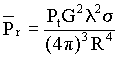 (1)
(1)
For plane targets (earth's surface at small depression angles):
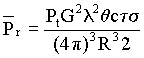 (2)
(2)
For volume targets (precipitation):
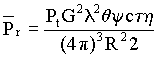 (3)
(3)
Where:
- Pr = average received power
- Pt = transmitted power
- G = Antenna gain
- lambda = wavelength
- sigma = section de coupe radar
- R = portée de la cible
- theta = largeur horizontale du rayon de l'antenne
- c = vélocité des ondes radio
- tau = longueur de l'impulsion émise
- psi = largeur verticale du rayon de l'antenne
- eta = reflectivity per unit volume
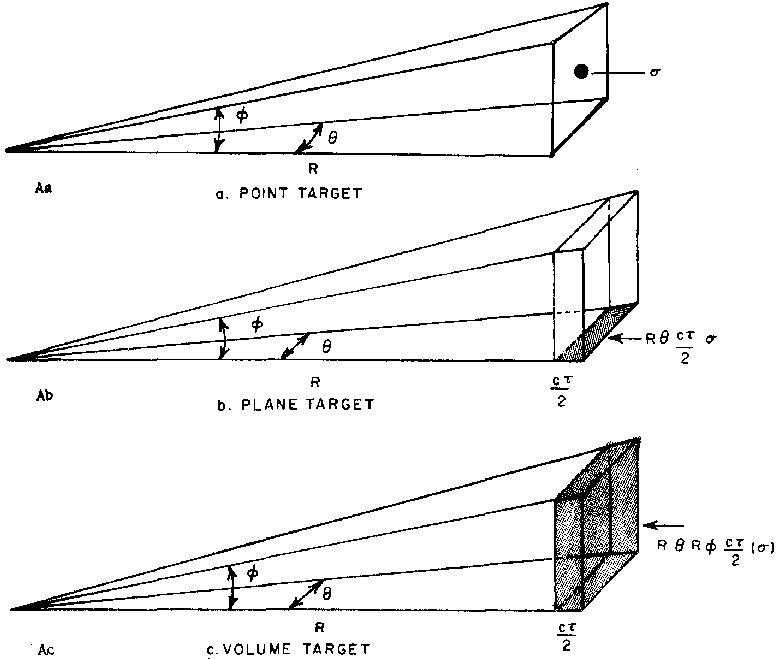
Ces équations montrent que l'intensité du signal d'écho varie according to whether the target is a point, a relatively small area, or a very large volume such as an extensive region of precipitation. The echo signal intensity of point targets varies inversely with the fourth power of the distance from the radar to the targets. The, intensity of area targets varies with the cube of the distance, and that of large volume targets, with the square of the distance.
La figure 1 illustre how the radar beamwidth and the cross section area or volume of the target interact to give these different variations with range of the returned signal. In Fig Aa, the point target has a radar cross-section [sigma]. In Fig. Ab there may be a number of targets with radar cross-section sigma over an area with dimensions of half the pulse length and the beam width at range R. Replacing sigma in equation (1) with this new expression for radar cross-section cancels one R in the denominator giving the R3 relationship. When the target is many sigma's spread over a volume with dimensions determined by range, horizontal and vertical beamwidth, and half the pulse length (Fig. Ac) R appears in the numerator twice, thus cancelling an R2 in the denominator of equation (1).
Because of differences in variation with distance of the return signal from various types of targets it is apparent that with combinations of targets the point targets might not be detectable. For example, an aircraft cannot be detected when it is flying through precipitation or in an area of ground targets unless special techniques are used to reduce the echo from precipitation or ground clutter.
Information on signals returned to the radar by a target may be presented to an operator in a number of ways; by lights or sounds that indicate there is a target at a selected location; by numbers that give the azimuth, elevation angle, and range of a selected target; or in 'picture' form showing all targets within range that are detected as the antenna rotates. The latter form of presentation is called a Plan Position Indicator (PPI). Plate 65 shows a photograph of a PPI. This photograph is a time exposure equal to the time for one antenna revolution. The center of the photograph is the location of the radar station. Concentric circles around the center indicate distance from the station. In this case the range circles are at 10 mi. intervals, so the total displayed range is 150 mi. North is at the top of the photograph and lines radiating from the center are at 10° intervals. A PPI display such as this corresponds very closely to a map. Often overlays with locations of cities, state boundaries, or other pertinent coordinates are superimposed over the PPI to aid in locating echoes. The plate shows a number of white dots or areas at various locations. These may be echoes from a variety of different targets, or they may be the result of interference or system malfunction.
The radar operator must keep watch of this entire area (70,650 sq. mi. in this example) and try to determine the nature of the targets. If he is a meteorologist he watches for and tracks weather phenomena and ignores echoes which are obviously not weather-related. If he is an air traffic controller he concentrates on those echoes that are from aircraft for which he is responsible. Many unexplained radar echoes are not studied or reported for several reasons. One of the reasons might be that the operators in general only track targets that they can positively identify and control. Since a radar operator can only handle a limited number (6 to 8) of targets simultaneously, he might not take serious note of any strange targets unless they appear to interfere with the normal traffic he is vectoring. Even when the unexplained extraordinary targets are displayed, he has little time available to track and analyze these targets. His time is fully occupied observing the known targets for which he is responsible. In addition, the operator is familiar with locally recurring strange phenomena due to propagation conditions and suspects the meteorological environment as being the cause. In general, the operator seldom has a way in which to record the displayed data for later study and analysis by specialists.
In addition to the tracking of various targets he must also be aware of the possibility of malfunction of the radar.
Fiabilité du système
Two types of failures occur in a radar system: those that are catastrophic and those that cause a gradual degradation. In spite of good maintenance procedures, there will be system component failures that occur due to external events such as ice or wind loading, rain on the cabling and connectors, bugs and birds in the feed structure. The operator is not always immediately aware of such failures. He is usually located in a soundproofed and windowless room remote from the transmitter, antenna, and receiving hardware. The operator has available to him only the console display and readout equipment. Catastrophic systems failure is usually self-evident to the operator. When the transmitter power tube fails, or the antenna drive unit fails, the operator is aware of this immediately on his PPI display. But when the gain in a receiving tube decreases, or the system noise slowly increases due to a component degradation, or the AFC in the transmitter section begins to go out of tolerance over a period of days causing increased frequency modulation or "pulse jitter" in the transmitted pulse, time may elapse before the operator becomes aware of the slowly deteriorating performance. Reduced sensitivity or the increased reception of extraneous targets from ground clutter or nearby reflecting structure is often evidence that the radar system is deteriorating.
It can be considered that a major system component of a typical radar might be subject to catastropic failure every 250 to 2,000 hours of operation (5 to 36 average failure-free days) and that graceful degradations of components occur continually. Possible failure thus becomes one of the first causes to be considered in analyzing unusual radar sightings. The next factor will be possible unusual propagation effects to which the radar is subject. Analysis of extraordinary sightings is further handicapped by the fact that the displayed data of the sighting usually are not recorded and that any explanations must frequently be based upon interpretations by the operators present at the time of the sighting. The point is that the operator, the radar, and the propagation medium are all fallible parts of the system.
Relations entre échos et cibles
Il y a 5 relations possibles entre échos et cibles radar. Il s'agit de :
- aucun écho - aucune cible ;
- aucun écho - lorsqu'un objet visuel semble être en position d'être détecté ;
- écho - non lié à une cible ;
- écho - d'une cible dans une position autre que celle indiquée ;
- écho - d'une cible à la localisation indiquée.
Les 1ʳᵉ et dernière possibilité sont indicatives d'un fonctionnement normal. Il est possible que (b) devienne important lorsqu'il y a un objet observé visuellement. Là, d'après la connaissances des types de cible détectables par le radar, une connaissance des caractéristiques de l'objet visuel pourrait être obtenue.
Les situations (c) où il existe un écho apparent mais pas de cible sont celles dans lesquelles la manifestation sur le PPI est dû à un signal qui n'est pas dû à une portion reradiée de l'impulsion transmise mais est due à une autre source. Celles-ci sont discustées dans une section ultérieure de ce chapitre.
Les situations où l'écho vient d'une cible non présente à la position indiquée (d) pourraient survenir en raison de l'une ou d'une combinaison des raisons suivantes. D'abord, une courbure anormale du rayon radar pourrait avoir lieu à cause des conditions atmosphériques. Ensuite, une cible détectable pourrait être présente au-delà de la portée désignée du radar et être présentée à l'affichage comme si elle était au sein de la portée désignée, par exemple, des échos multiple-trip de satellites artificiels avec de grandes sections de coupe radar. Également, l'énergie parasite de l'antenne pourrait être réfléchie par un obstacle à une cible dans une direction assez différente de celle dans laquelle l'antenne est dirigée. L'écho étant affiché le long d'azimut vers lequel l'antenne est pointée, la position affichée sera incorrecte. Enfin, des cibles pourraient être détectées par radiation dans les lobes latéraux et seraient affichées comme si elles avaient été détectée par le rayon principal.
La possibilité (e) listée ci-dessus englobe la large gamme de situations où une cible se trouve au lieu indiqué sur le système d'affichage. La préoccupation principale dans ce cas est l'identification de la cible.
Les relations possibles listées ci-dessus montrent que l'interprétation d'un écran radar n'est pas simple. Pour tenter d'identifier des cibles, l'opérateur doit connaître les caractéristiques de son radar ; s'il fonctionne ou non de manière adéquate ; et le type de cibles qu'il est capable de détecter. Il doit être pleinement au courant des conditions ou des événements par lesquels les échos seront présentés sur le radar à une position différente de la véritable localisation de la cible (ou dans le cas d'interferences par aucune cible). Enfin, l'opérateur doit acquérir des informations collatérales (données météo, transpondeur, communication vocale, observations visuelles ou informations [handover] d'un autre radar avant de pouvoir être absolument sûr qu'il a identifié un écho inhabituel.
Sources de signaux
Evaluation of Radar Echoes to Identify Targets
When there is an echo on the PPI of a search radar, the operator must determine the nature of the target. The information he has is relative signal intensity, some knowledge of fluctuation in intensity, position, velocity, and behavior relative to other targets. In addition he may be able to infer altitude if he is able to elevate the beam and reduce the gain to find an angle of maximum signal intensity. Previous sections of this chapter have briefly described a number of targets that search radars are capable of detecting. From the discussion it is apparent that there is overlap in the characteristics of different types of targets. Signal intensities, for example, range over several orders of magnitude. Wind-borne and powered targets may have comparable ground speeds depending on the wind speed. Many different types of targets show echo fluctuations. Thus there is no specific set of characteristics that will permit a given echo to be unambiguously identified as a specific target. At best all one can do is say that a given echo probably is, or is not, a specific target based on some of the observed characteristics.
Vitesse de la cible
Determination of the direction and speed of an echo in the PPI of a search radar requires some assumptions. A long range search radar antenna generally rotates at about 4 - 8 rpm. At 6 rpm, an antenna rotates through 360° in 10 sec. (=36°/sec). If the horizontal beam width of the antenna is 3.6° a point target will be within the beam for 0.1 sec. as the beam sweeps past. Then 9.9 sec. elapse until the beam again sweeps the target. If on this next revolution there is an echo in the general vicinity of the target detected on the previous sweep the operator must decide whether this echo is from the same target that was detected previously or is from a new target. If he assumes the two echoes are from the same target, he can then compute a velocity. If his assumption was correct, if his computations are accurate, and if the target is at the indicated locations, the computed ground speed is correct. If, however, the two echoes are not from the same target or are from a target that is not at the indicated location, then the computed speed will have no meaning.
The speed computed from the displacement of the echoes from a target at the indicated location represents the ground speed of the target. To aid in the identification of slow moving targets. it is necessary to determine its airspeed. This requires knowledge of the wind velocity at the location including altitude and time of the detection, and the assumption that the target is in essentially level flight. It is often difficult to determine precisely the wind velocity at a given point due to the wide spacing of stations that measure winds aloft and the six-hour interval between observations. Except in complex situations, it is usually possible, however, to extrapolate measured winds for a given location with sufficient accuracy to determine whether the target velocity and wind velocity have sufficient similarity to justify a conclusion that the target is probably windborne. Conversely if there is a large disparity between wind velocity and target velocity a logical conclusion would be that the target could not be windborne.
When an echo that has been moving in an orderly manner on the PPI suddenly disappears, the information for computing its speed also disappears. Any attempts to guess the speed would require the operator to make specific assumptions of the reason for the disappearance. He might assume that the target moved out of range during the brief time required for one antenna revolution. Such an assumption would probably require a very high speed target. Or the operator might assume that the target decreased altitude to a position below the radar horizon. If the target was located close to the radar horizon, an altitude change of a few tens of feet would be sufficient for it to disappear and the required speed (vertical velocity) would be quite small.
Target Intensity and Fluctuations
The power received from a point target is directly proportional to the radar scattering cross-section of the target and inversely proportional to the fourth power of the distance from the radar to the target. Therefore, for an equal signal to be received from two targets, a target 10 mi. from the radar would have to have a radar cross-section 10,000 times as large as a target at 1 mi. Examples of targets with differences in cross-sections of this order of magnitude are birds with cross-sections of 0.01 m2 or less and aircraft with cross-sections of up to 100 m2. Intensity differences such as these can be measured (by gain reduction to threshold of detection), but the nature of display systems such as PPI's is such that differences are considerably reduced. An echo on the PPI is composed of many small dots that result from an electron beam that excites the coating on the face of the tube causing it to emit light. The coating may be designed to emit light only when the electron beam excites it or may continue to emit light for some time after the excitation has ceased (persistence). The latter is usually the case for PPI's where the operator depends on persistence to see the 360° coverage provided by the rotating antenna. Haworth (1948) states that from 150 - 200 spots can be resolved along the radius of magnetically deflected radar tubes. Gunn (1963) points out that since the PPI trace lines converge at the center the light output per unit area of the tube face will decrease with increasing radial distance from the center. As a result echoes near the center are 'painted' with a higher intensity than echoes of comparable strength anywhere else on the display. These characteristics of the display system act to conceal further the relative magnitudes of the signal intensity of targets at different ranges, so that the operator loses much of the available radar information when it is displayed on the PPI. Fluctuations are smoothed out, and the intensities are normalized to some extent. The result is that he can give some information on an unknown target in comparison with a known target at the same range. Positive knowledge of the nature of a target at a given range can only result from auxiliary data. For example, if the operator is in contact with an aircraft that is over a given point and he has an echo at that point he will logically assume the echo is from the aircraft if the echo is moving on the course and at the speed reported by the pilot. He could then compare the intensity and fluctuations of other targets at that range with those of the known target and draw some conclusions as to whether they might be larger or smaller than the aircraft.
Behavior Relative To Other Targets
Very little can be said about a target from the examination of a single echo but some information can be obtained by comparing the echo with other echoes on the remainder of the PPI. When the echo is interpreted in terms of the appearance and behavior of other echoes a logical explanation may become evident.
For example, the author has seen isolated targets on the PPI that were moving toward the radar in a direction opposite to that of the wind, so that it was obvious that they could not be windborne. A slight elevation of the antenna caused them to disappear so it was apparent that they were at low levels. No attempt was made to send aircraft to the vicinity to look for targets. All other attempts to interpret the nature of real targets on that half of the PPI that would return the displayed echoes were futile. When the remainder of the PPI was examined it was found that the speed of a line of thunderstorms moving toward the station was the same as that of the echoes to the east. The direction of movement, however, was the same as that of the wind and not opposite, as with the echoes to the east. Further, the distance to the thunderstorms to the west was the same as the distance to the unknown echoes to the east. With this additional information it seemed likely that the echoes to the east were reflections of portions of the thunderstorms to the west. The obstacles causing the reflections were subsequently identified as large nearby chimneys that extended only slightly higher than the height of the radar so that when the antenna was elevated slightly the chimneys were below the main beam and no longer caused reflections.
Since the reflectors (chimneys) were very narrow, the reflection echoes were very narrow but their length was equal to the diameter of the precipitation area. The echoes therefore had a long, narrow (cigar-shaped) appearance. Since the apparent lengths in some cases were 10 - 15 mi. they were not mistaken for some type of flying vehicle.
Although the solution of the case discussed here is a simple, and, on the surface, obvious one, it does demonstrate the necessity of studying the entire PPI, not just one or two odd echoes. The case also illustrates how echo characteristics become distorted when the return is from a target not at the indicated location. The long, narrow shapes of the reflection echoes, a vertical extent of only 1° - 2° at ranges less than 50 mi. and movement against the wind all tended to rule out precipitation as the target.
The problem of identifying reflections is very difficult. The simplest case is where the reflector and reflected target are both fixed. The reflected echo is always in the same position and whether it appears or not depends on propagation conditions and if the reflector is of limited vertical extent on antenna elevation angle.
When the reflector is fixed and the target is moving the reflected echo also moves but in a different direction than the true target. Still the geometry is relatively simple and the reflected echo will move toward or away from the radar along a radial line extending from the radar across the reflector. The reflected echo will appear to move toward the radar when the distance from the radar to the true target is decreasing and away from the radar when the distance from the radar to the true target is increasing. The apparent speed of the reflected echo toward or away from the radar corresponds to the speed of the true target toward or away from the reflector. This is not its actual ground speed. A target could move at 500 knots along a constant-distance circle from the reflector, yet the reflected echo would be stationary. Only if the target moved directly toward or away from the reflector would the reflected echo have the same speed as the target; but the speed of the reflected echo can never exceed that of the target.
When the reflector is moving and the target is stationary (see discussion of Fig. 13) the reflected echo track is always further from the radar than the reflector track. The reflection echo will follow roughly the same track as the reflector but its apparent speed may be much greater depending on the distance between the reflector and target. When the reflector is far from the target the apparent speed of the reflected echo will be much greater than the true speed of the reflector. When the reflector is very close to the target the reflected echo will be close to the position of the reflector and its apparent speed will be comparable to that of the reflector.
The situation where both the reflector and the target are moving is very complex. The apparent speed of the reflected echo will depend on the relative speeds of both reflector and target. When the reflector is moving slowly, the condition of a stationary reflector will be approached but not quite realized. That is, the reflected echo will have a maximum apparent speed that does not greatly exceed that of the target, but since the reflector is moving, the reflection echo will not be restricted to motion along a single radial line.
When the reflector is moving rapidly compared to the target, the result is similar to the case of a fixed target, that is the reflected echo track approximates the reflector track but its apparent speed will be greater. When the target moves, the track correspondence is not as good and the reflected echo's apparent speed may greatly exceed that of the reflector.
The most complex cases are those in which a moving reflector is not illuminating a single target but may show a different target on each scan of the radar. In these cases there is no correspondence between reflected echo track and reflector track. Speed computations in these cases are erroneously based on multiple targets. Attempts to compute a speed therefore produce values that can vary from some very low speeds to thousands of knots.
It is obvious from the preceding discussion that it is nearly impossible to identify an unknown target working in real time at the PPI. To establish that an unknown is a reflection echo requires a determination of whether it is at the same azimuth as a reflector. Since any one of many other echoes could be the possible reflector, the geometry would have to be applied to each one in turn. When numerous echoes are on the PPI this is impossible.
Much valuable information can be recorded for later detailed study by photographing the PPI with a radarscope camera during each revolution of the radar antenna. Later the films can be studied, either as time-lapse motion pictures or frame by frame. For many years this type of radarscope photography has been used for studies of radar-detected precipitation patterns and has provided insights into meteorological phenomena that would have been impossible from subjective verbal descriptions of the echo patterns.
Radarscope photographs of the PPI have all the limitations of the PPI presentation itself. They cannot show intensity differences or minor intensity fluctuations. They do have the powerful advantage of making it possible to review a puzzling echo hundreds of times at various rates of viewing and to study the appearance and behavior of all echoes before, during and after the episode. Only by the study of radarscope films and many other supporting data is it possible to arrive at even a tentative conclusion that a given echo cannot be explained.
Conclusions
Radar is a valuable instrument for detecting and ranging targets that are not visible to an observer due to darkness, extreme distance, intervening rain, cloud cover, haze, or smog. Radar can also detect, or reflect from, atmospheric discontinuities that are not visible to the eye. The echoes of real targets and apparent targets that result from RPI, reflections, or system noise may on occasion produce scope presentations that are extremely difficult or impossible to interpret. The major difficulty is that while radar is designed to beam radiation in a specific direction and detect targets within a specific distance, it does not always do so. The transmitted radiation, while concentrated in a main beam, goes out as well, in many other directions. Portions of the main beam and the lobes may be reflected in other directions by nearby objects, by solid targets a considerable distance from the radar, or by layers or small volumes of atmospheric inhomogeneities. All of this radiation in various directions is refracted by atmospheric temperature and moisture profiles to deviate further from its original path. Portions of this radiation that impinge upon any of a wide variety of targets are reflected back along a reciprocal path and presented on the PPI as if they were at the position determined by the antenna elevation and azimuth, and the time required for the most recently transmitted pulse to travel out and back. Some of the displayed echoes will represent targets at the indicated locations. Some of the displayed echoes will be from targets not at the indicated position, and some of the echoes will not represent targets at all, but will be due to system noise or RFI. Since radar does not differentiate between the unique characteristics of different types of targets, it is impossible for even the most experienced radar operator to look at the PPI and positively identify all echoes on the scope.
Some auxiliary information on the possible nature of the targets may be derived from the study of the appearance of the PPI on successive antenna revolutions or from a series of PPI photographs. These successive presentations show the interpreter apparent motion and changes in intensity. This additional information is useful but still does not permit positive identification of the target. Only such generalizations may be made as that the target appears to be moving at 250 knots so it cannot be precipitation, birds, or a balloon. To even make this generalization the operator has to know or make some assumptions about the probable wind speed in the vicinity of the apparent target.
The data presented on the PPI of a single radar, therefore, do not permit the operator to say very much about the possible nature of a target displayed as an echo on the PPI. Many additional data are required such as meteorological conditions between the radar and the apparent location of the target, and auxiliary radar information such as target elevation angle and the bearing of the target from another radar. The detection of a target at the same location by two or more radars with different characteristics would usually rule out multiple trip echoes, reflections, and detection by side lobes. Surveillance by more than one radar would also aid in establishing continuity along an echo track if the rotation rate of the two radars was such that they were 180° apart so that one would "see" the echo when the other was "looking" 180° from it. The problem of determining speed is based on the assumption that a single target has moved a specific distance during the time that the beam is not aimed at it. In many cases this may be an erroneous assumption, and it requires either continuous tracking or surveillance by numerous radars to determine whether only a single target is involved.
It is hoped that this discussion of radar has convinced the reader that radar data are only a tool to be used in conjunction with many other bits of information for the solution of various problems. Radar alone cannot specify the exact nature of all targets especially when it was probably specifically designed to detect specific target types. It can only provide the operator with some generalized information about the target and he can only draw some general conclusions based on a number of assumptions he must make. If he makes the wrong assumption, he will come to an erroneous conclusion.
This does not mean that radar could not be a useful tool in any further studies of the UFO problem; it simply points out the need for, and problems of, gathering photographic and other data from a number of different types of radar on specific incidents before the data could be carefully analyzed and interpreted with any degree of confidence.
Bibliographie
- Allen, R.J. and M.G.H. Ligda. "Services for Bird Counter Study and Design," Final Report, Contract DA 42-00 7 AMC-306 (Y), Stanford Research Institute, Menlo Park, (1966).
- Atlas, D. "Radar Lightning Echoes and Atmospherics in Vertical Cross Section," Recent Advances in Atmospheric Electricity, Pergamon Press, New York, (1958a), 441-459.
- Atlas, D. "Radar as a Lightning Detector," Proc. Seventh Wx. Radar Conf., Miami Beach, Fla. (Available from American Meteorological Society, Boston, Mass.), (1958b), C-l - C-8.
- Atlas, D. "Sub-Horizon Radar Echoes by Scatter Propagation," J. Geophysical Res., Vol. 64, (1959), 1205-1218.
- Atlas, D. "Advances in Radar Meteorology," Advances in Geophysics, Vol. 10, Academic Press, New York, (1964), 317-478.
- Atlas, D. "Further Remarks on Atmospheric Probing by Ultrasensitive Radar," Paper presented to the Panel on Remote Atmospheric Probing of the National Academy of Sciences, Chicago, Ill., (1968).
- Atlas, D. and K.R. Hardy. "Radar Analysis of the Clear Atmosphere: Angels," Paper presented to the XV General Assembly of the International Scientific Radio Union, Munich, (1966a).
- Atlas, D., K.R. Hardy, and K. Naito. "Optimizing the Radar Detection of Clear Air Turbulence," J. Appl. Meteor., Vol. 5, (1966b), 450-460.
- Battan, L.J. "Duration of Connective Radar Cloud Units," Bull.AP4S, Vol. 34, (1953), 224-228.
- Bauer, J.R. "The Suggested Role of Stratified Elevated Layers in Transhorizon Short Wave Radio Propagation," Tech.Rep., No. 124, Lincoln Lab. M.I.T., (1956).
- Bean, B.R. and E.J. Dutton. "Radio Meteorology," NBS Monograph 92, U.S. Government Printing Office, Washington, D.C. (1966).
- Blackmer, R.H., Jr. "The Lifetime of Small Precipitation Echoes," Proc. Fifth Wx. Radar Conf. Asbury Park, N.J., (1955), 103-108.
- Blackmer, R.H., Jr. "Anomalous Echoes Observed By Shipborne Radars," Proc. Eighth Wx. Radar Conf., San Francisco, Calif. (available from AMS, Boston, Mass.), (1960), 33-38.
- Blackmer, R.H. Jr. and S.M. Serebreny. "Analysis of Maritime Precipitation Using Radar Data and Satellite Cloud Photographs," J. Appl. Meteor., Vol. 7, (1968), 122-131.
- Bonham, L.L. and L.V. Blake. "Radar Echoes from Birds and Insects," The Scientific Monthly, (April, 1956), 204-209.
- Borden, R.C. and T.K. Vickers. "A Preliminary Study of Unidentified Targets Observed on Air Traffic Control Radars," Technical Development Report No. 180, Civil Aeronautics Adminstration Technical Development and Evaluation Center, Indianapolis, C1953)
- Browning, D.A. and D. Ktlas. "Velocity Characteristics of Some Clear-Air Dot Angels," J. Atmos. Sci., Vol. 23, (1966), 592-604.
- Eastwood, F. Radar Ornithology, Methuen and Co., Ltd., 11 New Fetter Lane, London, 1967.
- Eastwood E., G.A. Isted and G.C. Rider. "Radar Ring Angels and the Roosting Behaviour of Starlings," Proc. Royal Soc., London, Vol. 156, (1962), 242-267.
- Eastwood, E. and G.C. Rider. "Some Radar Measurements of the Altitude of Bird Flight," British Birds, Vol. 58, (1965), 393-420.
- Edrington, T.S. "The Amplitude Statistics of Aircraft Radar Echoes," Trans. IEEE, Vol. MIL 9, (1965), 10-16.
- Ferrari, V.J. "An Epidemiologic Study of USAF Bird Strike Damage and Injury, 1960 to 1965," Life Sciences Division, Norton Air Force Base, California, (1966).
- Geotis, S.G. "Some Radar Measurements of Hailstones," J. Appl. Meteor., Vol. 2, (1963), 270-275.
- Glick, P.A., "The Distribution of Insects, Spiders and Mites in the Air," Tech. Bull. No. 673, U.S. Dept. of Agriculture, (1939)
- Goldstein, H., D.E. Kerr, and A.E. Bent. "Meteorological Echoes," M.I.T. Rad. Lab. Series, McGraw Hill, New York, Vol. 13, (1951), 588-640.
- Glover, K.M., K.R. Hardy, C.R. Landry, and T. Konrad. "Radar Characteristics of Known Insects in Free Flight," Proc., Twelfth Wx. Radar Conf., Norman, Oklahoma, (1966), 254-258.
- Gunn, K.L.S. "Tube Face Filters for Line Space Compensation," Proc. Tenth Wx. Radar Conf., Washington, D.C. (available from AMS, Boston, Mass.), (1963), 361-364.
- Gunn, K.L.S. "Tube Space Filters for Line Space Compensations," Proc. Tenth Wx. Radar Conf., Wash., D.C., (1965).
- Gunn, K. L.S., and T.W.R. East. "The Microwave Properties of Precipitation Particles," Q.J. Roy. Meteor.Soc., Vol. 80, (1954), 552-545.
- Hajovsky, R.G., A.P. Deam, and A.H. La Grone. "Radar Reflections from Insects in the Lower Atmosphere," IEEE Trans., Vol. AP-14, (1966), 224-227.
- Hansford, R.F. (Editor) Radio Aids to Civil Navigation, Heywood and Co. Ltd., London, 1960.
- Hardy, K.R., D. Atlas, and K.M. Glover. "Multiwavelength Backscatter From the Clear Atmosphere," J. Geophys. Res., 71, No. 6, (1966), 1537-1552.
- Hardy, K.R. and I. Katz. "Probing the Atmosphere with High Power, High Resolution Radars," Paper presented to the Panel on Remote Atmospheric Probing of the National Academy of Sciences, Chicago, Ill., (1968a).
- Haworth, L.J. "Introduction to Cathode Ray Tube Displays," M.I.T. Rad. Lab. Series, Vol. 22, Edited by T. Soller, M.A. Starr, and G.E. Valley, Jr., McGraw Hill, New York, (1948).
- Hilst, G.R., and G.P. MacDowell. "Radar Measurements of the Initial Growth of Thunderstorms," Bull. AMS, 31, (1950), 95-99.
- Hiser, H.W. "Some Interesting Radar Observations at the University of Miami," Proc. Fifth Wx. Radar Conf., Asbury Park, N.J., (1955), 287-293.
- Houghton, F. "Detection, Recognition and Identification of Birds on Radar," Proc. Eleventh Wx. Radar Conf., (1964), 14-21.
- Konrad, T.G., J.J. Hicks, and E.B. Dobson. "Radar Characteristics of Birds in Flight," Science, Vol. 159, (1968), 274-280.
- Lack, D. and G.C. Varley. "Detection of Birds by Radar," Nature, Vol. 156, (1945)
- La Grone, A., A. Deam, and G. Walker. Radio Sci. J. Res. (1964, 1965), 68D, 895.
- Lane, J. A. "Small Scale Irregularities of the Radio Refractive Index of the Troposphere," Nature, Vol. 204, (1964), 43 8-440.
- Levine, D. Radargrammetry, McGraw Hill, N.Y. 1960.
- Ligda, M.G.H. "Radar Storm Observation," Compendium of Meteorology, AMS, Boston, Waverly Press, Baltimore, Md., 1951, 1265-1262.
- Ligda, M.G.H. "The Radar Observation of Lightning," J. Atmos. and Terrestrial Physics, Vol. 9, (1956), 329-346.
- Ligda, M.G.H. "Middle-Latitude Precipitation Patterns as Observed by Radar" (a collection of composite radar observations), Scientific Report No. 1, Contract AF 19(604)-1564, Texas A&M College, College Station, Tex., (1957).
- Ligda, M.G.H. "Radar Observations of Blackbird Flights," Texas J. of Science, Vol. 10, (1958), 225-265.
- Ligda M.G.H., and S.G. Bigler. "Radar Echoes From a Cloudless Cold Front," J. Meteor., Vol. 15, (1958), 494-501.
- Ligda, M.G.H., R.T.H. Collis, and R.H. Blackmer, Jr. "A Radar Study of Maritime Precipitation Echoes," Final Report, Contract NOas 59-6170-a, SRI Project 2829, Stanford Research Institute, Menlo Park, Calif., (1960).
- Myres, M.T. "Technical Details of Radar Equipment Detecting Birds, and a Bibliography of Papers Reporting the Observation of Birds with Radar," Field Note No. 9, The Associate Committee on Bird Hazards to Aircraft, National Research Council of Canada, Ottawa, (1964).
- Nagle, R.E. and R.H. Blackmer, Jr. "The Use of Synoptic-Scale Weather Radar Observations in the Interpretation of Satellite Cloud Observations," Final Report, Contract AF 19 (628) -284, SRI Project 3947, Stanford Research Institute, Menlo Park, Calif., (1963).
- Page, R.M. "Radar Goes to Sea," (Unpublished report of early tests of the XAF radar by the U.S. Naval Research Laboratory. Described by Bonham and Blake 1956, (1939).
- Pererson, A.M, R.L. Leadabrand, W.E. Jaye, R.B. Dyce, L.T. Dolphin, R.I. Presnell, L.H. Rorden, and J.C. Schobom. "Radar Echoes Obtained from Earth Satellites, 1957, Alpha and 1957, Beta," Avionics Research, Pergamon Press, N.Y., (1960), 140-145.
- Plank, V.G. "A Meteorological Study of Radar Angels," Geophysical Research Papers No. 52, Air Force Cambridge Res. Lab., Bedford, Mass., (1956).
- Plank, V.G., R.M. Cunningham, and G.F. Campen, Jr. "The Refractive Index Structure of a Cumulus Boundary and Implications Concerning Radio Wave Reflection," Proc. Sixth Wx. Radar Conf. Cambridge, Mass., (1957), 273-280.
- Rainey, R.C. "Radar Observations of Locust Swarms," Science, Vol. 157, No. 3784, (1967) 98-99.
- Ritchie, D.J. Ball Lightning, Consultants Bureau, New York, 1961, 70.
- Rockney, V.D. "The WSR-57 Radar," Proc. Seventh Wx. Radar Conf., Miami Beach, Florida, (1958), F-14 to F-20.
- Schelling, J.G., C.R. Burrows, and E.B. Ferrell. "Ultra-short Wave Propagation," Proc. IRE, Vol. 21, (1933), 427-463.
- Senn, H.V. and H.W. Hiser. "Major Radar Parameters for Airborne Weather Reconnaissance," Proc. Tenth Wx. Radar Conf., Washington, D.C. (available from the AMS, Boston, Mass.), (1963), 341-347.
- Skolnik, M.I. Introduction to Radar Systems, McGraw Hill, New York, 1962, 648.
- Smith, E.K. Jr. and S. Weintraub. "The Constants in the Equation for Atmospheric Refractive Index at Radio Frequencies," Proc IRE, Vol. 41, (1953), 1035-1037.
- Smith, R.L. "Vertical Echo Protrusions Observed by WSR-57 Radar," Progress Report No. 10 on WSR-57 Radar Progrom, Dept. of Commerce, Weather Bureau, Washington, D.C., (1962), 20-30.
- U.S. Aix Force. "Ground Radar Equipment Characteristics Digest," ADCM 50-12, Air Defense Command, Colorado Springs, Cob., (1954)
- U.S. Navy. "Meteorological Aspects of Radio Radar Propagation," NAVWEPS 50-IP-550, U.S. Navy Weather Research Facility, Norfolk, Virginia, (1960).
- Walker, W. "Use of Sun to Check WSR-57 Azimuth and Height Accuracy," Progress Report No. 10 on WSR-57 Radar Program, U.S. Dept. of Commerce, Washington, (1962), 15-19.
- Williams, E.L. "Progress Report on the AN/CPS-9 Radar Program," Proc.Third Wx.Radar Conf. McGill University, Montreal, (1952).