(La biographie du Dr. James E. McDonald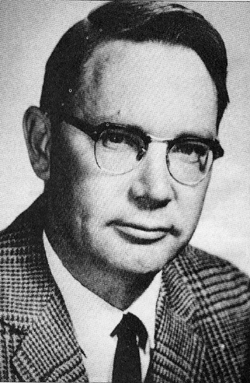 suit :)
Dr. James E. McDonald
Né : Duluth (Minnesota), 7 mai 1920.
Adresse personnelle : 3461 East Third St., Tucson, Ariz.
Formation :
- Université d'Omaha, Omaha (Nebraska), B.A. (Chimie) 1942.
- Massachusetts Institute of Technology, Cambridge, Mass. (Météorologie) 1945.
- Université d'Etat de l'Iowa, Ames, Ia., Ph.D. (Physique) 1951.
Carrière professionnelle :
- Instructor, Dept. de Physique, Université d'Etat de l'Iowa, 1946-49.
- Professeur assistant, Dept. of Physique, Iowa State University, 1950-53.
- Chercheur physicien. Projet de Physique des Nuages, Université de Chicago, 1953-54.
- Professeur assistant, Dept. de Physique, Université d'Arizona, 1954-56, Professeur, 1956-57.
- Directeur adjoint. Institut de Physique Atmosphérique, Université d'Arizona, 1954-57.
- Professeur, Dept. de Météorologie, et Physicien Senior, Institut de Physique Atmosphérique, 1958 à aujourd'hui.
Autres activités :
- Marine U.S., 1942-45, renseignement naval et aérologie.
- Membre, Panel on Weather and Climate Modification, National Academy of Sciences, 1965-present
- Membre, ESSA-Navy Project Stormfury Advisory Panel, 1966-present.
- Membre, American Meteorological Society Commission on Publications, 1966- present.
- Membre, Advisory panel for weather modification. National Science Foundation, 1967-present.
Affiliations professionnelles :
- Association Américaine pour l'Avancement de la Science, American Meteorological Society, Sigma Xi, American Geophysical Union, Royal Meteorological Society, Arizona Academy of Science, American Association of University Professors.
Personnel : Marié, 1945, Betsy Hunt: 6 enfants.
Domaines d'intérêt particulier :
Physique atmosphérique, Physique des nuages et des précipitations, optique météorologique, électricité atmosphérique, modification de la météo, phénomènes aériens non identifiés.
Déclaration du Dr. James E. McDonald, Physicien sénior, Institut de Physique Atmosphérique, and professeur, Département de Météorologie, Université d'Arizona, Tucson (Arizona)
Dr. McDonald. Merci, M. Edward J. Roush.
Je suis particulièrement ravi d'avoir cette chance de fournir des commentaires et suggestions sur la base de ma propre expérience au comité, et je souhaite recommander le Comité sur la Science et l'Astronautique pour franchir cette première, et j'espère très significative étape, afin d'examiner le problème qui a intrigué tant de gens depuis 20 ans.
Comme le Dr. Josef Allen Hynek l'a souligné dans ses remarques, une des difficultés du
problème dont nous parlons aujourd'hui est que la communauté scientifique, pas seulement aux Etats-Unis mais au
niveau mondial, a eu tendance à écarter le problème ovni et à le considérer comme insensé. Le fait que
tant de données anecdotiques soient impliquées a, on peut le comprendre, découragé nombre de scientifiques de
prendre au sérieux ce qui, en fait, je pense est un sujet d'une importance scientifique extraordinaire.
l'a souligné dans ses remarques, une des difficultés du
problème dont nous parlons aujourd'hui est que la communauté scientifique, pas seulement aux Etats-Unis mais au
niveau mondial, a eu tendance à écarter le problème ovni et à le considérer comme insensé. Le fait que
tant de données anecdotiques soient impliquées a, on peut le comprendre, découragé nombre de scientifiques de
prendre au sérieux ce qui, en fait, je pense est un sujet d'une importance scientifique extraordinaire.
J'ai étudié maintenant depuis près de 2 ans, à un niveau plutôt intensif, le problème ovni. J'ai interrogé plusieurs centaines de témoins dans des cas sélectionnés, et je suis étonné de ce que j'ai trouvé.
Je n'avais aucune idée que la situation ovni soit en quelque manière ce qu'elle semble réellement être.
Il y a un certain parallèle entre la lente reconnaissance du problème par le Dr. Hynek et ma lente reconnaissance du problème. J'ai été curieux des ovnis de manière courante pendant 10 ou 20 ans et ait même examiné des cas dans la région de l'Arizona du sud off and on rather casually, rencontrant principalement des laymen sincères ne reconnaissant pas une lumière de stroboscope d'avion, ou Vénus, ou un météore brillant, lorsqu'ils les voient. Il est assez vrai que de nombreuses personnes identifient mal des phénomènes naturels ; et mon expérience a été principalement mais pas entièrement limitée à cette sorte de cas.
Il y a 2 ans environ je devins plus que casually curious pour plusieurs raisons qui ne sont pas très pertinentes ici, et commençais à passer bien plus de temps et changeais rapidement mes notions sur le problème. Je visitais la base aérienne de Wright-Patterson, vit leur fichiers ovnis très impressionnants et surprenants, dont le schéma est complètement différent de ce que j'avais imaginé.
A la même époque, je contactais un certain nombre de groupes privés d'enquêtes sur les ovnis, l'un des meilleurs et les plus constructifs étant situé ici à Washington, le Comité National d'Enquêtes sur les Phénomènes Aériens ; contactais un autre des grands groupes nationaux, l'Organisation de Recherche sur le Phénomène Aérien, et trouvais à nouveau quelque peu à ma surprise, que des groupes amateurs opéraient on a shoestring basis, et souvent dédaignés par nous les scientifiques, faisaient, en fait, vraiment un travail d'enquête plutôt bon étant données leurs ressources, et avaient compilé dans leurs dossiers, par exemple au NICAP, de l'ordre de 10000 ou 12000 cas, dont j'ai vérifié de nombreux par la suite, et tous impliquant un problème qui a été perdu de vue, balaysé sous le tapis, ignoré, et qui nécessite maintenant d'être très rapidement mis au jour comme un problème demandant une attention scientifique très sérieuse et de très haut calibre.
Je voudrais souligner cela. Nous devons très rapidement avoir des gens très bons examinant ce problème, parce qu'il relever d'une préoccupation très sérieuse. Nous traitons ici de phénomène inexplicables, de phénomènes déroutants, qui ne seront pas éclaircis sans les meilleurs scientifiques.
Le périmètre de mes remarques ce matin, et le périmètre des remarques plus détaillées de ma déclaration préparée qui a été soumise, touche 2 grands domaines :
On m'a demandé de résumer les résultats de mes interviews de témoins ces 2 dernières années, ce que j'ai trouvé, les problèmes que j'ai rencontré et ainsi de suite ; et, en 2nd lieu de m'adresser aux catégories d'explications passées d'observations d'ovnis, qui s'articulent sur mon propre domaine de la physique atmosphérique.
Permettez-moi de me retourner très brièvement sur mon expérience. Dans les 2 dernières années j'ai pu consacrer une partie substantielle de mon temps à ce problème. J'ai me suis principalement concentré sur les témoins d'observations d'ovnis ayant vérifiés par certains des groupes indépendantes ; c'est-à-dire que je ne traitais plus, ces 2 dernières années, de données brutes d'origines où ses trouvaient principalement des phénomènes mal identifiés, mais au contraire des données filtrées, pré-triées, reposant très fortement sur des groupes comme le NICAP et l'APRO, ainsi que d'autres groupes de ce pays et d'autres groupes à l'étranger pour mes cas proéminents et mes éléments de fond.
J'ai également eu la chance d'interoger 75 ou 80 témoins en Australie, Nouvelle Zélande et Tasmanie, lorsque j'étais descendu dans cette région l'été dernier. Divers types d'explications atmosphériques avaient été invoqués dans les cas australiens. Je dois dire que nombre d'entre eux sont simplement raisonnables du point de vue scientifique tout comme de nombreuses que nous avons entendues dans ce pays. Mais je trouvais principalement en Australie que la nature des observations est similaire à celles aux Etats-Unis, des objets semblables à des disques, en forme de cigare, des objets sans ailes, sans moyens évidents de propulsion, se déplaçant souvent sans aucun bruit, faisant parfois des bruits, survolant des voitures, comme le Dr. Hynek l'a mis en avant, provoquant des interférences avec le système de démarrage, et le même type de réticence publique à faire des signalement était très évident.
Je veux souligner, comme une des idées reçues très importantes qui a été stimulée, qu'au lieu de traiter avec des témoins qui cherchent avant tout la notoriété, qui cherchent à raconter une belle histoire, qui se manifestent tous pour attirer l'attention, il s'agit généralement du contraire. Et c'est vrai en Australie également. Les gens ne souhaitent pas vraiment vous parler d'une observation d'ovni, ont peur des connaissances qui penseraient qu'ils sont "roulent sur la jante," comme disent les australiens. Encore et encore vous rencontrez cela. Les gens sont réticents à signaler ce qu'ils voient. Il existe un véritable couvercle de ridicule qui n'a été résolu par aucun groupe, il a juste évolué de la manière dont le problème dans son ensemble s'est dévoilé. Ce n'est pas complètement nouveau en science. C'est arrivé auparavant.
Je suis sûr qu'un certain nombre de personne à la table des participants sont familiers d'un chapitre intéressant de la science il y a des années lorsque les météorites, sur lesquelles la NASA et de nombreux scientifiques du monde entier ont aujourd'hui une très grande quantité d'informations scientifiques utiles, furent dédaignées et raillées comme non réelles. Il était considéré comme insensé que des paysans racontent des histoires sur les pierres tombant du ciel. Les efforts de quelques scientifiques pour jeter un œil au problème et obtenir des données initiales furent simplement ignorés jusqu'à ce qu'un événement très inhabituel mais très réel intervienne dans le nord de la France, une pluie de météorites. Ils y envoyèrent alors un académicien éminent afin de jeter un œil à ce dont ces gens parlaient, et by golly, les paysans apparurent avoir raison. Tout le monde au village, le prefet de police, les administrateurs locaux, tous les paysans avaient vu des pierres tomber du ciel, et pour la 1ʳᵉ fois l'Académie française daigna jetter un œil au problème. La météoritique était née.
Nous faisons ici face à une situation similaire en science. Nous avons tendu à l'ignorer parce que nous pensions que c'était insensé. Cela défie absolument toute explication, et par conséquent la situation a évolué where we can't get going because we aren't already going.
La communauté scientifique dans son ensemble ne prendra pas ce problème au sérieux parce qu'elle n'a pas de données scientifiques. Ils veulent des données instrumentales.
Pourquoi n'ont-ils pas de données instrumentales ? Parce que les scientifiques ne le prennent pas suffisamment au sérieux pour obtenir les données scientifiques. C'est comme celui de 20 ans qui ne peut avoir un emploi parce qu'il manque d'expérience, et qui manque d'expérience parce qu'il ne peut avoir d'emploi. De la même manière vous trouvez le scientifique souhaitant que vous lui donniez de bonnes lectures métriques et des traces de magnétomètre, et ainsi de suite : mais nous ne les avons pas encore parce que le corps collectif des scientifiques, dont moi-même, a ignoré les ovnis.
Me tournant vers certains des points forts de mon expérience des interviews, je mentionne d'abord le couvercle de
ridicule.
Nous n'avons pas affaire à des chercheurs de publicités. Nous ne traitons pas, et là je concours avec
les remarques du Dr. Hynek, nous ne traitons pas de religiosité et de cultisme. Ces personnes ne sont pas le moins du
monde intéressées par des observations. Ils ont de fermes convictions totalement indépendantes des observations. Ils
ne causent aucun bruit qui perturbe le signal réel.
Le général John A. Samford de la Force Aérienne l'a bien dit, il y a 16 ans de cela. Le
général Samford, alors Directeur du Renseignement, dit, et je l'appuie à 100 %,
de la Force Aérienne l'a bien dit, il y a 16 ans de cela. Le
général Samford, alors Directeur du Renseignement, dit, et je l'appuie à 100 %, des observateurs crédibles
observent des objets relativement incroyables.
Ce fut dit il y a 16 ans de cela, et cela arrive toujours.
I will touch dans un moment ou deux sur une observation dans le district de M. Pettis qui illustre très bien cela,
une observation cette année à
Redlands, en Californie, au sujet de laquelle je pense le Dr. James A. Harder pourrait en dire plus.
Une autre caractéristique de l'interview des témoins est la tendance du témoin d'ovni à se tourner d'abord non pas vers l'hypothèse qu'il regarde un vaisseau spatial, mais plutôt qu'il doit s'agir d'une ambulance là-bas avec une lumière rouge clignotante ou qu'il s'agit d'un hélicoptère là-haut. Une interprétation conventionnelle est d'abord considerée ; seulement alors le témoin sort-il de la voiture ou voiture de patrouille et réalise que la chose est arrêtée au milieu des airs et recule et a 6 lumières brillantes, ou quelque chose comme ça. Seulement après une 1ʳᵉ hypothèse économique le témoin, dans ces cas impressionnants, va plus loin dans ses hypothèses, et réalise finalement qu'il regarde quelque chose qu'il n'a jamais vu avant.
J'aime la phrase du Dr. Hynek pour cela, l'escalade d'hypothèses
. Cette tendance à prendre une
supposition d'abord puis à upgrade it est si caractéristique que je souligne que c'est un point très
important.
Puis, regardant le côté négatif, tous ceux d'entre nous qui ont examiné des cas ne sont parfois pas tranquilles quant à l'incapacité typique de la personne non scientiquement formée d'estimer les angles, de même comprendre ce que vous demandez lorsque vous demandez une estimation angulaire. Nous sommes tous conscients des erreurs grossières dans les distances, hauteurs et vitesses ainsi estimées.
Et je voudrais souligner à ceux qui citent la jury trial experience que la tendance d'un groupe de témoins d'un accident à venir avec des récits assez différents ne doit pas être surévaluée ici. Ces témoins n'arrivent pas, disons, d'un accident au coin de la rue en disant avoir vu une girafe tuée par un tigre. Ils parlent d'un accident. Ils se mélangent dans les détails. Il y a legally confusing difference of timing and distance, et ainsi de suite ; mais tous sont d'accord sur le fait qu'il s'agissait d'un accident automobile.
De même aussi lorsque vous avez affaire à des cas de témoins multiples dans les observations d'ovnis. Il y a un noyau impressionnant de cohérence ; tout le monde parle d'un objet qui n'a pas d'ailes, toutes les 10 personnes pourraient dire qu'il avait la forme d'un dôme ou quelque chose comme ça, et puis il y a des différences mineures quant à la taille qu'ils pensent qu'il avait, à combien de distance il se trouvait, etc. Ces dernières variations posent un problème très réel. It stands as a negative factor with respect to the anecdotal data, but it does not mean we are not dealing with real sightings of real objects.
Then there's the very real but not terribly serious problem of the hoaxers, fabricators, liars, and so on. You do encounter cases from time to time where you end up thinking, well, this person has some reason to have invented the whole story. Sometimes it is fairly apparent. Sometimes it takes a lot of digging to prove it.
I might say here that the independent investigative groups have done an excellent job. It takes a knowledge of human characteristics, not scientific expertise to detect lies and hoaxes.
Then there is the problem that you always have to be sure in talking with witnesses that you are not dealing with somebody already very enthusiastic about UFO's. You have to try to establish, and this is not always easy, whether he has prior knowledge of the whole UFO literature. Are you dealing with somebody who is just telling you again what he has read in a recent magazine in the barber chair?
I emphasize that my experience is that again and again you find people who were not really interested in UFO's until they saw one themselves. Then they suddenly became very, very concerned, as one more member of the public who has become a UFO witness; and in this body of citizens there are some very distressed persons who wish that the scientific community, or the Government, were doing something about this problem.
The types of objects that are being seen, and I state the word "objects" not "hazy lights," are spread over quite a range of types, a baffling range.
I want to use that word many times, because it speaks for my experience. The UFO problem is baffling. But there is a predominance of disc-shaped objects and elongated cigar-shaped objects, objects without wings, appendages, tails, and that sort of thing. Typically, wingless objects, disc- and cigar-shaped.
The same type of observations have been coming from all parts of the world, and have been for a number of years. My direct interviews with a witness in Australia speak for that global pattern.
Another characteristic that emerges is a quite fluctuatory frequency of sightings. Right now, in the past few months, there have not been very many really impressive cases that have come up; but last fall, for example, England had a wave of sightings which was unprecedented in the English experience, that led, for example, to a BBC documentary that has just been produced. It led also to a recently published study, that I got only a couple of weeks ago from the Stoke-on-Trent area in Staffordshire, 70 sightings in about a 2½ month period in this area. It happens that one of my colleagues is an English physicist from that very area. As he points out, these are no-nonsense people who are not airy-fairy types that would be on LSD), or seeing ghosts in the sky.
He is puzzled, and I am puzzled.
Well, there are many questions that are asked by skeptical scientists, skeptical members of the public; and skepticism, as Mark Twain said, is what gets you an education.
Il y a des questions comme : Pourquoi ne voit-on pas d'ovnis à l'étranger ? Pourquoi des ovnis ne
sont-ils pas vu par des pilotes de ligne ? Pourquoi des ovnis ne sont-ils pas vu par des foules plutôt que par
des personnes seules ? Pourquoi ne sont-ils pas détectés par les radars ? Pourquoi les observateurs météo et
météorologues ne voient-ils pas d'ovnis ? Pourquoi n'y a-t-il pas de bangs soniques, ou pourquoi n'y a-t-il pas
d'ovnis écrasés ?
Et finalement une question soulevée fréquemment : Si les ovnis viennent d'ailleurs, s'ils sont vraiment des
appareils représentant une civilisation supérieure, pourquoi pas de contact ?
C'est une question qui vient
encore et encore, la plupart des personnes en savant assez sur le problème ovni pour réaliser qu'il doit y avoir
quelque chose ne peuvent, dans leur première approche du problème, concevoir une visite depuis autre part, une
surveillance, ou ce que vous voulez, sans contact.
I want to return to that point later, but I wish to emphasize that that is a fallacious question. If we were under surveillance from some advanced technology sufficiently advanced to do what we cannot do in the sense of interstellar travel, then, as Arthur Clarke has put it quite well, quoted in Time magazine the last week, we have an odd situation. Arthur Clarke points out that any sufficiently advanced technology would be indistinguishable from magic. How well that applies to UFO sightings. You have a feeling you are dealing with some very high technology, devices of an entirely real nature which defy explanation in terms of present-day science. To say that we could anticipate the values, reasons, motivations, and so on, of any such system that has the capability of getting here from somewhere else is fallacious.
That is a homocentric fallacy of the most obvious nature, yet it is asked over and over again.
In my prepared statement I will be able to cover more of these points, of course.
The heart of the problem lies in citing cases, and I have investigated, personally, on the order of 300 cases dealing with key witnesses. I have looked as carefully as I can for all reasonable explanations.
There are many cases that fall apart when you investigate them. Then there are far too many that resist the best analysis that many of us have been able to subject them to.
Laissez-moi juste citer brièvement, pour prendre un cas récent plutôt qu'un ancien, l'exemple de Redlands, et peut-être que le Dr. Harder pourra vous fournir plus de détails.
Le 4 février de cette année, à 19:20, au-dessus d'une zone résidentielle dans cette ville d'une population de
30 000 habitants, un disque a été vu. 20 témoins ont été interrogés par des enquêteurs de l'Université de
Redlands, le décrivant comme ayant des fenêtres
, des ouvertures
ou quelque chose de
ce genre. Ils ont interrogé un peu plus d'une demi-douzaine d'entre eux et tous ont vu quelque chose à la
base qu'ils ont décrit comme ressemblant à des réacteurs
.
Cet objet stationnait à une hauteur estimée de 300 pieds environ. Les estimations varient, mais il en est sortit environ 300 pieds. Les citoyens sont sortis dans la rue parce que les chiens aboyaient et, parcequ'ils avaient entendu un bruit inhabituel, et rapidement il y avait des gens à peu près dans toute la rue. Il fut estimé que plus de 100 témoins étaient concernés, et 20 furent directement interrogés.
Là se trouvait un objet vu par de nombreuses personnes. Il stationna, puis fonça au double de son altitude environ, stationna à nouveau, et descendit à travers Redlands à courte distance, stationna à nouveau, et enfin décolla rapidement vers le nord-ouest.
Ce cas n'a reçu aucune attention scientifique au-delà de cette enquête du Dr. Philip Seff et de ses collègues. Il n'a pas reçu de notoriété publique. Il ne fut, en fait, que rapporté dans une courte rubrique du journal local et nulle part ailleurs sur les câbles. Cela arrive encore et encore.
Ici, par exemple, se trouvent les rapport pour 1 mois de l'automne dernier, clipping-service coverage on the things that get local coverage, but don't get on the wires, because in the present climate of the opinion, wire editors, like scientists, Congressmen, and the public at large, feel sure there is nothing to all this, and they don't put them on the wires. You have to go right to the local town to get press coverage in most cases.
Le cas de Redlands de février 1968, case illustrates that very well. Once in a while a case will get on the wires and receive national attention, but by and large, one just doesn't read about these cases in other parts of the country, because wire services don't carry them.
Laissez-vous vous parler d'un autre cas qui répond aux questions : Pourquoi n'y a-t-il pas de témoins
multiples ? Pourquoi ne sont-ils pas vus en ville ? Pourquoi ne sont-ils jamais vus de jour ?
It is true that there is a preponderance of nighttime sights. Maybe this is merely a matter of luminosity.
It is also true that there seem to be more reports from rather remote areas, say desert areas or swampy areas, than in the middle of cities. But there are city observations. And it is also true there are more individual witness cases than sightings by large crowds. But in every instance there are striking exceptions to this.
In New York City, on November 22, 1966, a total of eight witnesses, members of the staff of the American Newspaper Publishers Association, were the witnesses in a good case. I interviewed William Leick, of that staff, the manager of the office there. I heard about it through a NICAP report. It did not appear in the papers, as I will mention. William Leick had been looking out the window, saw an object over the U.N. building. It was hovering, and as he talked to a colleague he realized there was something odd about it, so they walked out on the terrace. Soon they had six others out on the terrace. This was at 4:30 in the afternoon. It was kind of a cushion-shaped object, as he described it, and had no wings. It was rocking a little from time to time, blinked in the afternoon sun a little bit, had kind of an orange glow. All eight were watching, and after it hovered for several moments it rose vertically and then took off at high speed. There is an example of midtown sighting in New York where the witnesses are staff members of a responsible organization. Leick, himself, had been trained in intelligence, in World War II. There is no reason at all to think he and his colleagues would invent this.
They did call a New York paper, but to say they weren't the least bit interested. There was no report published in a New York paper. Next they called a local Air Force office but no one came to investigate it. It came to my attention because one of the members of the staff knew of NICAP and sent NICAP a report.
This sort of thing has happened over and over again. The ridicule lid keeps these out of sight; too many of them are occurring to delay any longer in getting at this problem with all possible scientific assistance.
A famous multiple-witness instance occurred in Farmington, N. Mex., on March 17, 1950. I interviewed seven witnesses there. A very large number of objects were involved. There were several different groups of objects, all described as disc-shaped objects. They were explained as Skyhook balloons, officially, so I checked into that.
I finally established that there was no Skyhook balloon released anywhere in the United States on or near that day. The witnesses included some of the leading citizens in the town. It was reported nationally at that time but was soon forgotten.
I have interviewed one of the witnesses in a Washington State sighting, at Longview, Wash., July 3, 1949. An air show was being held and someone spotted the UFO because there was a sky-writing aircraft overhead that some people were watching. They spotted the first of three disc-like objects that came over Longview that morning. The person whom I interviewed is a former Navy commander, Moulton B. Taylor. He was the manager of the air show, so he got on the public address system and got everybody to look at this object before it crossed the skies. It was fluttering as it went across the sky. There were pilots, engineers, police officers, and Longview residents in the audience. Many had binoculars. Taylor estimated it to be about 10 minutes of arc in diameter. Because the aircraft was still skywriting people continued to watch the sky. Two successive objects of the same type flew over in the next 20 minutes. A total of three objects came over, and they were from three different directions: one from the north, one from the northwest, and one almost from the west, quite clearly ruling out an explanation like balloons, which became the official explanation. There were no balloon stations anywhere near Longview, Wash., as a matter of fact, and the balloon explanation is quite inadequate.
Here we have a case of over a hundred witnesses to the passage of a wingless object moving at relatively high velocity. When the second and third objects went over, someone had the presence of mind to time the fluttering rate -- it was 48 per minute.
Here again we have a multiple-witness case, a daytime sighting case, and one which you can't quickly write off.
Si le temps le permet je voudrais parler d'un certain nombre de cas radar. Un des plus fameux est l'observation de l'Aéroport National de Washington. Le 19 juillet 1952, les radars de la CAA et de la base aérienne d'Andrews repérèrent des inconnus se déplaçant à des vitesses variant de 100 miles/h à plus de 800 miles/h, et un certain nombre de pilotes de ligne dans les airs les virent, et were in some instances vectored in by the CAA radar people, and then saw luminous objects in the same area that they showed on radar up near Herndon and Martinsburg.
I talked to five of these CAA people. One can still go back and check these old cases, I emphasize. I also talked to four of the airline pilots who were in the air at the time. I have gone over the quantitative aspects of the official explanation that this was ducting or trapping of the radar beams. That is quite untenable. I have gone over the radiosonde, computed the radar refractive index gradient, and it is nowhere near the ducting gradient.
Also, it is very important that at one time three different radars, two CAA and one Andrews Air Force Base radar, all got compatible echoes. That is extremely significant.
And finally from a radar-propagation point of view, the angles of propagation, radar and visual, were far above any values that would permit trapping, which makes this a case which is not an explained case. It was an instance of unidentified aerial objects over our Capital, I believe.
One could go on with many cases. I want to just briefly touch two categories of atmospheric explanations that have been rather widely discussed, and close with that.
Meteorological optics is a subject, that I enjoy and have looked into over the years rather carefully, and I must
express for the record my very strong disagreement with Dr. Donald H. Menzel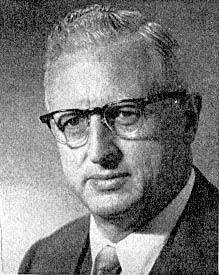 , former
director of Harvard Observatory, whose two books on the subject of UFO's lean primarily on meteorological
explanations. I have checked case after case of his, and his explanations are very, very far removed from what are
well-known principles and quantitative aspects of meteorological optic objects. He has made statements that simply do
not fit what is known about meteorological objects.
, former
director of Harvard Observatory, whose two books on the subject of UFO's lean primarily on meteorological
explanations. I have checked case after case of his, and his explanations are very, very far removed from what are
well-known principles and quantitative aspects of meteorological optic objects. He has made statements that simply do
not fit what is known about meteorological objects.
I would be prepared to talk all day on specific illustrations but time will not permit more.
Secondly, there has more recently been a suggestion made by "Aviation Week" Senior Editor Philip Julian Klass ,
that the really interesting UFO's are atmospheric-electrical plasmas of some type similar to ball lightning, but
perhaps something different, something we don't yet understand but are generated by atmospheric processes.
,
that the really interesting UFO's are atmospheric-electrical plasmas of some type similar to ball lightning, but
perhaps something different, something we don't yet understand but are generated by atmospheric processes.
The first time anyone tried the ball lightning hypothesis was in Air Force Project Grudge, back in 1949. The Weather Bureau was asked to do a special study of ball lightning. I recently got a declassified copy of that, and the Air Force position at that time, and since then was that ball lightning doesn't come near to explaining these sightings. I concur in that. When you deal with multiple-witness cases involving discs with metallic luster, definite outline, seen in the daytime, completely removed from a thunderstorm, perhaps seen over center Manhattan, or perhaps in Redlands, Calif., they are not ball lightning or plasmas.
In weather completely unrelated to anything that could provide a source of energy, the continuous power source required to maintain a plasma in the face of recombination and decay of a plasma, Klass' views just do not make good sense.
It is just not reasonable to suggest that, say the BOAC Stratocruiser that was followed by six UFO's for 90 miles up in the St. Lawrence Valley in 1954 was followed by a plasma, or that these people in Redlands were looking at a plasma, or that the 20 or so objects that went over Farmington were plasmas.
One of the most characteristic features of a plasma is its very short lifetime and exceedingly great instability, as some of your members will know from your contact with fusion research problems. The difficulty of sustaining a plasma for more than microseconds is a very great difficulty. To suggest that clear weather conditions can somehow create and maintain plasmas that persist for many minutes, and fool pilots with 18,000 flight hours into thinking that they are white- and red-domed discs, to take a very famous case over Philadelphia where the pilot thought he was about 100 yards from this dome-disc, is unreasonable. It is not a scientifically well-defended viewpoint.
To conclude, then, my position is that UFO's are entirely real and we do not know what they are, because we have laughed them out of court. The possibility that these are extraterrestrial devices, that we are dealing with surveillance from some advanced technology, is a possibility I take very seriously.
I reach that hypothesis, as my preferred hypothesis, not by hard fact, hardware, tailfins, or reading license plates, but by having examined hundreds of cases and rejected the alternative hypothesis as capable of accounting for them.
I am afraid that this possibility has sufficiently good backing for it, despite its low a priori ability, that we must examine it. I think your committee, with its many concerns for the entire aerospace program, as well as our whole national scientific program, has a very special reason for examining that possibility. Should that possibility be correct, if there is even a chance of its being correct, we ought to get our best people looking at it. Instead, we are collectively laughing at this possibility.
To meet Mr. Rumsfeld's request, let me remark on Dr. Hynek's two recommendations. I strongly concur in the need for some new approach. I am sure Dr. Hynek was not suggesting there be one single UFO committee. In fact, he said, "not a one-shot approach." A pluralistic approach to the problem is needed here.
The Defense Department is already supporting some work on it. NASA definitely has a need to look at this problem. We have to pay very serious attention to the problem and get a variety of new approaches.
The other point Dr. Hynek mentioned was that we try to look at this on a worldwide basis. This is crucially important. We are dealing with a real problem here, and I insist it is a global problem. We can study it in the United States, but if we ignore what is happening in France and England -- one of the greatest UFO waves that ever occurred was in France -- would be a serious mistake. I strongly urge that your committee consider holding rather more extensive Hearings in which a larger segment of the scientific community is given the opportunity to talk pro and con on the issue, hearings aimed at getting a new measure of scientific attention to this important problem.
Merci.
M. Roush. Merci, Dr. McDonald, pour votre présentation. Comme nous l'avons expliqué il y a un moment, nous sommes pressés par le temps. Nous are entertaining questions de membres du comité.
M. Bell. Dr. McDonald, je veux vous féliciter pour votre intéressante déclaration. Mais qu'est-ce qui vous amène à croire que, quoi que soient ces phénomènes, ils sont extraterrestres ?
Quels faits avez-vous ?
D. McDonald. Puis-je dire que je n'utiliserai pas le mot "croire." Je dirais l'"hypothèse" qu'ils sont une surveillance extraterrestre, est l'hypothèse que je considère actuellement comme la plus probable.
Comme je l'ai mentionné, il ne s'agit pas de faits au sens de preuves incontestables, mais traitant de cas après cas où les témoins ont montré une crédibilité que je ne peux contester. Ca m'impressionne. Cela n'a rien à voir avec des phénomènes géophysiques ou astronomiques ; ils semblent être des dispostifs semblables à des appareils et des machines. Je devrais vous répondre en termes des cas après cas sur lesquels moi et d'autres ont enquêté, pour rendre ça clair. C'est cette très grande masse de témoignages impressionnants de témoins, de données de détection radar sur des objets à ultra-haute-vitesse se déplaçant parfois à plus de 5000 miles/h, d'ovnis, d'observations radar et visuelles combinées, et tout simplement trop d'autres éléments cohérents suggérant que nous avons affaire à des appareils semblables à des machines venus d'ailleurs.
M. Bell. Des photos ont-elles été prises ?
Dr. McDonald. Oui ; il y a eut des photos de prises.
Par exemple, une photographie prise dans l'Ohio, par un avion de reconnaissance photo de l'Air Force le 24 mai 1954. I recently have looked a little more closely at the data. This was explained as an undersun, but that idea is subject to quantitative observation. The angles just do not fit. There is a very important case at Edwards Air Force base with two witnesses, where they got photographs of the object. Unfortunately, in this case I have not seen the photo, but I have talked with the persons who took it. There are photographs, but not nearly as many as we would like. We would like to have lots of them. In a case in Corning, Calif., a police officer, one of five witnesses, had a loaded camera in his patrol car, 20 paces from where he watched the object, didn't even think of getting his camera. He said he was too flabbergasted to think of it. That is a part of the problem.
M. Roush. M. Hechler.
M. Hechler. Avez-vous examiné de quelconques rapports de communication par ces objets ?
Dr. McDonald. Oui ; le problème du contact est très important. Il y a une catégorie de contact, pas au sens
d'un serrage de mains, mais plutôt light response. J'ai un fichier sur plusieurs d'entre eux, et j'en cherche
d'autres. Par exemple, à Shamokin (Pennsylvanie), Kerstetter est le nom du témoin, il travaille pour une
banque à Shamokin. J'ai parlé au président de la banque au sujet de sa fiabilité et eut de très bonnes
recommandations. L'année dernière, lui et sa femme et sa famille étaient en voiture près d'une arête
montagneuse à Shamokin, virent une chose stationnant au-dessus de la montagne, comme les lumières
clignotantes d'un theater marquee. Il avait une lampe-torche. Il ne connaissait pas le code Morse, mais cela n'était
vraiment pas grave. Il envoya des flashes lumineuses dans divers ordres et reçus les lumières en retour de la
chose. La même chose arriva à Newton (New Hampshire) en août de l'année dernière, où
plusieurs personnes virent un objet arrivant au-dessus d'eux. Ils eurent la même idée et se signalèrent avec
une lampe-torche. Ce n'était pas du Morse, ce n'était pas trait point, puis trait trait trait, et cela revint avec
des signaux lumineux répliqués, sans erreur. La même chose arriva en Virginie Occidentale, où un
pharmacien, nommé Sommers, fit cela avec ses phares. Alors que j'étais en Australie, je parlais de chasseurs sortis
chasser le kangourou. Un disque arriva au-dessus, un dit : donne-leur du Morse
; le flash revint
faithfully, et ils partirent en vitesse. Est-ce un contact ? Je ne sais pas. Personne got any intelligence out
of it either way, if you will pardon the whimsy. Il serait terrible qu'en fait cela soit de la surveillance et notre
technologie ait été représentée par la lampe-torche toujours prête [Rire].
We may be flunking our exam.
M. Roush. M. Downing.
M. Downing. Je suis intéressé par votre témoignage. A la page 10 de votre déclaration écrite, vous dites qu'il est malheureux qu'aucune version acceptable de la Référence 6 n'existe, bien qu'il ait été possible d'en obtenir une dans le statut d'une acceptabilité limitée.
Pourquoi n'est-il pas disponible ?
Dr. McDonald. Eh bien, c'était un document de l'Air Force. Cela fut achevé en 1949. Ils furent classés jusqu'à il y a quelques années en arrière. Personne ne pouvait y avoir accès, parce qu'ils étaient sous une classification du DoD. Mais la règle de 12 ans expira, et le Dr. Leon Davidson parvint à obtenir une copie.
Il est accessible au sens où si j'accepte de payer 90 $ pour des photocopies je peux aujourd'hui l'avoir. Il n'est pas publié au sens d'être accessible dans toute bibliothèque du pays. Ma Référence 7, que la NICAP vient juste de publier, est accessible aux scientifiques dans tout le pays. La question est celle de l'Air Force qui a pour politique de ne pas publier de tels élements, et qu'ils aient été classés. Je pense que le comité Moss et le NICAP are to be highly praised to get out in the open Reference 7.
M. Downing. Y'a-t-il une raison pour laquelle ceci est classé ?
Dr. McDonald. Il y a une raison compréhensible pour laquelle l'Air Force a eut à classer cela. Un objet aérien non identifié, par présomption, est hostile jusqu'à preuve du contraire. So there has been this unfortunate, but entirely understandable measuring of these two areas. The national defense mission of the Air Force has necessitated they have some part of the UFO problem inevitably, and they got it in the first instance. They have long since told us there is no hostility here, hence the scientific curiosities going unattended because it doesn't fall under the defense mission, in other words to be transferred into NASA, NSF, or something like that. That does not mean the Air Force won't continue to watch unidentified objects on the millisecond basis. But they not need worry about this other part of the problem. I think it is understandable, but needs changing.
Mr. Roush. Mr. Pettis.
Mr. Pettis. Mr. Chairman, Doctor.
I was a little bit interested in your observations about this UFO sighting in my hometown of Redlands.
I might observe that Redlands is a rather conservative community, when people in Redlands say they saw something, they saw something. I did not happen to be in Redlands that particular date, so I did not see this.
But I would like to observe this, that having spent a great deal of my life in the air, as a pilot, professional and private pilot, I know that many pilots and professional pilots have seen phenomena that they could not explain.
These men, most of whom have talked to me, have been very reticent to talk about this publicly, because of the ridicule that they were afraid would be heaped upon them, and I'm sure that if this committee were ever to investigate this, or bring them in here, there probably would have to be a closed hearing, Mr. Chairman.
However, there is a phenomena here that isn't explained.
I think probably we ought to do a little looking into this, is my personal opinion.
M. Roush. M. Ryan.
M. Ryan. Oui, merci M. le président.
D'abord je voudrais vous féliciter, M. Roush, pour votre intérêt pour les questions de ce sujet, et le président de l'ensemble du comité pour avoir arrangé des auditions sur ce problème.
Je pense qu'il est important que ce comité ne s'écarte pas de sa juridiction, mais qu'il explore avec grande attention les propositions qui ont été faites par les témoins ici, et qu'il ait un champ d'exploration continu sur l'ensemble de cette question. Je veux féliciter le Dr. McDonald pour having been persistent in presenting his views to the various members of the committee, helping to bring about these hearings.
Je me demandais, Dr. McDonald, si vous would care to evaluate le projet de recherche à l'Université du Colorado, et commenter là-dessus ?
M. Roush. M. Ryan, puis-je juste dire que nous sommes tous d'accord sur le fait que ce n'est pas le lieu pour discuter de ce projet particulier, et que le but du symposium n'était pas d'aller dans les activités d'une autre branche du gouvernement, mais plutôt d'explorer cela comme un phénomène scientifique.
Je suis sûr que le Dr. McDonald sera très heureux de conférer avec vous en privé là-dessus, mais si vous pouviez montrer une certaine restriction ici, la présidence vous en serait vraiment reconnaissante.
M. Ryan. Bien, laissez-moi reformuler ma question.
Au regard du fait qu'il y a une étude menée par un projet à l'Air Force, et l'Université du Colorado, pensez-vous que quoi que ce soit d'autre doive être fait par une branche quelconque du gouvernement ?
Dr. McDonald. Absolument, oui.
M. Ryan. Que recommandez-vous ?
Dr. McDonald. I think that we need to get a much broader basis of investigation of UFO's, as I did say, a few moments ago, it would be very salutary to have a group in NASA looking at this problem, and to have some NASA support of independent studies. It would be very good for the National Science Foundation to support, say, some university people interested in it. It would be good to have the Office of Naval Research et cetera involved.
We don't deal with many other important problems, space, or molecular biology or health without a pluralistic approach, a multiplicity of research programs. I don't want to touch a frayed nerve here. This problem of duplication is sometimes lamented. But by and large I think you will agree we would gain from having a lot of different people with slightly different points of view going at every problem. At the moment everything is focused through one agency, and everything now hinges on that one particular program you have asked me about, and my answer was, we very definitely need some independent programs.
I am on record elsewhere than here in my specific views on that project.
Mr. Ryan. En regardant en arrière à la page 14, vous avez écrit une lettre à l'Académie Nationale des Sciences, concernant ce projet. Avez-vous eu une quelconque réaction de la part de l'Académie Nationale des Sciences ?
Dr. McDonald. Oui, j'ai reçu une lettre du Dr. Frederick Seitz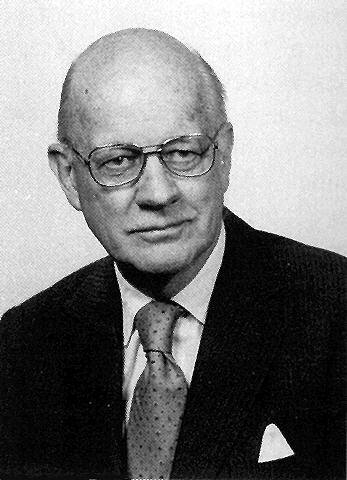 , disant que
pour le moment nous devions laisser le projet
Colorado poursuivre son cours. That was the gist of the answer.
, disant que
pour le moment nous devions laisser le projet
Colorado poursuivre son cours. That was the gist of the answer.
Mr. Roush. I would appreciate it, if we dispensed with that. Let me say that the National Academy is undertaking an evaluation of the University of Colorado project, and this will be published.
Mr. Ryan. I'm suggesting maybe this committee should make an investigation of the University of Colorado project.
Chairman Miller. That is something we don't have authority to do here.
Mr. Ryan. To what extent, Dr. McDonald, have sightings been picked up by radar, and to what extent have those that have been picked up been explored? n1[*NCAS Editor's Note: There was an apparent garble in the original; the second clause in the sentence read "and what extent of those that have been picked up been explored?" ]
Dr. McDonald. Well, there are many such sightings, I dare say there are thousands of military radar sightings that were for the short period unidentified. Then they identify them. But here is an impressive number of both military and civilian radar sightings that defy radar explanation in terms of unknown phenomena. Most of these deficiencies are well understood, so one can be fairly sure that many of these unidentified radar cases have no conventional explanation.
In a case where a P-61 flew over Japan, back some years ago, made six passes at an unidentified object it was getting radar returns on, and the pilot saw it visually. Here you are dealing with an unknown. Then there was a case in Michigan where a ground radar detected an object at 600 miles an hour coming in over Saginaw Bay. The pilot got a radar return, and also saw a vast luminous object; the object turned in a very sharp 180 degree turn and went back, and eluded the F-94. Here you are dealing with a case where radar propagation anomalies will not explain it. There was one radar in the airplane at 20,000 feet and one radar on the ground, both showing the object. There are many cases like that which I could enlarge on.
Mr. Ryan. Let me ask a further question: In the course of your investigation and your study of UFO sightings, have you found any cases where contemporaneously with the sighting of UFOs allegedly, there were any other events which took place, which might or might not be related to the UFO's ?
Dr. McDonald. Yes. Certainly there are many physical effects. For instance, in Mr. Pettis' district, several people found the fillings in their mouth hurting while this object was nearby, but there are many cases probably on record of car ignition failure. One famous case, was at Levelland, Tex., in 1967. Ten vehicles were stopped within a short area, all independently in a 2-hour period, near Levelland, Tex. There was no lightning or thunder storm, and only a trace of rain. There is another which I don't know whether to bring to the committee's attention or not. The evidence is not as conclusive as the car stopping phenomenon, but there are too many instances for me to ignore. UFO's have often been seen hovering near power facilities. There are a small number but still a little too many to seem pure fortuitous chance, of system outages, coincident with the UFO sighting. One of the cases was Tamaroa, Ill. Another was a case in Shelbyville, Ky., early last year. Even the famous one, the New York blackout, involved UFO sightings. Dr. Hynek probably would be the most appropriate man to describe the Manhattan sighting, since he interviewed several witnesses involved. I interviewed a woman in Seacliff, N.Y. She saw a disk hovering and going up and down. And then shooting away from New York just after the power failure. I went to the FPC for data, they didn't take them seriously although they had many dozens of sighting reports for that famous evening. There were reports all over new England in the midst of that blackout, and five witnesses near Syracuse, N.Y., saw a glowing object ascending within about a minute of the blackout. First they thought it was a dump burning right at the moment the lights went out. It is rather puzzling that the pulse of current that tripped the relay at the Ontario Hydro Commission plant has never been identified, but initially the tentative suspicion was centered on the Clay Substation of the Niagara Mohawk network right there in the Syracuse area, where unidentified aerial phenomenon has been seen by some of the witnesses.
This extends down to the limit of single houses losing their power when a UFO is near. The hypothesis in the case of car stopping is that there might be high magnetic fields, d.c. fields, which saturate the core and thus prevent the pulses going through the system to the other side. Just how a UFO could trigger an outage on a large power network is however not yet clear. But this is a disturbing series of coincidences that I think warrant much more attention than they have so far received.
M. Ryan. As far as you know, has any agency investigated the New York blackout in relation to UFO?
Dr. McDonald. None at all. When I spoke to the FPC people, I was dissatisfied with the amount of information I could gain. I am saying there is a puzzling and slightly disturbing coincidence here. I'm not going on record as saying, yes, these are clear-cut cause and effect relations. I'm saying it ought to be looked at. There is no one looking at this relation between UFO's and outages.
M. Roush. Our time is really running short, Mr. Ryan.
M. Ryan. One final question. Do you think it is imperative that the Federal Power Commission, or Federal Communications Commission, investigate the relation if any between the sightings and the blackout?
Dr. McDonald. My position would call for a somewhat weaker adjective. I'd say extremely desirable.
M. Roush. Merci.
Merci, Dr. McDonald.
Déclaration préparée sur les Objets Volants Non Identifiés
- Introduction
- Périmètre et contexte
- Nature du problème
- Hypothèses Alternatives
- Cas rencontrés
- Observations de pilotes
- Observations par témoins multiples
- Observations en zone urbaine
- Observations d'astronomes
- Observations de météorologues
- Explication par des ballons
- Cas radar
- Cas photographiques
- Effets physiques
- Hostilité possible
- Physique atmosphérique
- Synthèse & recommandations
Références
Table des matières alternative pour études de cas d'observations individuels.
James E. McDonald, Physicien Sénior, Institut de Physique Atmosphérique, et Professeur du Département de Météorologie de l'Université d'Arizona, Tucson (Arizona)
Introduction
I should like first to commend the House Committee on Science and Astronautics for recognizing the need for a closer look at scientific aspects of the long-standing puzzle of the Unidentified Flying Objects (UFOs). From time to time in the history of science, situations have arisen in which a problem of ultimately enormous importance went begging for adequate attention simply because that problem appeared to involve phenomena so far outside the current bounds of scientific knowledge that it was not even regarded as a legitimate subject of serious scientific concern. That is precisely the situation in which the UFO problem now lies. One of the principal results of my own recent intensive study of the UFO enigma is this: I have become convinced that the scientific community, not only in this country but throughout the world, has been casually ignoring as nonsense a matter of extraordinary scientific importance. The attention of your Committee can, and I hope will, aid greatly in correcting this situation. As you will note in the following, my own present opinion, based on two years of careful study, is that UFOs are probably extraterrestrial devices engaged in something that might very tentatively be termed "surveillance."
Si l'hypothèse extraterrestre se révèle
exacte (et je souligne que les éléments actuels ne pointent que dans cette direction mais ne peuvent être
décrits comme constituant une preuve irréfutable),
alors clairement les ovnis deviendront un problème scientifique de la plus haute priorité. Je pense que vous seriez
d'accord que, même s'il y avait une chance infime de l'exactitude de cette
hypothèse, les ovnis demanderaient la plus grande
des attentions. En fait, cette chance semble à certains de nous loin d'être triviale. Nous partageons
le point de vue du vice-amiral Roscoe Henry Hillenkoetter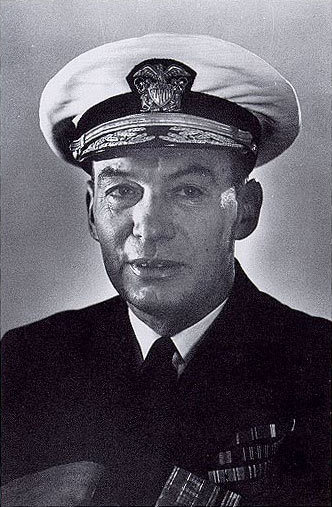 , ancien directeur de la
CIA, qui dit il y a 8 ans de cela,
, ancien directeur de la
CIA, qui dit il y a 8 ans de cela, Il est
impératif que nous apprenions d'où viennent les ovnis et quel est leur but
Votre comité étant concerné non seulement par les larges aspects de notre programme scientifique national mais aussi
par la poursuite de notre programme spatial entier, et puisque ce programme spatial a été attaché pendant des années
au but dramatique de la recherche de la vie dans l'univers, je soumets que le sujet du Symposium d'aujourd'hui
mérite éminemment votre attention. En fait, je dois dire, pour information, que je pense qu'aucun autre problème
dans votre juridiction n'est d'une importance scientifique et nationale comparable. Ce sont des mots forts, et je
les pèse.
In addition to your Committee responsibilities with respect to science and the aerospace programs, there is another still broader basis upon which it is highly appropriate that you now take up the UFO problem: Twenty years of public interest, public puzzlement, and even some public disquiet demand that we all push toward early clarification of this unparalleled scientific mystery. I hope that our session here today will prove a significant turning point, orienting new scientific efforts towards illumination of this scientific problem that has been with us for over 20 years.
Portée et contexte de ces commentaires
It has been suggested that I review for you my experiences in interviewing UFO witnesses here and abroad and that I discuss ways in which my professional experience in the field of atmospheric Physique and meteorology illuminates past and present attempts at accounting for UFO phenomena. To understand the basis of my comments, it may be helpful to note briefly the nature of my own studies on UFOs.
I have had a moderate interest in the UFO problem for twenty years, much as have a scattering of other scientists. In southern Arizona, during the period 1956-66, I interviewed, on a generally rather random basis, witness in such local sightings as happened to come to my attention via press or personal communications. This experience taught me much about lay misinterpretations of observations of aircraft, planets, meteors, balloons, flares, and the like. The frequency with which laymen misconstrue phenomena associated with fireballs (meteors brighter than magnitude 5), led me to devote special study to meteor Physique; other topics in my own field of atmospheric Physique also drew my closer attention as a result of their bearing on various categories of UFO reports. This period of rather casual UFO-witness interviewing on a local basis proved mainly educational; yet on a few occasions I encountered witnesses of seemingly high credibility whose reports lay well outside any evident meteorological, astronomical, or other conventional bounds. Because I was quite unaware, before 1966, that those cases were, in fact, paralleled by astonishing numbers of comparable cases elsewhere in the U.S. and the rest of the world, they left me only moderately puzzled and mildly bothered, since I came upon relatively few impressive cases within the environs of Tucson in those dozen years of discursive study. I was aware of the work of non-official national investigative groups like NICAP (National Investigations Committee on Aerial Phenomena) and APRO (Aerial Phenomena Research Organization) ; but lacking basis for detailed personal evaluation of their investigative methods, I simply did not take their publications very seriously. I was under other misimpressions, I found later, as to the nature of the official UFO program, but I shall not enlarge on this before this Committee. (I cite all of this here because I regard it relevant to an appreciation, by the Committee, of the way in which at least one scientist has developed his present strong concern for the UFO problem, after a prior period of some years of only mild interest.) Despite having interviewed a total of perhaps 150-200 Tucson-area witnesses prior to 1966 (75 of them in a single inconclusive case in 1958), I was far from overwhelmed with the importance of the UFO problem.
A particular sighting incident in Tucson in early 1966, followed by the widely-publicized March, 1966, Michigan sightings (I, too, felt that the "swamp gas" explanation was quite absurd once I checked a few relevant points), led me finally to take certain steps to devote the coming summer vacation months to a much closer look at the UFO problem. Within only a few weeks in May and June of 1966, after taking a close look at the files and modes of operation of both private and official (i.e., Project Bluebook) UFO investigative programs, after seeing for the first time press-clipping files of (to me) astonishing bulk, covering innumerable intriguing cases I had never before heard of, and (above all) after the beginning of what became a long period of personal interviewing of key witnesses in important UFO cases, I rapidly altered my conception of the scientific importance of the UFO question. By mid-1966, I had already begun what became months of effort to arouse new interest and to generate new UFO investigative programs in various science agencies of the Federal government and in various scientific organizations. Now, two years later, with very much more background upon which to base an opinion, I find myself increasingly more concerned with what has happened during the past twenty years' neglect, by almost the entire scientific community, of a problem that appears to be one of extremely high order of scientific importance.
La nature non conventionnelle de la problèmatique ovni
To both laymen and scientists, the impressive progress that science has made towards understanding our total environment prompts doubt that there could be machine-like objects of entirely unconventional nature moving through our atmosphere, hovering over automobiles, power installations, cities, and the like, yet all the while going unnoticed by our body scientific. Such suggestions are hard to take seriously, and I assure you that, until I had taken a close look at the evidence. I did not take them seriously. We have managed to so let our preconceptions block serious consideration of the possibility that some form of alien technology is operating within our midst that we have succeeded in simply ignoring the facts. And we scientists have ignored the pleas of groups like NICAP and APRO, who have for years been stressing the remarkable nature of the UFO evidence. Abroad, science has reacted in precisely this same manner, ignoring as nonsensical the report-material gathered by private groups operating outside the main channels of science. I understand this neglect all too well; I was just one more of those scientists who almost ignored those facts, just one more of those scientists who was rather sure that such a situation really could not exist, one more citizen rather sure that official statements must be basically meaningful on the non-existence of any substantial evidence for the reality of UFOs.
The UFO problem is so unconventional, involves such improbable events, such inexplicable phenomenology, so defies ready explanation in terms of present-day scientific knowledge, has such a curiously elusive quality in many respects, that it is not surprising (given certain features in the past twenty years' handling of the problem) that scientists have not taken it very seriously. We scientists are, as a group, not too well-oriented towards taking up problems that lie, not just on the frontiers of our scientific knowledge, but far across some gulf whose very breadth cannot be properly estimated. These parenthetical remarks are made here to convey, in introductory manner, viewpoints that will probably prove to be correct when many more scientists begin to scrutinize this unprecedented and neglected problem. The UFO problem is, if anything, a highly unconventional problem. Hence, before reviewing my own investigations in detail, and before examining various proposed explanations lying within atmospheric Physique, it may be well to take note of some of the principal hypotheses that have been proposed. at one time or another, to account for UFOs.
Des hypothèses alternatives
In seeking explanations for UFO reports, I like to weigh witness-accounts in terms of eight principal UFO hypotheses:
- Hoaxes, fabrications, and frauds.
- Hallucination, mass hysteria, rumor phenomena.
- Lay misinterpretations of well-know physical phenomena (meteorological, astronomical, optical, aeronautical, etc.).
- Semi-secret advanced technology (new test vehicles, satellites, novel weapons, flares, re-entry phenomena, etc.).
- Poorly understood physical phenomena (rare atmospheric-electrical or atmospheric-electrical effects, unusual meteoric phenomena, natural or artificial plasmoids, etc.).
- Poorly understood psychological phenomena.
- Extraterrestrial devices of some surveillance nature.
- Spaceships bringing messengers of terrestrial salvation and occult truth.
Because I have discussed elsewhere all of these hypotheses in some detail (Ref. 2), I shall here only very briefly comment on certain points. Hoaxes and fabrications do crop up, though in percentually [sic] far smaller numbers than many UFO scoffers seem to think. Some of the independent groups like APRO and NICAP have done good work in exposing certain of these. Although there has been a good deal of armchair-psychologizing about unstable UFO witnesses, with easy charges of hallucination and hysteria, such charges seem to have almost no bearing in the hundreds of cases I have now personally investigated. Misinterpreted natural phenomena (Hypothesis 3) do explain many sincerely-submitted UFO reports; but, as I shall elaborate below, efforts to explain away almost the entirety of all UFO incidents in such terms have been based on quite unacceptable reasoning. Almost no one any longer seriously proposes that the truly puzzling UFO reports of close-range sighting of what appear to be machines of some sort are chance sightings of secret test devices (ours or theirs) ; the reasons weighing against Hypothesis 4 are both obvious and numerous. That some still-not-understood physical phenomena of perhaps astronomical or meteorological nature can account for the UFO observations that have prompted some to speak in terms of extraterrestrial devices would hold some weight if it were true that we dealt therein only with reports of hazy, glowing masses comparable to, say, ball lightning or if we dealt only with fast-moving luminous bodies racing across the sky in meteoric fashion. Not so, as I shall enlarge upon below. Jumping to Hypothesis 6, it seems to receive little support from the many psychologists with whom I have managed to have discussions on this possibility; I do not omit it from consideration, but, as my own witness-interviewing has proceeded, I regard it with decreasing favor. As for Hypothesis 8, it can only be remarked that, in all of the extensive literature published in support thereof, practically none of it has enough ring of authenticity to warrant serious attention. A bizarre "literature" of pseudo-scientific discussion of communications between benign extraterrestrials bent on saving the better elements of humanity from some dire fate implicit in nuclear-weapons testing or other forms of environmental contamination is certainly obtrusive on any paperback stand. That "literature" has been one of the prime factors in discouraging serious scientists from looking into the UFO matter to the extent that might have led them to recognize quickly enough that cultism and wishful thinking have essentially nothing to do with the core of the UFO problem. Again, one must here criticize a good deal of armchair researching (done chiefly via the daily newspapers that enjoy feature-writing the antics of the more extreme of such groups). A disturbing number of prominent scientists have jumped all too easily, to the conclusion that only the nuts see UFOs.
The seventh hypothesis, that UFOs may be some form of extraterrestrial devices, origin and objective still unknown,
is a hypothesis that has been seriously proposed by many investigators of the UFO problem. Although there seems to
be some evidence that this hypothesis was first seriously considered within official investigative channels in 1948
(a year after the June 24,1947 sighting over Mt. Rainier that brought the UFO problem before the general public),
the first open defense of that Hypothesis 7 to be based on any substantial volume of evidence was made by
Donald E. Keyhoe (Ref. 3) in about 1950. His subsequent writings, based on far more
evidence than was available to him in 1950, have presented further arguments favoring an extraterrestrial origin of
UFOs. Before I began an intensive examination of the UFO problem in 1966, I was disposed to strong doubt that the
numerous cases discussed at length in Keyhoe's rather dramatically-written and dramatically-titled books (Ref. 4)
could be real cases from real witnesses of any appreciable credibility. I had the same reaction to a 1956 book (Ref.
5) written by Edward J. Ruppelt , an engineer in charge of the official investigations in
the important 1951-3 period. Ruppelt did not go as far as Keyhoe in suggesting the extraterrestrial UFO hypothesis,
but he left his readers little room for doubt that he leaned toward that hypothesis. I elaborate these two writers'
viewpoints because, within the past month, I have had an opportunity to examine in detail a large amount of formerly
classified official file material which substantiates to an almost alarming degree the authenticity and hence the
scientific import of the case-material upon which Keyhoe and Ruppelt drew for much of their discussions of UFO
history in the 1947-53 period (Refs. 6 and 7). One of these sources has just been published by NICAP (Ref. 7), and
constitutes, in my opinion, an exceedingly valuable addition to the growing UFO literature. The defense of the
extraterrestrial hypothesis by Keyhoe, and later many others (still not within what are conventionally regarded as
scientific circles), has had little impact on the scientific community, which based its write-off of the UFO problem
on press accounts and official assurances that careful investigations were turning up nothing that suggested
phenomena beyond present scientific explanation. Hypothesis No. 7 has thus received short shrift from science to
date. As one scientist who has gone to some effort to try to examine the facts, I say that this has been an
egregious, if basically unwitting, scientific error -- an error that must be rectified with minimum further delay.
On the basis of the evidence I have examined, and on the basis of my own weighing of alternative hypotheses
(including some not listed above), I now regard Hypothesis 7 as the one most likely to prove correct. My scientific
instincts lead me to hedge that prediction just to the extent of suggesting that if the UFOs are not of extramundane
origin, then I suspect that they will prove to be something very much more bizarre, something of perhaps even
greater scientific interest than extraterrestrial devices.
, an engineer in charge of the official investigations in
the important 1951-3 period. Ruppelt did not go as far as Keyhoe in suggesting the extraterrestrial UFO hypothesis,
but he left his readers little room for doubt that he leaned toward that hypothesis. I elaborate these two writers'
viewpoints because, within the past month, I have had an opportunity to examine in detail a large amount of formerly
classified official file material which substantiates to an almost alarming degree the authenticity and hence the
scientific import of the case-material upon which Keyhoe and Ruppelt drew for much of their discussions of UFO
history in the 1947-53 period (Refs. 6 and 7). One of these sources has just been published by NICAP (Ref. 7), and
constitutes, in my opinion, an exceedingly valuable addition to the growing UFO literature. The defense of the
extraterrestrial hypothesis by Keyhoe, and later many others (still not within what are conventionally regarded as
scientific circles), has had little impact on the scientific community, which based its write-off of the UFO problem
on press accounts and official assurances that careful investigations were turning up nothing that suggested
phenomena beyond present scientific explanation. Hypothesis No. 7 has thus received short shrift from science to
date. As one scientist who has gone to some effort to try to examine the facts, I say that this has been an
egregious, if basically unwitting, scientific error -- an error that must be rectified with minimum further delay.
On the basis of the evidence I have examined, and on the basis of my own weighing of alternative hypotheses
(including some not listed above), I now regard Hypothesis 7 as the one most likely to prove correct. My scientific
instincts lead me to hedge that prediction just to the extent of suggesting that if the UFOs are not of extramundane
origin, then I suspect that they will prove to be something very much more bizarre, something of perhaps even
greater scientific interest than extraterrestrial devices.
Des remarques sur INTERVIEWING EXPERIENCE AND TYPES OF UFO CASES ENCOUNTERED
Sources des cas traités
Prior to 1966, I had interviewed about 150-200 persons reporting UFOs; since 1966, I have interviewed about 200-250 more. The basis of my post-1966 interviewing has been quite different from the earlier period of interviewing of local witnesses, whose sightings I heard about essentially by chance. Almost all of my post-1966 interviews have been with witnesses in cases already investigated by one or more of the private UFO investigatory groups such as NICAP or APRO, or by the official investigative agency (Project Bluebook). Thus, after 1966, I was not dealing with a body of witnesses reporting Venus, fireballs, and aircraft strobe lights, because such cases are so easily recognizable that the groups whose prior checks I was taking advantage of had already culled out and rejected most of such irrelevant material. Many of the cases I checked were older cases, some over 20 years old. It was primarily the background work of the many independent investigatory groups here and in other parts of the world (especially the Australian area where I had an opportunity to interview about 80 witnesses) that made possible my dealing with that type of once-sifted data that yields up scientifically interesting information so quickly. I wish to put on record my indebtedness to these "dedicated amateurs", to use the astronomer's genial term; their contribution to the ultimate clarification of the UFO problem will become recognized as having been of basic importance, notwithstanding the scorn with which scientists have, on more than one occasion, dismissed their efforts. Although I cite only the larger of these groups (NICAP about 12,000 members, APRO about 8,000), there are many smaller groups here and abroad that have done a most commendable job on almost no resources. (Needless to add, there are other small groups whose concern is only with sensational and speculative aspects.)
Some relevant witness-characteristics
By frequently discussing my own interviewing experience with members of those non-official UFO groups whose past
work has been so indispensable to my own studies, I have learned that most of my own reactions to the UFO
witness-interview problem are shared by those investigators. The recurrent problem of securing unequivocal
descriptions, the almost excruciating difficulty in securing meaningful estimates of angular size, angular
elevation, and angular displacements from laymen, the inevitable variance of witness-descriptions of a shared
observation, and other difficulties of non-instrumental observing are familiar to all who have investigated UFO
reports. But so also are the impressions of widespread concern among UFO witnesses to avoid (rather than to seek)
publicity over their sightings. The strong disinclination to make an open report of an observation of something the
witness realizes is far outside the bounds of accepted experience crops up again and again. In my interviewing in
1947 sightings, done as a crosscheck on case material used in a very valuable recent publication by
Ted Bloecher (Ref. 8), I came to realize clearly for the first time that this reluctance
was not something instilled by post-1947 scoffing at UFOs, but is part of a broadly disseminated attitude to
discount the anomalous and the inexplicable, to be unwilling even to report what one has seen with his own eyes if
it is well outside normal experience as currently accepted. I have heard fellow-scientists express dismay at the
unscientific credulity with which the general public jumps to the conclusion that UFOs are spaceships. Those
scientists have certainly not interviewed many UFO witnesses; for almost precisely the opposite attitude is
overwhelmingly the characteristic response. In my Australian interviewing, I found the same uneasy feeling about
openly reporting an observation of a well-defined UFO sighting, lest acquaintances think one "has gone round the
bend." Investigators in still other parts of the world where modern scientific values dominate world-views have told
me of encountering just this same witness-reluctance. The charge that UFO witnesses, as a group, are hyperexcitable
types is entirely incorrect I would agree with the way Maj. Gen. John A. Samford, then Director of Air Force
Intelligence, put it in a 1952 Pentagon press conference: "Credible observers have sighted relatively incredible
objects."
(Ref. 8), I came to realize clearly for the first time that this reluctance
was not something instilled by post-1947 scoffing at UFOs, but is part of a broadly disseminated attitude to
discount the anomalous and the inexplicable, to be unwilling even to report what one has seen with his own eyes if
it is well outside normal experience as currently accepted. I have heard fellow-scientists express dismay at the
unscientific credulity with which the general public jumps to the conclusion that UFOs are spaceships. Those
scientists have certainly not interviewed many UFO witnesses; for almost precisely the opposite attitude is
overwhelmingly the characteristic response. In my Australian interviewing, I found the same uneasy feeling about
openly reporting an observation of a well-defined UFO sighting, lest acquaintances think one "has gone round the
bend." Investigators in still other parts of the world where modern scientific values dominate world-views have told
me of encountering just this same witness-reluctance. The charge that UFO witnesses, as a group, are hyperexcitable
types is entirely incorrect I would agree with the way Maj. Gen. John A. Samford, then Director of Air Force
Intelligence, put it in a 1952 Pentagon press conference: "Credible observers have sighted relatively incredible
objects."
Not only is the charge of notoriety-seeking wrong, not only is the charge of hyperexcitability quite inappropriate to the witnesses I have interviewed, but so also is the easy charge that they see an unusual aerial phenomenon and directly leap to some kind of "spaceship hypothesis." My experience in interviewing witnesses in the selected sample I have examined since 1966 is that the witness first attempts to fit the anomalous observation into some entirely conventional category. "I thought it must be an airplane." Or, "At first, I thought it was an auto-wrecker with its red light blinking." Or, "I thought it was a meteor -- until it stopped dead in midair," etc. Hynek has a very happy phrase for this very typical pattern of witness-response: he terms it "escalation of explanation", to denote the often rapid succession of increasingly more involved attempts to account for and to assimilate what is passing before the witness' eyes, almost invariably starting with an everyday interpretation, not with a spaceship hypothesis. Indeed, I probably react in a way characteristic of all UFO investigators; in those comparatively rare cases where the witness discloses that he immediately interpreted what he sighted as an extraterrestrial device, I back away from what is likely to be a most unprofitable interview. I repeat: such instances are really quite rare; most of the general population has soaked up a degree of scientific conventionalism that reflects the net result of decades, if not centuries of scientific shaping of our views. I might interject that the segment of the population drawn to Hypothesis 8 above might be quick to jump to a spaceship interpretation on seeing something unusual in the sky, but, on the whole, those persons convinced of Hypothesis 8 are quite uninterested in observations, per se. Their conviction is firm without bothering about such things as observational matters. At least that is what I have sensed from such exposure as I have had to those who support Hypothesis 8 fervently.
Crédibilité des témoins
Evaluating credibility of witnesses is, of course, an ever-present problem at the present stage of UFO studies. Again, from discussions with other investigators, I have concluded that common sense and previous everyday experience with prevaricators and unreliable persons lead. each serious UFO investigator to evolve a set of criteria that do not differ much from those used in jury instructions in our courts (e.g. Federal Jury Instructions). It seems tedious to enlarge here on those obvious matters. One can be fooled, of course; but it would be rash indeed to suggest that the thousands of UFO reports now on record are simply a testimony to confabulation, as will be better argued by some of the cases to be recounted below.
Fiabilité observationnelle des témoins
Separate from credibility in the sense of trustworthiness and honesty is the question of the human being as a sensing system. Clearly, it is indispensable to be aware of psychophysical factors limiting visual discrimination, time estimation, distance estimation, angular estimation, etc. In dealing with the total sample of all observations which laymen initially label as UFOs, such factors play a large role in sorting out dubious cases. In the type of UFO reports that are of primary significance at present, close-range sightings of objects of large size moving at low velocities, or at rest, and in sight for many seconds rather than fractions of a second, all of these perceptual problems diminish in significance, though they can never be overlooked.
A frequent objection to serious consideration of UFO reports, made by skeptics who have done no first-hand case investigations, is based on the widely discrepant accounts known to be presented by trial-witnesses who have all been present at some incident. To be sure, the same kind of discrepancies emerge in multiple-witness UFO incidents. People differ as to directions, relative times, sizes, etc. But I believe it is not unfair to remark, as the basic rebuttal to this attack on UFO accounts, that a group of witnesses who see a street-corner automobile collision do not come to court and proceed, in turn, to describe the event as a rhinoceros ramming a baby carriage, or as an airplane exploding on impact with a nearby building. There are, it needs to be soberly remembered, quite reasonable bounds upon the variance of witness testimonies in such cases. Thus, when one finds a half-dozen persons all saying that they were a few hundred feet from a domed disk with no resemblance to any known aircraft, that it took off without a sound, and was gone from sight in five seconds, the almost inevitable variations in descriptions of distances, shape, secondary features, noises, and times cannot be allowed to discount, per se, the basically significant nature of their collective account. I have talked with a few scientists, especially some psychologists, whose puristic insistence on the miserable observing equipment with which the human species is cursed almost makes me wonder how they dare cross a busy traffic intersection. Some balance in evaluating witness perceptual limitations is surely called for in all of these situations. With that balance must go a healthy skepticism as to most of the finer details, unless agreed upon by several independent witnesses. There is no blinking that anecdotal data are less than ideal; but sometimes you have to go with what you've got. To make a beginning at UFO study has required scrutiny of such anecdotal data; the urgent need is to get on to something much better.
Problème de la connaissance antérieure du phénomène ovni par les témoins
In interviewing UFO witnesses, it is important to try to ascertain whether the witness was, prior to his reported sighting, familiar or unfamiliar with books and writings on UFOs. Although a strong degree of familiarity with the literature of UFOs does not negate witness testimony, it dictates caution. Anyone who has done a lot of interviewing at the local level, involving previously unsifted cases, will be familiar with occasional instances where the witness exhibited such an obvious enthusiasm for the UFO problem that prudence demanded rejection of his account.
However, in my own experience, a much more common reaction to questions concerning pre-sighting interest in UFO matters is some comment to the effect that the witness not only knew little about UFOs beyond what he'd happened to read in newspapers, but he was strongly disinclined to take the whole business seriously. The repetitiveness and yet the spontaneity with which witnesses of seeming high credibility make statements similar to, "I didn't believe there was anything to all the talk about UFOs until I actually saw this thing," is a notable feature of the interview-experience of all of the investigators with whom I have talked. Obviously, an intending prevaricator might seek to deceive his interrogator by inventing such an assertion ; but I can only say that suspicion of being so duped has not been aroused more than once or twice in all of the hundreds of witnesses I have interviewed. On the other hand, I suppose that. In several dozen instances, I have lost interest in a case because of a witness openly stressing his own prior and subsequent interest in the extraterrestrial hypothesis.
Occasionally one encounters witnesses for whom the chance of prior knowledge is so low as to be almost amusing. An Anglican missionary in New Guinea, Rev. N. E. G. Cruttwell (Ref. 9), who has done much interviewing of UFO witnesses in his area, has described testimony of natives who come down into the mission area from their highland home territory only when they are wallaby-hunting, natives who could not read UFO reports in any language of the world, yet who come around, in their descriptions of what they have seen, to the communications-shortcut of picking up a bowl or dish from a nearby table to suggest the shape they are seeking to describe in native tongue. Little chance of bias gained from reading magazines in a barber-chair in such instances.
Types de récits d'ovnis of present interest
The scope of the present statement precludes anything approaching an exhaustive listing of categories of UFO phenomena: much of what might be made clear at great length will have to be compressed into my remark that the scientific world at large is in for a shock when it becomes aware of the astonishing nature of the UFO phenomenon and its bewildering complexity. I make that terse comment well aware that it invites easy ridicule; but intellectual honesty demands that I make clear that my two years' study convinces me that in the UFO problem lie scientific and technological questions that will challenge the ability of the world's outstanding scientists to explain as soon as they start examining the facts.
- Lumières dans le ciel nocturne -- ("DLs" comme les appele l'équipe du NICAP, sur la base de la profusion des signalements de "lumières damnables" meandering or hovering or racing across the night sky in unexplainable manner are one of the most common, yet one of the least useful and significant categories of UFO reports.) Ultimately, I think their significance could become scientifically very substantial when instrumental observing techniques are in wide use to monitor UFO movements. But there are many ways that observers can be misled by lights in the night sky, so I shall discuss below only such few cases as are of extremely unconventional nature and where the protocols of the observations are unusually strong.
- Close-range sighting's of wingless discs and cigar-shaped objects. -- This category is far more interesting. Many are daytime sightings, many have been made by witnesses of quite high credibility. Structural details such as "ports" and "legs" (to use the terms the witnesses have adopted to suggest most closely what they think they have seen) are described in many instances. Lack of wings and lack of evident means of propulsion clearly rule out conventional aircraft and helicopters. Many are soundless, many move at such speeds and with such accelerations that they defy understanding in terms of present technology. It is to be understood that I speak here only of reports from what I regard as credible observers.
- Close-range nighttime sightings of glowing, hovering objects, often with blinking or pulsating discrete lights. -- In these instances, distinct shape is not seen, evidently in many cases because of the brilliance of the lights. Less significant than those of the preceding category, these nonetheless cannot be accounted for in terms of any known vehicles. Frequently they are reported hovering over vehicles on the ground or following them. Sometimes they are reported hovering over structures, factories, power installations, and the like. Soundlessness is typical. Estimated sizes vary widely, over a range that I do not believe can be accounted for simply in terms of the known unreliability of distance and size estimates when one views an unknown object.
- Radar-tracked objects, sometimes seen visually simultaneously by observers on the ground or in the air. -- In many of these cases, the clues to the non-conventional nature of the radar target is high speed (estimated at thousands of miles per hour in certain instances); in others, it is alternate motion and hovering; in still others, it has been the unconventional vertical motions that make the radar observations significant. Clearly, most important are those instances in which there was close agreement between the visual and the radar unknown. There are far more such cases than either scientists or public would guess.
Those four categories do not exhaust the list by any means. But they constitute four commonly encountered categories that are of interest here. Examples will be found below.
Question fréquemment rencontrées
Comme l'a dit Mark Twain, La foi est une grande chose, mais on peut douter qu'elle vous donne une
éducation.
There are many questions that one encounters again and again from persons who have done no personal case-checking and who maintain a healthy skepticism about UFOs. Why don't pilots report these things if they are buzzing around in our skies? Why aren't they tracked on radar? Why don't our satellite and astronomical tracking systems get photos of UFOs? Why are they always seen in out-of-the way rural areas but never over large cities? Why don't large groups of people ever simultaneously see UFOs, instead of lone individuals? Why don't astronomers see them? Shouldn't UFOs occasionally crash and leave clear-cut physical evidence of their reality? Or shouldn't they at least leave some residual physical evidence in those alleged instances where the objects have landed? Shouldn't they affect radios and produce other electromagnetic effects at times? If UFOs are a product of some high civilization, wouldn't one expect something of the nature of inquisitive behavior, since innate curiosity must be a common denominator of anything we would call "Intelligence"? Why haven't they contacted us if they're from somewhere else in the universe and have been here for at least two decades? Is there any evidence of hostility or hazard? Are UFOs seen only in this country? Why didn't we see them before 1947, if they come from remote sources? And so on.
In the following sections, I shall show how some of these questions do have quite satisfactory answers, and how some of them still defy adequate rebuttal. I shall use mostly cases that I have personally investigated, but, in a few instances (clearly indicated), I shall draw upon cases which I have not directly checked but for which I regard the case-credentials as very strong.
Useful source materials on UFO's
Hoping that Committee staff personnel will be pursuing these matters further, I remark next on some of the more significant items in the UFO literature. All of these have been helpful in my own studies.
One of the outstanding UFO references (though little-known in scientific circles) is The UFO Evidence, edited
by Richard H. Hall and published by NICAP (Ref. 10). It summarizes about 750 UFO cases
in the NICAP flies up to about 1964. I have cross-checked a sufficiently large sample of cases from this reference
to have confidence in its generally very high reliability. A sequel volume, now in editorial preparation at NICAP,
will cover the 1964-68 period. Reference 8, by Bloecher, is one of the few sources of extensive documentation (here
primarily from national newspaper sources) of the large cluster of sightings in a period of just a few weeks in the
summer of 1947; its study is essential to appreciation of the opening phases of the publicly recognized UFO problem.
Reference 7 is another now-accessible source of extremely significant UFO documentation; it is unfortunate that no
generally accessible version of Reference 6 exists, though the Moss Subcommittee, through pleas of Dr. Leon
Davidson, has managed to get it into a status of at least limited accessibility. I am indebted to Davidson for a
recent opportunity to study it for details I missed when I saw it two years ago at Bluebook headquarters.
and published by NICAP (Ref. 10). It summarizes about 750 UFO cases
in the NICAP flies up to about 1964. I have cross-checked a sufficiently large sample of cases from this reference
to have confidence in its generally very high reliability. A sequel volume, now in editorial preparation at NICAP,
will cover the 1964-68 period. Reference 8, by Bloecher, is one of the few sources of extensive documentation (here
primarily from national newspaper sources) of the large cluster of sightings in a period of just a few weeks in the
summer of 1947; its study is essential to appreciation of the opening phases of the publicly recognized UFO problem.
Reference 7 is another now-accessible source of extremely significant UFO documentation; it is unfortunate that no
generally accessible version of Reference 6 exists, though the Moss Subcommittee, through pleas of Dr. Leon
Davidson, has managed to get it into a status of at least limited accessibility. I am indebted to Davidson for a
recent opportunity to study it for details I missed when I saw it two years ago at Bluebook headquarters.
The 1956 book by Ruppelt (Ref. 8) is a source whose authenticity I have learned, through much personal cross-checking, is far higher than I surmised when I first read it a dozen years ago. It was for years difficult for me to believe that the case-material which he summarized could come from real cases. References 5 and 6, plus other sources, do, however, now attest to Ruppelt's generally high reliability. Similarly Keyhoe's books (Refs. 3 and 4) emerge as sources of UFO case material whose reliability far exceeds my own first estimates thereof. As a scientist, I would have been much more comfortable about Keyhoe's books had they been shorn of extensive direct quotes and suspenseful dramatizations; but I must stress that much checking on my part has convinced me that Keyhoe's reportorial accuracy was almost uniformly high. Scientists will tend to be put off by some of his scientific commentary, as well as by his style; but on UFO case material, his reliability must be recognized as impressive. (Perhaps it is well to insert here the general proviso that none of these sources, including myself, can be expected to be characterized by 100 per cent accuracy in a problem as intrinsically messy as the UFO problem; here I am trying to draw attention to sources whose reliability appears to be in the 90+% range.)
A useful collection of 160 UFO cases drawn from a wide variety of sources has been published by Olsen (Ref. 11), 32 of which he obtained directly from the official files of Project Bluebook, a feature of particular interest. A book devoted to a single short period of numerous UFO observations within a small geographic area, centering around an important sighting near Exeter, N.H., is Fuller's Incident at Exeter (Ref. 12). Having checked personally on a number of features of the main Sept. 3, 1965, sighting, and having checked indirectly on other aspects, I would describe Reference 12 as one of the significant source-items on UFOs.
Several books by the Lorenzens, organizers of APRO, the oldest continuing UFO investigating group in this country, contain valuable UFO reference material (Ref. 13). Through their writing, and especially through the APRO Bulletin, they have transmitted from South American sources numerous unusual sightings from that country. I have had almost no opportunity to cross-check those sightings, but am satisfied that some quite reliable sources are being drawn upon. An extremely unusual category of cases, those involving reports of humanoid occupants of landed UFOs, has been explored to a greater extent by APRO than by NICAP. Like NICAP, I have tended to skirt such cases on tactical grounds; the reports are bizarre, and the circumstances of all such sightings are automatically charged in a psychological sense not found in other types of close-range sightings of mere machine-like devices. Since I shall not take up below this occupant problem, let me add the comment that I do regard the total number of such seemingly reliable reports (well over a hundred came just from central France in the outstanding 1954 sighting wave in that country), far too great to brush aside. Expert psychological opinion is badly needed in assessing such reports (expert but not close-minded opinion). For the record, I should have to state that my interviewing results dispose me toward acceptance of the existence of humanoid occupants in some UFOs. I would not argue with those who say that this might be the single most important element of the entire UFO puzzle; I would only say that most of my efforts over the past two years, being aimed at arousing a new degree of scientific interest among my colleagues in the physical sciences, have led me to play down even the little that I do know about occupant sightings. One or two early attempts to touch upon that point within the time-limits of a one-hour colloquium taught me that one loses more than he gains in speaking briefly about UFO occupants. (Occupant sightings must be carefully distinguished from elaborate "contact-claims" with the Space Brothers;
I hold no brief at all for the latter in terms of my present knowledge and interviewing experience. But occupants there seem to be, and contact of a limited sort may well have occurred, according to certain of the reports. I do not regard myself as very well-informed on this point, and will say little more on this below.)
It is, of course, somewhat more difficult to assess the reliability of foreign UFO references. Aimé Michel (Ref. 13) has assembled a day-by-day account of the remarkable French UFO wave of the fall of 1954, translated into
English by the staff of CSI (Civilian Saucer Intelligence) of New York City, a now-inactive but once very productive
independent group. I have spoken with persons having first-hand knowledge of the French 1954 episode, and they
attest to its astonishing nature. Life and The New Yorker published full contemporary accounts at the
time of the 1954 European wave. An earlier book by Michel (Ref. 14), also available in English, deals with a broader
temporal and geographic range of European UFO sightings. A just-published account of about 70 UFO sightings that
occurred within a relatively small area around Stoke-on-Trent, England, in the summer and fall of 1967 (Ref. 15)
presents an unusual cross-section of sightings that appear to be well-documented. A number of foreign UFO journals
are helpful sources of the steady flow of UFO reports from other parts of the world, but a cataloging will not be
attempted here. Information on some of these, as well as on smaller American groups, can be found in the two
important books by Jacques Vallée
(Ref. 13) has assembled a day-by-day account of the remarkable French UFO wave of the fall of 1954, translated into
English by the staff of CSI (Civilian Saucer Intelligence) of New York City, a now-inactive but once very productive
independent group. I have spoken with persons having first-hand knowledge of the French 1954 episode, and they
attest to its astonishing nature. Life and The New Yorker published full contemporary accounts at the
time of the 1954 European wave. An earlier book by Michel (Ref. 14), also available in English, deals with a broader
temporal and geographic range of European UFO sightings. A just-published account of about 70 UFO sightings that
occurred within a relatively small area around Stoke-on-Trent, England, in the summer and fall of 1967 (Ref. 15)
presents an unusual cross-section of sightings that appear to be well-documented. A number of foreign UFO journals
are helpful sources of the steady flow of UFO reports from other parts of the world, but a cataloging will not be
attempted here. Information on some of these, as well as on smaller American groups, can be found in the two
important books by Jacques Vallée (Refs. 16 and 17).
Information on pre-1947 UFO-type sightings form the subject of a recent study by Lore and Denault (Ref. 18). I shall
return to this phase of the UFO problem below; I regard it as being of potentially very great significance, though
there is need for far more scholarly and scientific research before much of it can be safely interpreted. Another
source of sightings of which many may ultimately be found to fall within the presently understood category of UFO
sightings is the writings of Charles Fort (Ref. 19). His curious books are often
drawn upon for material on old sightings, but not often duly acknowledged for the mine of information they comprise.
I am afraid that it has not been fashionable to take Fort seriously; it certainly took me some time to recognize
that, mixed into his voluminous writings, is much that remains untapped for its scientific import. I cannot imagine
any escalated program of research on the UFO program that would not have a subgroup studying Fortean reports
documented from 19th century sources.
(Ref. 19). His curious books are often
drawn upon for material on old sightings, but not often duly acknowledged for the mine of information they comprise.
I am afraid that it has not been fashionable to take Fort seriously; it certainly took me some time to recognize
that, mixed into his voluminous writings, is much that remains untapped for its scientific import. I cannot imagine
any escalated program of research on the UFO program that would not have a subgroup studying Fortean reports
documented from 19th century sources.
To close this brief compilation of useful UFO references, two recent commentaries (not primarily source-references) of merit may be cited, books by Stanton (Ref. 20) and by Young (Ref. 21).
Next, I examine a number of specific UFO cases that shed light on many of the recurrent questions of skeptical slant often raised against serious consideration of the UFO problem.
Pourquoi les pilotes ne voient-ils pas d'ovnis ?
Cette question may come in just that form from personnes n'ayant essentiellement pas de connaissance de l'histoire
des ovnis. Pour les autres qui savent bien qu'il y a eut "quelques" observations de pilotes, cela vient
dans une forme modifiée , telle que, Pourquoi est-ce que les pilotes de ligne et militaires ne voient-ils pas
tout le temps des ovnis s'ils sont dans notre atmosphère ?
Comme réponse partielle, considérez les cas
suivants (pour faciliter les références internes, je numéroterai l'ensemble des cas séquentiellement traités ici par
la suite en détails).
1. Cas 1. Boise (Idaho), 4 juillet 1947
Environ 1 semaine après l'observation maintenant fameuse du Mont Rainier par le pilote privé Kenneth E. Arnold ,
un équipage de DC-3 de United Air Lines observa 2 formations séparées de disques sans ailes, peu après
avoir décolé de Boise (Réfs. 8, 10, 22, 28). J'ai localisé et interrogé le pilote, le capitaine
Emil J. Smith, aujourd'hui avec le bureau de New York de United. Il confirma la
fiabilité des récits précédemment publiés. Le vol 105 de United avait quitté Boise à 21:04. A
environ 8 mn dehors, en route pour Seattle, grossièrement au-desuss de Emmet (Idaho), le co-pilote Stevens, qui
repéré le 1er des 2 groupes d'objets, alluma ses phares d'atterrissage avec l'impression initiale que les objets
étaient d'autres appareils. Mais, en les étudiant à nouveau devant le ciel du crépuscule, Smith et Stevens
réalisèrent bientôt que ni des ailes ni des dérives n'étaient visibles sur les 5 objets devant. Après avoir appelé
une hotesse, afin d'avoir la confirmation d'un 3ᵉ témoin, ils regardèrent la formation un peu plus
longtemps, appelèrent la CAA de Ontario (Oregon) pour
tenter d'avoir une confirmation du sol, et virent alors la formation foncer en avant et dispparaître à
grande vitesse au large à l'Ouest.
,
un équipage de DC-3 de United Air Lines observa 2 formations séparées de disques sans ailes, peu après
avoir décolé de Boise (Réfs. 8, 10, 22, 28). J'ai localisé et interrogé le pilote, le capitaine
Emil J. Smith, aujourd'hui avec le bureau de New York de United. Il confirma la
fiabilité des récits précédemment publiés. Le vol 105 de United avait quitté Boise à 21:04. A
environ 8 mn dehors, en route pour Seattle, grossièrement au-desuss de Emmet (Idaho), le co-pilote Stevens, qui
repéré le 1er des 2 groupes d'objets, alluma ses phares d'atterrissage avec l'impression initiale que les objets
étaient d'autres appareils. Mais, en les étudiant à nouveau devant le ciel du crépuscule, Smith et Stevens
réalisèrent bientôt que ni des ailes ni des dérives n'étaient visibles sur les 5 objets devant. Après avoir appelé
une hotesse, afin d'avoir la confirmation d'un 3ᵉ témoin, ils regardèrent la formation un peu plus
longtemps, appelèrent la CAA de Ontario (Oregon) pour
tenter d'avoir une confirmation du sol, et virent alors la formation foncer en avant et dispparaître à
grande vitesse au large à l'Ouest.
Smith insista en me disant qu'il n'y avait là aucun phénomène nuageux pouvant les amener à faire une
confusion et qu'ils observèrent ces objets suffisamment longtemps pour être assez certain qu'il n'étaient pas
des appareils conventionnels. Ils semblaient plats à la base, arrondis au sommet
, me dit-il, et
il ajouta qu'il semblait y avoir une sorte de rugosité
perceptible sur le sommet, bien qu'il ne put
affiner cette description. Presque immédiatement aprèq qu'ils aient perdu de vue les 5 premiers, une 2nde formation
de 4 (3 en ligne et un 4ème au large sur le côté) arrivèrent devant leur position, voyageant à nouveau
vers l'Ouest mais à une altitude légèrement plus élevée que les 8000 pieds du DC-3. Ils passèrent rapidement
hors de vue à l'Ouest à des vitesses qu'ils considérèrent bien au-delà des vitesses alors
connues. Smith insista sur le fait qu'ils ne furent jamais certains des tailles et des distances, mais qu'ils
avaient eut l'impression générale que ces appareils à l'apparence de disques étaient sensiblement plus grands
que les appareils ordinaires. Smith insista sur le fait qu'il n'avait pas pris au sérieux les histoires des
actualités de la semaine précédente qui inventèrent le terme depuis persistant de "soucoupe volante". Mais,
après avoir vu ce total de 9 appareils non conventionnels, sans ailes et à haute vitesse le soir du 4/7/47,
il devint bien plus intéressé par le sujet. Néanmoins, en parlant avec moi, il souligna qu'il ne spéculerait pas sur
leur véritable nature ou origine. J'ai parlé avec le personnel de United Air Lines qui a connu Smith
pendant des années et se porte garant de sa fiabilité complète.
Discussion. -- L'observation United Air Lines du 4/7/47 est d'un intérêt historique parce qu'elle a à l'évidence reçu bien plus de crédit que tout autre des 85 signalements d'ovnis publiés dans les récits de presse le 4 juillet 1947 (voir Réf. 8). Même s'il ne s'agit pas de la plus impressionnate observation d'ovni par l'équipage d'un avion de ligne, elle est néanmoins significative. Elle a eut lieu par temps clair, s'est étalée sur un temps total estimé entre 10 et 12 mn, a été un cas avec des témoins multiples dont 2 observateurs expérimentés familiers des appareillages aériens, et a été faite au-dessus de l'échelle d'altitude de 1000 pieds (climb-out) ce qui, combiné au fait que les 9 objets ont été vus au-dessus de l'horizon, exclut complètement les phénomènes optiques comme une explication prête. Il est officiellement listé comme Non Identifié.
2. Cas 2. Montgomery (Alabama), 24 juillet 1948
Une autre observation fameuse d'avion de ligne des premières années est le cas de Chiles-Whitted des Eastern Airlines (Refs. 3, 5, 6 , 10, 23, 24, 25, 26). An Eastern DC-3, en route from Houston to Atlanta, was flying at an altitude of about 5000 ft., near Montgomery at 2:45 a.m. The pilot, Capt. Clarence S. Chiles, and the co-pilot, John B. Whitted, both of whom now fly jets for Eastern, were experienced fliers (for example, Chiles then had 8500 hours in the air, and both had wartime military flying duty behind them). I interviewed both Chiles and Whitted earlier this year to cross-check the many points of interests in this case. Space precludes a full account of all relevant details.
Chiles pointed out to me that they first saw the object coming out of a distant squall-line area which they were just
reconnoitering. At first, they thought it was a jet, whose exhaust was somehow accounting for the advancing glow that
had first caught their eyes. Coming almost directly at them at nearly their flight altitude, it passed off their
starboard wing at a distance on which the two men could not closely agree: one felt it was under 1000 ft, the other
put it at several times that. But both agreed, then and in my 1968 interview, that the object was some kind of
vehicle. They saw no wings or empennage, but both were struck by a pair of rows of windows or some apparent openings
from which there came a bright glow like burning magnesium
. The object had a pointed "nose", and from the nose
to the rear along its underside there was a bluish glow. Out of the rear end came an orange-red exhaust or wake that
extended back by about the same distance as the object's length. The two men agreed that its size approximated that of
a B-29, though perhaps twice as thick. Their uncertainty as to true distance, of course, renders this only a rough
impression. There is uncertainty in the record, and in their respective recollections, as to whether their DC-3 was
rocked by something like a wake. Perception of such an effect would have been masked by Chiles' spontaneous reaction
of turning the DC-3 off to the left as the object came in on their right Both saw it pass aft of them and do an abrupt
pull-up, but only Whitted, on the right side, saw the terminal phase in which the object disappeared after a short
but fast vertical ascent By "disappeared", Whitted made clear to me that he meant just that; earlier interrogations
evidently construed this to mean "disappeared aloft" or into the broken cloud deck that lay above them. Whitted said
that was not so; the object vanished instantaneously after its sharp
pull-up. (This is not an isolated instance of abrupt disappearance. Obviously I cannot account for such cases.)
Discussion. -- This case has been the subject of much comment over the years, and rightly so. Menzel (Ref. 24) first .proposed that this was a "mirage", but gave no basis for such an unreasonable interpretation. The large azimuth-change of the pilots' line of sight, the lack of any obvious light source to provide a basis for the rather detailed structure of what was seen, the sharp pull-up, and the high flight altitude involved all argue quite strongly against such a casual disposition of the case. In his second book, Menzel (Ref. 25) shifts to the explanation that they had obviously seen a meteor. A horizontally-moving fireball under a cloud-deck, at 5000 ft., exhibiting two rows of lights construed by experienced pilots as ports, and finally executing a most non-ballistic 90-degree sharp pull-up, is a strange fireball indeed. Menzel's 1963 explanation is even more objectionable, in that he implies, via a page of side-discussion, that the Eastern pilots had seen a fireball from the Delta Aquarid meteor stream. As I have pointed out elsewhere (Ref. 2), the radiant of that stream was well over 90 away from the origin point of the unknown object. Also, bright fireballs are, with only rare exceptions, not typical of meteor streams. The official explanation was shifted recently from "Unidentified" to "Meteor", following publication of Menzel's 1963 discussion (see Ref. 20, p. 88).
Wingless, cigar-shaped or rocket-shaped
objects, some emitting glowing wakes, have been reported by other
witnesses. Thus, Air Force Capt. Jack Puckett, flying near 4000 ft. over Tampa in a C-47 on August 1, 1946 (Ref. 10,
p. 23), described seeing a long, cylindrical shape approximately twice the size of a B-29 with luminous
portholes
, from the aft end of which there came a stream of fire as it flew near his aircraft. Puckett states that
he, his copilot, Lt. H. F. Glass, and the flight engineer also saw it as it came into within an estimated 1000 yards
before veering off. Another somewhat similar airborne sighting, made on January 22, 1956 by TWA Flight Engineer Robert
Mueller at night over New Orleans, is on record (Ref. 27). Still another similar sighting is the AAL case cited below
(Sperry case). Again, over Truk Is., in the Pacific, a Feb. 6, 1953, mid-day sighting by a weather officer involved a
bullet-shaped object without wings or tail (Ref. 7, Rept. No. 10). Finally, within an hour's time of the
Chiles-Whitted sighting. Air Force ground personnel at Robins AFB, Georgia, saw a rocket-like object shoot overhead in
a westerly direction (Refs. 3, 5, 10, 6). In none of these instances does a meteorological or astronomical explanation
suffice to explain the sightings.
3. Cas 3. Sioux City, Iowa, 20 Janvier 1951
Another of the many airline-crew sightings of highly unconventional aerial devices that I have personally checked was, like Cases 1 and 2, widely reported in the national press (for a day or two, and then forgotten like the rest). A check of weather data confirms that the night of 1/20/51 was clear and cold at Sioux City at the time that a Mid-Continent Airlines DC-3, piloted by Lawrence W. Vinther, was about to take off for Omaha and Kansas City, at 8:20 p.m. CST. In the CAA control tower, John M. Williams had been noting an oddly manenvering light high in a westerly direction. Suddently the light abruptly accelerated, in a manner clearly precluding either meteoric or aircraft origin, so Williams alerted Vinther and his co-pilot, James F. Bachmeier. The incident has been discussed many times (Ref. 4,5, 10, and 28), but to check details of these reports, I searched for and finally located all three of the above-named men. Vinther and Bachmeier are now Braniff pilots, Williams is with the FAA in Sacramento. From them I confirmed the principal features of previous accounts and learned additional information too lengthy to recapitulate in full here.
The essential point to be emphasized is that, shortly after Vinther got his DC-3 airborne, under Williams'
instructions to investigate the oddly-behaving light, the object executed a sudden dive and flew over the DC-3 at an
estimated 200 ft. vertical clearance, passing aft and downward. Then a surprising maneuver unfolded. As Vinther
described it to me, and as described in contemporary accounts, the object suddenly reversed course almost 180°,
without slowing down or slewing, and was momentarily flying formation with their DC-3, off its port wing. (Vinther's
dry comment to me was: This is something we don't see airplanes do.
) Vinther and Bachmeier agreed that the
object was very big, perhaps somewhat larger than a B-29, they suggested to newspapermen who interviewed them the
following day. Moonlight gave them a good silhouetted view of the object, which they described as having the form of a
fuselage and unswept wing, but not a sign of any empennage, nor any sign of engine-pods, propellers, or jets. Prior to
its dive, it had been seen only as a light; while pacing their DC-3, the men saw no luminosity, though during the dive
they saw a light on its underside. After about five seconds, the unknown object began to descend below them and flew
under their plane. They put the DC-3 into a steep bank to try to keep it in view as it began this maneuver; and as it
crossed under them, they lost it, not to regain sight of it subsequently.
There is much more detail, not all mutually consistent as to maneuvers and directions, in the full accounts I obtained from Vinther, Bachmeier, and Williams. The dive, pacing, and fly-under maneuvers were made quickly and at such a distance from the field that Williams did not see them clearly, though he did see the object leave the vicinity of the DC-3. An Air Force colonel and his aide were among the passengers, and the aide caught a glimpse of the unknown object, but I have been unable to locate him for further cross-check.
Discussion. -- The erratic maneuvers exhibited by the unknown object while under observation from the control
tower would, by themselves, make this a better-than-average case. But the fact that those maneuvers prompted a tower
operator to alert a departing aircrew to investigate, only to have the object dive upon and pace the aircraft after a
non-inertial course-reversal, makes this an unusually interesting UFO. Its configuration, about which Vinther and
Bachmeier were quite positive in their remarks to me (they repeatedly emphasized the bright moonlight, which checks
with the near-full moon on 1/20/51 and the sky-cover data I obtained from the Sioux City Weather Bureau), combines
with other features of the sighting to make it a most significant case. The reported shape (tailless, engineless,
unswept aircraft of large size) does not match that of any other UFO that I am aware of; but my exposure to the
bewildering range of reported configurations now on record makes this point less difficult to assimilate. This case is
officially carried as Unidentified, and, in a 1958 publication (Ref. 29), was one of 12 Unidentifieds singled out for
special comment. A contemporary account (Ref. 28), taking note of a then recent pronouncement that virtually all UFOs
are explainable in terms of misidentified Skyhook balloons, carried a lead-caption. The Office of Naval Research claims that cosmic ray balloons explain all
saucer
reports. If so, what did this pilot see?
Certainly it would not be readily explained away as a balloon, a meteor,
a sundog, or ball lighting. Rather, it seems to be just one more of thousands of Unidentified Flying Objects for which
we have no present explanations because we have laughed such reports out of scientific court. Bachmeier stated to me
that, at the time, he felt it had to be some kind of secret device, but, in the ensuing 17 years, we have not heard of
any aircraft that can execute instantaneous course-reversal. Vinther's comment to me on a final question I asked as to
what he thinks, in general, about the many airline-pilot sightings of unidentified objects over the past 20 years, was
: Nous n'avons pas des hallucinations.
4. Cas 4. Minneapolis (Minnesota), 11 Octobre 1951
Il y a bien plus de pilotes privés que de pilotes de ligne, et il n'est donc pas surprenant qu'il y ait plus
d'observations d'ovnis de la part des premiers que des derniers. Un ingénieur et ancien pilote de P-38 de la Force
Aérienne, Joseph J. Kaliszewski, volant pour le
programme de ballon Skyhook de
General Mills sur des missions de suivi de ballon, observa des objets non-conventionnels en 2 jours successifs en
octobre 1951 (réfs. 5, 7, 10). Les 2 furent signalées via les canaux
de la compagnie à l'agence enquêtrice officielle (Bluebook), dont le rapport (réf. 7) décrit les
témoins comme très crédibles
et comme des observateurs expérimentés de ballon en haute
altitude
. Le 10 octobre, à environ 10 h 10, Kaliszewski et Jack Donaghue se trouvaient à 6000
ft pieds dans leur avion, montant vers leur ballon cible, lorsque Kaliszewski repéra un objet étrange
traversant le ciel d'Est en Ouest, beaucoup plus haut et derrière notre ballon (qui était proche de 20000
pieds à ce moment).
Lorsque j'ai interrogé Kaliszewski, il m'a confirmé que cet objet avait une
leur particulière sur lui, traversant derrière et au-dessus de notre ballon d'Est en Ouest très rapidement, venant
d'abord dans une légère plongée, leveling off for about a minute and slowing down, then into a sharp left turn and
climbing at an angle of 50° to 60° into the southeast with a terrific acceleration.
The two observers had the
object in view for an estimated two minutes, during which it crossed a span of some 45 of the sky. No vapor trail
was seen, and Kaliszewski was emphatic in asserting that it was not a balloon, jet, or conventional aircraft.
The following morning, near 0630, Kaliszewski was flying on another balloon mission with Richard Reilly and, while airborne north of Minneapolis, the two of them noticed an odd object. Quoting from the account submitted to the official agency (Ref. 7, Rept. No. 2) :
The object was moving from east to west at a high rate and very high. We tried keeping the ship on a constant course and using the reinforcing member of the windshield as a point. The object moved past this member at about 50 degrees per second. This object was peculiar in that it had what can be described as a halo around it with a dark undersurface. It crossed rapidly and then slowed down and started to climb in lazy circles slowly. The pattern it made was like a falling oak leaf inverted. It went through these gyrations for a couple minutes and then with a very rapid acceleration disappeared to the east. This object Dick and I watched for approximately 5 mn.
Shortly after, still another unknown object shot straight across the sky from west to east, but not before Kaliszewski succeeded in radioing theodolite observers at the University of Minnesota Airport. Two observers there (Douglas Smith, Richard Dorian) got fleeting glimpses of what appeared to them to be a cigar-shaped object viewed through the theodolite, but could not keep it in view due to its fast angular motion. In my conversations with Kaliszewski about these sightings, I gained the impression of talking with a careful observer, in full accord with impressions held by three other independent sources, including Air Force investigators.
Discussion -- The October 10 sighting is officially categorized as "Aircraft," the October 11 main sighting as "Unidentified." When I mentioned this to Kaliszewski, he was unable to understand how any distinction could be so drawn between the two sightings, both of which he felt matched no known aeronautical device. Clearly, objects performing such intricate maneuvers are not meteors, nor can they be fitted to any known meteorological explanations of which I am aware. Instead, these objects seem best described as devices well beyond the state of 1951 (or 1968) technology.
5. Cas 5. Willow Grove (Pennsylvanie), 21 mai 1966
Skipping over many other pilot observations to a more recent one which I have personally checked, I call attention to
a close-range airborne sighting of a domed-disc, seen under midday conditions by two observers. One of them, William
O. Powell, of Radnor, Pa., is a pilot with 18,000 logged flight hours. He and a passenger. Miss Muriel McClave, were
flying in Powell's Luscombe in the Philadelphia area on the afternoon of 5/21/66 when an object that had been first
spotted as it apparently followed an outbound flight of Navy jets from Willow Grove NAS made a sharp (non-banking)
turn and headed for Powell's plane on a near-collision course. As the object passed close by, at a distance that
Powell put at roughly 100 yards, they both got a good look at the object. It was circular in planform and had no wings
or visible means of propulsion, both witnesses emphasized to me in interviews. The upper domed portion they described
as porcelain-white
, while the lower discoid portion was bright red ("dayglow red" Powell put it). It was
slightly below their altitude as it passed on their right, and Powell pointed out that it was entirely solid, for it
obscured the distant horizon areas. His brief comment about its solidity and reality was, It was just like looking
at a Cadillac.
He estimated its airspeed as perhaps 200 mph, and it moved in a steady, non-fluttering manner. He
estimated its diameter at perhaps 20 feet. Miss McClave thought it might have been nearer 40 feet across. Each put the
thickness-to-diameter ratio as about one-half. After it passed their starboard wing, Powell could see it only by
looking back over his shoulder through a small aft window, but Miss McClave had it in full view when suddenly, she
stated to me, it disappeared instantaneously, and they saw no more of it.
Discussion. -- Powell flies executive transports for a large Eastern firm, after years of military and airline
duty. I have discussed the case with one of his superiors, who speaks without qualification for Powell's
trustworthiness. At a UFO panel discussion held on April 22, 1967 at the annual meeting of the American Society of
Newspaper Editors, Powell was asked to summarize his sighting. His account is in the proceedings of that session (Ref.
30). I know of no natural phenomenon that could come close to explaining this sighting. The visibility was about 15
miles, they were flying in the clear at 4500 ft., and the object passed nearby. A pilot with 18000 hours flight
experience is not capable of precise midair distance and speed estimates, but his survival has probably hinged on not
commonly making errors of much over a factor or two. Given the account and accepting its reliability, it seems
necessary to say that here was one more case of what Gen. Samford described as credible observers seeing relatively
incredible objects
. I felt that Powell's summary of his sighting at the ASNE meeting was particularly relevant
because, in addition to my being on the panel there. Dr. D. H. Menzel et M. P. J. Klass, both strong exponents of meteorological-type UFO theories,
were present to hear
his account. I cannot see how one could explain this incident in terms of meteorological optics nor in terms of ball
lighting plasmoids. Here again, we appear to be dealing with a meaningful observation of some vehicle or craft of
non-terrestrial origin. Its reported instantaneous disappearance defies (as does the same phenomenon reported by J. B.
Whitted and numerous other UFO witnesses) ready explanation in terms of present-day scientific knowledge. Powell
reported his sighting at Willow Grove NAS, but it engendered no interest.
Cas 6. Eastern Quebec, 29 juin 1954
A case in which I have not been able to directly interview any witnesses, but about which a great deal is on record, through contemporary press accounts, through the pilot's subsequent report, and through recent interviews by BBC staff members, occurred near Seven Islands, Quebec, just after sunset on 6/29/54. A BOAC Stratocruiser, bound from New York to London with 51 passengers, was followed for 18 minutes (about 80 miles of airpath) by one large object and six smaller objects that flew curious "formations" about it. The pilot of the Stratocruiser was Capt. James Howard, a highly respected BOAC flight officer still flying with BOAC. At the time, he had had 7500 flight hours. About 20 witnesses, including both passengers and crew, gave statements as to the unprecedented nature of these objects (Refs. 4, 10, and Associated Press wire stories datelined June 30, 1954).
Discussion. -- The flight was at 19000 ft in an area of generally fair weather, with good visibility, attested by Howard and by weather maps for that day. No obvious optical or electrical explanation seems capable of accounting for this long-duration sighting. The objects were dark, not glowing, and their position relative to the sunset point precludes sundogs as an explanation. Mirage phenomena could not account for the eighty-mile persistence, nor for the type of systematic shape-changes described by the witnesses, nor for the geometrically regular formations taken up by the satellite objects as they shifted positions from time to time. Just before an F-86 arrived from Goose AFB at Howard's request, First Officer Boyd and Navigator George Allen, who were watching the objects at that moment, said the small objects seemed to merge into the larger object. Then the large object receded rapidly towards the northwest and was out of sight in a matter of seconds. Such a maneuver of a number of satellite objects seeming to merge with or to enter a larger object has been reported in other UFO incidents around the world.
Cas 7. Goshen (Indiana), 21 avril 1950
Une autre des premières observations d'avion de ligne qui sembla worth personally cross-checking impliquait l'équipage et les passagers d'un DC-3 de la TWA le soir du 27/4/50 (Refs. 4, 5, 10, 23). J'ai interrogé le pilote, le capitaine Robert Adickes et le copilote, le capitaine Robert F. Manning, et confirmé l'ensemble des caractéristiques principales d'abord rapportées en détails dans un récit de magazine par Keyhoe (Ref. 31). Le DC-3 se trouvait à environ 2000 pieds, dirigé vers Chicago, lorsque, vers 20:25 environ, Manning repéra un objet rouge luisant à l'arrière de l'aile droite, bien à leur arrière. Manning m'envoya une copie des notes qu'il avait prises cette nuit-là à son hôtel de Chicago. Citation des notes :
Son apparence était semblable à celle d'une Lune rouge sang en ascension, et cela semblait se rapprocher de nous à un rythme de convergence relativement lent. Je le regardais s'approcher pendant 2 mn environ, tentant de déterminer ce que ça pourrait être. J'ai alors attiré l'attention de Adickes sur l'objet en demandant ce qu'il pensait que c'était. Il appela notre hôtesse, Gloria Henshaw, et lui montra. A ce moment l'objet avait un roulement relatif de 100 ° environ et était légèrement plus lent que nous. C'était comme s'il maintenait sa position par rapport à nous, à environ 1/2 mile de distance.
Le récit de Manning note alors que le capitaine Adickes envoya l'hôtesse prévenir les passagers (voir le récit de Keyhoe, Ref. 31), puis fit basculer le DC-3 à tribord pour essayer de se rapprocher de l'objet inconnu. Manning poursuit dans ses notes du 27/4/50 :
Alors que nous tournions, l'objet sembla virer loin de nous dans une direction juste à l'ouest du nord, vers la zone aéroportuaire de South Bend. Il sembla descendre alors qu'il augmentait sa vitesse, et en quelque minutes nous l'avions perdu de vue...
Discussion -- Bien que, dans mon interview, j'aie trouvé des différences dans la forme de l'objet, telle que
les 2 pilotes de la TWA s'en souvenaient, tous 2 était affirmatifs sur le fait qu'il ne s'agissait pas d'un appareil, tous 2 insistèrent sur sa luminosité
rouge, et tous 2 furent impressionnés par sa vitesse élevée de départ. Manning fit remarquer qu'il n'avait jamais rien
vu de pareil avant ou depuis ; et il concéda, en réponse à ma demande, que le nombre décroissant de rapports d'ovnis
par des avions de ligne ces dernières années vient probablement principalement de la réticence des pilotes à en faire
des rapports. Lui comme Adickes, comme la plupart des autres pilotes que j'ai interrogés, indiquèrent ne pas être au
courant de quelconques réglements empêchant de faire des signalements, cependant. J'ai mentionné à Adickes qu'il y a
une indication indirecte dans 1 référence (Ref. 5) selon laquelle l'explication officielle de cette observation était
des reflets de hauts-fourneaux sur des nuages
. Il indiqua que c'était absolument hors de question. Il doit être
noté que ici, comme dans de nombreuses autres observations de pilotes, une limite supérieure, même si elle grossière,
est imposée dans la gamme de l'inconnu en vertu d'une ligne de visée inclinée vers le bas. Dans de tels cas, les
explications de
météores sont presque automatiquement exclues. Le cas de Goshen n'a pas explication évidente météorologique,
astronomique ou optique.
Cas 8, Newport News (Virginie), 14 Juillet 1952
Another case in which experienced pilots viewed UFOs below them, and hence had helpful background-cues to distance and size, occurred near 8:12 p.m. BST, July 14, 1952. A Pan American DC-4, en route from New York to Miami, was at 8000 ft over Chesapeake Bay, northeast of Newport News, when its cockpit crew witnessed glowing, disc-shaped objects approaching them at a lower altitude (estimated at perhaps 2000 ft). First Officer Wm. B. Nash, at the controls for Capt. Koepke (who was not on the flight deck during the sighting) and Second Officer Wm. H. Fortenberry saw six amber-glowing objects come in at high velocity and execute a peculiar flipping maneuver during an acute-angle direction-change. Almost immediately after the first six reversed course, two other apparently identical discs shot in under the DC-4, joining the other six. I am omitting here certain other maneuver details of significance, since these are on record in many accounts (4, 5, 10, 11, 25). Although I have not interviewed Nash (now in Germany with PAA, and Fortenberry is deceased), I believe that there has never been any dispute as to the observed facts. Nash has stated to T. M. Olsen (author of Ref. 11) that one of the most accurate accounts of the facts has been given by Menzel (Ref. 25), adding that Menzel's explanation seems entirely out of the question to him. A half-dozen witnesses on the ground also saw unknowns at that time, according to official investigators.
The objects had definite edges, and glowed "like hot coals", except when they blinked out, as they did in unison just after the first six were joined by the latter two. When the lights came back on, Nash and Fortenberry saw them climbing westward, eight in line, north of Newport News. The objects climbed above the altitude of the DC-4 and then blinked out in random order and were seen no more.
Discussion. -- Menzel explains this famous sighting as resulting from a searchlight playing on thin haze layers, an almost entirely ad hoc assumption, and one that will not account for the amber color, nor for the distinct edges, nor for the final climb-out of the objects. The rapid motion, abrupt course-reversal, and the change from negative to positive angles of elevation of the line of sight to the unknowns seem to preclude any meteorological-optical explanation, and there is, of course, no possibility of explaining cases like this in terms of bail lightning, meteors, balloons, or many of the other frequently adduced phenomena. Nash has stated that he feels these were "intelligently operated craft" This case is officially "Unidentified."
9. Many other pilot sightings, both recent and old, could readily be cited. Not only civilian pilots but dozens of military pilots have sighted wholly unconventional objects defying ready explanation (see esp. Ref. 10 and Ref. 7 for many such instances). Thus, the answer to the question, "Why don't pilots see UFOs?" is: "They do."
Pourquoi les ovnis sont-ils vu uniquement par des personnes seules ? Pourquoi pas des observations par plusieurs témoins ?
Il est vrai qu'il y a plus de signalements d'ovnis par des témoins seuls que de cas à plusieurs témoins. Mais, pour indiquer qu'en aucun cas tous les signalements intéressants d'ovnis nécessitent des témoins seuls, considérez les exemples suivants :
Cas 9. Farmington (Nouveau-Mexique), 17 mars 1950
In the course of checking this famous case that made short-lived press headlines in 1950, I interviewed seven Farmington witnesses out of a total that was contemporarily estimated at "hundreds" to "over a thousand." (Refs. 5, 25) It became clear from my interviewing that the streets were full of residents looking up at the strange aerial display that day. It was not only a multiple-witness case, but also a multiple-object case. My checking was done seventeen years after the fact, so the somewhat confused recollective impressions I gained are not surprising. But that unidentified aerial objects moved in numbers over Farmington on 8/17/50 seems clear. One witness with whom I spoke, Clayton J. Boddy, estimated that he had observed a total of 20 to 30 disc-shaped objects, including one red one substantially larger than the others, moving at high velocity across the Farmington sky on the late morning of 8/17/50. John Baton, a Farmington realtor, described being called out of a barber shop when the excitement began and seeing a high, fast object suddenly joined by many objects that darted after it. Baton sent me a copy of an account he had jotted down shortly after the incident A former Navy pilot. Baton put their height at perhaps 15,000 ft. "The object that has me puzzled was the one we saw that was definitely red. It was seen by several and stated by all to be red and traveling northeast at a terrific speed." Baton also spoke of the way the smaller objects would "turn and appear to be flat, then turn and appear to be round," a description matching an oscillating disc-shaped object. No one described seeing any wings or tails, and the emphasis upon the darting, "bee-like" motion was in several of the accounts I obtained from witnesses. I obtained more details, but the above must suffice here for a brief summary.
Discussion. -- This once-headlined, but now almost forgotten multiple-witness case has been explained as resulting from the breakup of a Skyhook balloon (Ref. 25). Skyhooks do shatter at the very low temperatures of the upper troposphere, and occasionally break into a number of smaller pieces. But to suggest that such fragments of transparent plastic at altitudes of the order of 40-50,000 ft. could be detected by the naked eye, and to intimate that these distant objects of low angular velocity could confuse dozens of persons into describing fast-moving disc-shaped objects (including a large red object) is simply not reasonable. However, to check further on this, I contacted first Holloman AFB and then the Office of Naval Research, who jointly hold records on all Alamogordo Skyhook releases. No Skyhooks or other experimental balloons had been released from the Holloman area or any other part of the country on or near the date of this incident. A suggestion that the witnesses were seeing only cotton-wisps was not only unreasonable, given the witness accounts, but was in fact tracked down by a local journalist to comments casually made by a law enforcement officer and overheard by another reporter. From my examination of this case, I see no ready explanation for the numerous disc-shaped objects moving in unconventional manner and seen by large numbers of Farmington residents on 3/17/50.
Cas 10. Longview (Washington), 3 juillet 1949
Nombre des cas d'ovnis que je cite sont drawn intentionnellement des premières années, afin d'illustrer que les
preuves de l'existence d'un phénomène relativement réel et scientifiquement significatif sont avec nous depuis un
nombre dérangeant d'années. Je discute pour la suite d'un cas au sujet duquel je détiens des copies d'éléments des
dossiers d'enquête officiels, copies indiquant que cet incident fut observé par 150 autres
personnes à une exhibition aérienne
, en du témoin l'ayant signalé, Moulton B. Taylor. J'ai interrogé
M. Taylor et obtenu de solides recommandations sur sa fiabilité de la part d'un ancien officier supérieur, l'amiral
Delmer S. Fahrney , sous les ordres duquel Taylor servit pour travailler sur les missiles
guidés de la Marine avant l'incident. Taylor est un ingénieur en
aéonautique, et fut responsable d'un aéroport à Longview, en charge d'une exhibition aérienne qui devait se tenir
l'après-midi du 7/3/49, le jour de l'incident en question. Un
skywriting Stearman se trouvait à 10000 pieds à 10:40, laying down "Air Show Today", and hence holding the attention
of a number of the personnel already at the airport, when the first of three unidentified objects flew over at high
altitude. Alerted by one of the persons who first spotted the object coining from the northwest, Taylor got on the
public address system and announced to all persons at hand that they should look up to see the odd object. Many had
binoculars, and among the over 150 persons present were police officers, city officials and a number of Longview's
leading citizens, Taylor emphasized. The object was observed by a number of experienced pilots; and, according to
official file summaries, all agreed that the object was shaped much like a discus. It seemed to have metallic luster
and oscillated periodically as it crossed the sky from northwest to southeast until lost in mill-smoke. Taylor
described the motion as a
, sous les ordres duquel Taylor servit pour travailler sur les missiles
guidés de la Marine avant l'incident. Taylor est un ingénieur en
aéonautique, et fut responsable d'un aéroport à Longview, en charge d'une exhibition aérienne qui devait se tenir
l'après-midi du 7/3/49, le jour de l'incident en question. Un
skywriting Stearman se trouvait à 10000 pieds à 10:40, laying down "Air Show Today", and hence holding the attention
of a number of the personnel already at the airport, when the first of three unidentified objects flew over at high
altitude. Alerted by one of the persons who first spotted the object coining from the northwest, Taylor got on the
public address system and announced to all persons at hand that they should look up to see the odd object. Many had
binoculars, and among the over 150 persons present were police officers, city officials and a number of Longview's
leading citizens, Taylor emphasized. The object was observed by a number of experienced pilots; and, according to
official file summaries, all agreed that the object was shaped much like a discus. It seemed to have metallic luster
and oscillated periodically as it crossed the sky from northwest to southeast until lost in mill-smoke. Taylor
described the motion as a sculling or falling-leaf motion rather than a movement through the axis of the disc.
Its angular size he estimated as about that of a pinhead at arm's length, or about that of a DC-3 at 30,000 ft., both
of which come out to be near 10 mn of arc (one-third of moon's diameter).
The crowd's attention to events in the sky did not lapse when the first object was lost from view, and, about nine minutes later, someone spotted a second object, whereupon the event was again announced via the public address system. Still a third object was brought to the attention of the crowd in the same manner at 11:25. The second object came out of the north, the third came from almost due west. In the third case, someone thought of timing the oscillation frequency (all three exhibited the same unconventional oscillation, with sun-glint perceptible in certain of the instances of tipping, Taylor mentioned). The oscillation frequency was clocked at 48 per minute. In the official report are height estimates and some disparate comments on color, etc., from several other witnesses, as well as remarks on other sightings in the same area on the same day. Full details cannot be recounted here, for reasons of space limitation. Taylor, in his statement submitted to official investigators, said:
My experience in radio control of pilotless aircraft and guided missiles for the Navy at NAMU during the war, and
over 20 years of aircraft study, does not permit my identification of the objects which were seen. They definitely
were not balloons, birds, common aircraft, parachutes, stars, meteors, paper, clouds, or other common objects. They
moved in a regular motion either straight or in curved lines. They were all at approximately the same altitude, but
moved on different courses as indicated on the sketch. The oscillations were clearly visible and timed on the 3rd
sighting ***."
Discussion. -- The official explanation for this case is "Balloons". I obtained information on upper winds over that part of Washington on that day (700 and 500 mb charts), and the flow aloft between 10000 and 20000 ft was from the southwest. The objects, all reported as about the same angular size, came from three distinctly different directions, all within a period of less than an hour. This immediately casts very strong doubt on the balloon hypothesis, as does the flipping motion, the sunglint, and, above all, the fact that no pilot balloon stations were located close upwind of Longview. Furthermore, a typical pilot balloon of about 1 meter diameter could be no higher than about 2500 ft altitude to subtend as large an angle as 10 minutes of arc. Taylor's report (official flies) gave transit times of 2-3 minutes for the unknowns to cross the Longview sky, and, during such a time interval, the normal ascent rate of a pilot balloon would carry it up by 1200-1800 ft. To then fit the angular-size requirements would clearly require that the balloons have been released at some nearby location, which fails to match known pibal-station locations at that time. Furthermore, surface winds were from the west, and winds a short distance above the ground were southwesterly, as indicated by pulp mill smoke-drift described in Taylor's report. This, plus the previously cited upper-flow directions, contradict the balloon hypothesis for all three directions of arrival, particularly those coming from north and northwest. To hypothesize that these were, say, Skyhook balloons coming from three different (unknown) sites, at three different high altitudes, but all so arranged that the apparent balloon diameter came out at about the same 10 minutes of arc each time is scarcely reasonable. In all, I can only regard the balloon explanation as untenable.
Disc-shaped objects have been sighted in dozens of instances, including Arnold's 6/24/47 Mt Rainier sighting. In many, though not all, the odd flipping or fluttering motion has been described by witnesses (Refs. 8, 10). What the dynamical significance of this might be is unclear. We know no more about this in 1968 than we knew in 1947, because such observations have been ignored as nonsense or misidentified balloons.
Cas 11. Salt Lake City (Utah), 3 Octobre 1961
A midday sighting of a lens-shaped object involving one airborne witness and seven witnesses on the ground became headline news in Salt Lake City (Ref. 32). Accounts of the incident have been summarized elsewhere (Refs. 2, 10, 13, 25). A private pilot, Mr. Waldo J. Harris, was taking off on Runway 160 at Utah Central Airport at almost exactly noon on 10/2/61 when he noted what he at first idly viewed as a distant airplane. He noted it again in the same area just after becoming airborne, once more after gaining some altitude, and then became somewhat puzzled that it had not exhibited any appreciable change of position. About then it seemed to tilt, glinting in the noonday sun, and exhibiting a shape unlike any aircraft. To get a better view, Harris climbed towards the southeast and found himself at its altitude when he was somewhat above 6000 ft. By then it appeared as a biconvex metallic gray object, decidedly different from conventional aircraft, so he radioed back to the airport, where eventually seven persons were taking turns viewing it with binoculars. I have interviewed not only Harris, but also Jay W. Galbraith, operator of the airport, who, with his wife, watched the object, and Robert G. Butler, another of those at the airport. As Harris attempted to close in, he got to a minimal distance that he thought might have been approximately two or three miles from the object, when it abruptly rose vertically by about 1000 ft, a maneuver confirmed by the ground witnesses. They indicated to me that it took only a second or perhaps less to ascend. Just before the abrupt rise, Harris had been viewing the object on an essentially dead-level line of sight, with distant Mt. Nebo behind it, a significant feature of the case, as will be brought out in a moment.
Before Harris could close his distance much more, the object began moving off to the southeast at a speed well above his light-plane top speed. It was soon an estimated ten miles or so away, but Harris continued his attempt to close. However, after seeming to hover a short time in its new location, it began rising and moving westward, at an extremely rapid speed, and passed out of sight aloft to the southwest in only a few seconds. Some, but not all of the ground witnesses, observed this final fast climb-out, I was told. Military jets were called, but the object had gone before they arrived.
Both Harris and the ground observers using binoculars attested to lack of wings or tail, and to the biconvex side
view. Harris said he had the impression its surface resembled sand-blasted aluminum
, but his closest view was
about 2-3 miles away, and its estimated size was put at about 50-60 ft diameter (and only a tenth as thick), so the
impression of surface texture must be regarded as uncertain. All witnesses confirmed that the object "wobbled" during
its hovering. Jay Galbraith said that, when Harris' Mooney Mark 20A was only a speck, they could see the disc rather
easily by naked eye, suggesting that its size may have been substantially larger than Harris' estimated 50 ft.
Galbraith's recollection of its final departure was that it climbed at a very steep angle, perhaps within about 20 of
the vertical, he thought. Butler also recalled the final departure and stressed that it was a surprisingly steep
climb-out, quite beyond any known jet speed. All remarked on 10/2/61 being a beautifully clear day.
Discussion. -- Once again we deal with observed performance characteristics far beyond anything of which we have present knowledge: a wingless device that can hover, shoot straight up, and move fast enough to pass out of sight in a matter of a few seconds does not correspond to any known terrestrial craft. The official explanation was originally that Harris saw Venus. From astronomical data, one finds that Venus was in the Utah sky at noon in early October, but lay in the southwest, whereas everyone's line of sight to the object lay to the southeast. Furthermore, Harris' statement that at one stage he viewed the disc against a distant mountain would contradict such an explanation. Finally, it is well known to astronomers that Venus, even at peak brilliance, is not very easily spotted in daytime, whereas he had no difficulty relocating it repeatedly as he flew. Menzel (Ref. 25) proposed that it was merely a sundog that Harris and the others were observing, and this was subsequently adopted as the official explanation. But sundogs (parhelia), for well-known reasons, occur at elevation angles equal to or slightly greater than the sun, which lay about 40° above the southern horizon at noon in Salt Lake that day. Such a solar position would imply that a sundog might have lain to the southeast (22° to the left of the sun), but at an elevation angle that completely fails to match Harris' dead-level viewing (against a distant mountain, to further embarrass the sundog hypothesis).
Finally, to check the witness' statements about cloud-free skies. I checked with the Salt Lake City Weather Bureau office, and their logs showed completely clear skies and 40 miles visibility. Sundogs cannot occur without ice crystal clouds present. The only weather balloon released that morning was sent up at 10:00 ; but in any event, one would have to write off almost all of the observed details to propose that this incident was a misinterpretation of a weather balloon. As I see it the 10/2/61 Salt Lake City sighting is just one more of the hundreds of very well-observed cases of machine-like craft exhibiting "flight performance" far beyond the state and present-day technology.
Cas 12. Larson AFB, Moses Lake (Washington), 8 Janvier 1953
NICAP's recent publication of long-inaccessible official report-summaries (Ref. 7) makes readily available to interested scientists a large number of fascinating UFO reports. Many are in the multiple-witness category. For example, the dawn (0715 PST) sighting at Larson AFB where "over sixty varied military and civilian sources observed one green disc-shaped object. The observations continued for fifteen minutes during which time the object moved in a southwesterly direction while bobbing vertically and going sideways. There was no sound. An F-84 aircraft was scrambled but a thirty minute search of the area produced negative intercept results."
The official summary also notes that the "winds were generally from 240° below an overcast at 13000 ft. Thus the object would appear to move against the wind since it must have been below the clouds. There was no air traffic reported in the area."
No radar sites in the area had unusual returns or activity, according to the same report.
Discussion. -- This green disc, moving against the wind below an overcast and seen by over sixty witnesses, is an official Unidentified.
Cas 13. Savannah River A.E.C Plant, Eté 1952
A rather illuminating multiple-witness case was called to my attention by John A. Anderson, now at Sandia Base, New Mexico, but in 1952 working as a young engineer in the Savannah River AEC facility near Aiken, S.C. After a considerable amount of cross-checking on the part of both Anderson and myself, the date was inferred to be late July, 1952, probably 7/19/52. The circumstance giving a clue to the date was that, at about 10:00 a.m. on the day in question, Anderson, along with what he estimated at perhaps a hundred other engineers, scientists and technicians from his group were outside watching a "required attendance" skit presented from a truck-trailer and commemorating the 150th anniversary of the founding of the DuPont company, July 18, 1802. Anderson indicated that some less than absorbed in the skit first spotted the unidentified object in the clear skies overhead, and soon most eyes had left the skit to watch more technically intriguing events overhead. A greenish glowing object of no discernible shape, and of angular size estimated by Anderson to be not over a fifth of full-moon diameter, was darting back and forth erratically at very high speed. Anderson had the impression it was at great altitude, but conceded that perhaps nothing but the complete lack of sound yielded that impression. It was in view for about two minutes, moving at all times. He stressed its "phenomenal maneuverability"; it repeatedly changed direction abruptly in sharp-angle manner, he stressed. The observation was terminated when the object disappeared over the horizon "at apparently tremendous velocity."
Discussion. -- Anderson said that the event was discussed among his group afterwards, and all agreed it could not possibly have been a conventional aircraft. He remarked that no one even thought of suggesting the unreasonable notion that it was an hallucination or illusion. Despite searching local papers for some days thereafter, not a word of this sighting was published, and no further information or comment on it came from within the very security-conscious AEC plant. He was unaware of any official report.
Months after hearing of this from Anderson, in one of my numerous rereadings of Ruppelt's book (Ref. 5), I came across a single sentence in which Ruppelt, referring to the high concentration of reports in the Southeast around September of 1952, states that: "Many of the reports came from people in the vicinity of the then new super-hush-hush AEC facility at Savannah River, Georgia." Whether one of those reports to the official investigative agency came from within Anderson's group or other Savannah River personnel on the 7/52 incident is unknown. If not, then we may have here a case where dozens of technically-trained personnel witnessed an entirely unexplainable aerial performance, yet reported nothing. Anderson knew of no report, and was unaware of any assembling of witness-information within his group, so the evidence points in the direction that this event may have gone unreported. If, as Anderson is inclined to think, this event was on July 19, 1952, it occurred only about twelve hours before the famous Washington National Airport radar-visual sightings; but this date remains uncertain.
Cas 14. Trinidad (Colorado), 23 Mars 1966
A daytime sighting by at least a dozen persons, in several parts of town, occurred near 5:00 p.m. on 3/23/66 in Trinidad, Colo. Following up a report in the APRO Bulletin on this interesting case, I eventually interviewed ten witnesses (seven children of average age near 12, and five adults). This case came just a few days after the famous "swamp gas" UFO incidents in southern Michigan, which made headline news all over the country. As APRO noted in its account, the Trinidad case seems in several respects a distinctly better case, yet went essentially unnoted outside of Trinidad. (Press reporting of UFO sightings leaves very much to be desired; I concur in the cited APRO comment. However, press shortcomings in the UFO area are only secondary factors in the long failure to get this matter out into the open.)
The witness-variance that skeptics like to cite is fairly well illustrated in the results of my ten interviews. I wish space permitted a full exposition of what each witness told me, for it would not only attest to that well-known variance but would also illustrate the point made earlier, namely, that despite those bothersome differences in details, there nevertheless comes through a consistent core of information on observations of something that was of scientific interest.
Mrs. Frank R. Hoch paid no attention when her son first tried to call her out to see something in the sky. Knowing it was kite season, dinner preparations took precedence, and she told the 10-year-old boy to go ride his bike. The second time he was more insistent, and she went outside to look. Two objects, domed on the top but nearly flat on the bottom, shaped like a cup upside down, having no rim or "sombrero brim", she said, were moving slowly westward from Fisher's Peak, which lies just south of Trinidad. Her son, Dean, told her he had seen three such objects when he tried to get her to come out earlier. (Mr. Louis DiPaolo, a Trinidad postman whom I interviewed, had also seen three objects.)
Interestingly, when Mrs. Hoch saw the objects, one was between her and the ridge, the other just above the low ridgeline. The ridge is about a half-mile from the Hoch residence. A photo of the ridge, with roughly-scaled objects sketched on it, suggests an angular diameter of perhaps a degree (object size of order 100 ft), in disagreement with her earlier angular estimates. It was clear that Mrs. Hoch was, as are most, unfamiliar with angular-size estimating. The objects, Mrs. Hoch said, moved up and down in a bobbing manner as they progressed slowly westward along the ridgeline. Occasionally they tilted, glinting in the late afternoon sun as if metallic. No sound was mentioned by any witness except one young boy whose attention was drawn to the object by a "ricocheting sound", as he put it. DiPaolo's observations were made with 7x35 binoculars; he also described the objects as metallic in appearance and shaped like a saucer upside down. His attention had been called to it by neighborhood boys playing outside. Mrs. Amelia Berry, in another part of Trinidad, evidently saw the objects somewhat earlier, when they were farther east, circling near Fisher's Peak, but she was uncertain of the precise time. She saw only two, and remarked that they seemed to "glitter", and she described them as "saucer shaped", "oblong and narrow". Mrs. J. R. Duran, horseback-riding with a 12-year-old son on the opposite (north) side of town also saw two objects, "flat on the bottom, and domed on top, silvery", when her son called them to her attention. She described them as "floating along slowly, bobbing up and down, somewhat to the west of Fisher's Peak." She, like the other witnesses, was positive that these were not airplanes. No one described anything like wings or tail. A number of witnesses were so close that, had this been an unconventional helicopter, its engine-noise would have been unmistakable.
Discussion. -- Notwithstanding differences in the witness accounts (more of which would emerge from a more complete recounting), the common features of the observers' descriptions would seem to rule out known types of aircraft, astronomical, meteorological, and other explanations.
Cas 15, Redlands (Californie), 4 février 1968
Un cas encore plus récent de témoins multiples de grand intérêt fut bien documenté par 3 professeurs ed
l'Université de Redlands peu après qu'il ait eut lieu le soir du 4 février 1968.
L'APRO prévoit d'en faire un rapport de
synthèse honnêtement détaillé. Le Dr. Philip Seff m'a gentiment envoyé une copie des témoignages que lui et
ses collègues se sont assurés en interrogeant près de 20 parmi un total estimé à une centaine de témoins de
cette observation à basse altitude dans une zone résidentielle de Redlands. Parce que je comprends que le Dr.
Harder va fournir un rapport suffisamment détaillé de ce cas à votre Comité, je ne n'en donnerait qu'une
version abrégée. A 19:20 de nombreuses personnes sortirent dehors pour comprendre l'origine de soit (a) l'aboiement
inhabituel de chiens du voisinage, soit (b) un son dérangeant inhabituel. Rapidement de nombreuses personnes en haut
et en bas de plusieurs rues observent un objet rond et planiforme, estimé à peut-être 50 ou 60 pieds de
diamètre, se déplaçant lentement vers l'est-nord-est à une altitude placée par la plupart des
témoins à peut-être 300 pieds. Des ouvertues ou panneaux luisants étaient disposés autour de son
périmètre supérieur et des flammes rouges-orangées semblables à celles de réacteurs
ou quelque
chose ressemblant à des flammes émanait d'un certain nombre de sources sur la surface inférieure. Un certain
nombre d'effets psysiologiques [sic] étranges furent remarqués par divers témoins, et les réactions animales furent
une caractéristique notable de ce cas. L'objet à un moment monta brusquement de quelques centaines de pieds
avant de poursuivre son mouvement quelque peu "saccadé" à l'est puis stationna un court moment et partit au
loin avec une accéleration au nord-ouest.
Discussion. -- Le trio de l'Université de Redlands s'enquit d'une détection radar, mais fut informé que le radar le plus proche était celui de la base aérienne de March, à Riverside, et que le beam clearing intervening ridges ne pouvait détecter si bas une cible au-dessus de Redlands. Un aspect intéressant de la couverture des ovnis par la presse, un aspect très caractéristique, est illustré ici. Les articles locaux de la région de Redlands ne portaient que de courts morceaux de l'événement ; au-delà de cela aucune couverture de presse n'eut lieu, autant que j'ai été capable de m'en assurer.
A l'évidence même les câbles d'état ne rapportèrent par l'histoire (je pense que ce fait mérite d'être souligné avec force. One has to see national clipping-service coverage, drawing upon many small-town journaux, to gain even a dim glimpse du nombre étonnant de signalements d'ovnis ayant lieu steadily, mais restant non rapporté sur les câbles d'état et nationaux de sorte que personne hormis des enquêteurs très diligents sur les ovnis n'ait aucune appréciation de la véritable fréquence des observatiosn d'ovnis. Il ne s'agit pas de "calmer la presse", pas de censure ; les wire editors "savent" simplement qu'il n'y a rien dans tout de non sens sur les ovnis. Une histoire locale sera lancée juste pour son intérêt local, mais cet intérêt retombe rapidement avec la distance radiale au site d'observation). Ainsi, nous devons nous confronter à une situation, développée sur plus de 20 ans, dans laquelle plus d'une centaine de citoyens d'une ville d'environ 30 000 habitants peut voir une machine aérienne particulièrement non conventionnelle juste au-dessus d'eux et, pratiquement au moment où les chiens se sont arrêtés d'aboyer, la presse et les autorités ne sont pas intéressées ; le Dr. Seff m'a dit juste la semaine dernière avoir rencontré à l'Université de Redlands coed qui a vu l'objet (il ne l'avait pas interrogée auparavant), et elle semblait toujours terrifiée par l'incident. Je pense que votre comité doit reconnaître une obligation scientifique non remplie d'aller au fond de ces questions.
8. De nombreux autres cas à témoins multiples pourraient être cités, certains issus de ma propre expérience d'interview, que plus que d'après d'autres sources dans ce pays et à l'étranger. L'observation du 28 octobre 1954 à Rome fut estimée avoir été faite par des milliers de personnes, dont l'un était l'ambassadeur américain Clare Booth Luce (Réf. 10) avec l'équipe de son ambassade. Melle Luce dit qu'il avait la forme d'un dollar argenté et avait traversé le ciel en 30 s environ. Un groupe d'observation aujourd'hui fameux des 26/27 juin 1959, près de Boianai (Nouvelle-Guinée), fut fait par plusieurs douzaines de témoins, dont j'ai interrogé le principal à Melbourne, en 1967, le révérend William B. Gill. Bloecher (Réf. 8) décrit un certain nombre d'incidents de mi-1947 où les totaux de témoins varient de douzaines jusqu'à bien plus d'une centaine de personnes. Hall (réf. 10) cite plus de cas récents. De nombreuses autres sources pourraient être citées pour montrer que l'avis selon lequel les ovnis ne sont jamais vus autrement que par des individus seuls roulant le long d'une route isolée (une configuration fréquente, pour sûr !) ne s'accorde pas avec les faits véritables. Les cas d'ovnis à témoins multiples sont impressivement nombreux.
Pourquoi les ovnis ne sont-ils jamais observés dans des villes ? Pourquoi juste dans des lieux isolés ?
One cannot study the UFO problem long without being struck by the preponderance of reports that come from somewhat remote areas, non-urban areas. Similarly, one cannot escape the conclusion that more UFOs are reported at night than in day. For the latter, luminosity and its obvious effect on probability of chance visual detection may go far towards explaining the diurnal variation of UFO sightings (though I suspect that moat students of the problem would conclude that there is a real excess of nightttme occurrences for quite unknown reasons). Why, some ask with respect to the geographical distribution, don't the UFOs, if real and if extraterrestrial, spend most of their time looking over our cities? That's what we'd do, if we got to Mars and found huge urban complexes, some skeptics insist.
It is surprising to find scientists who do not see through the transparency of that homocentric fallacy. If it were true that we were under surveillance from some advanced civilization of extraterrestrial origin, the pattern of the observations, the motivation of the surveillance, and the degree of interest in one versus another aspect of our planet could be almost incomprehensible to us. Aboriginal natives under anthropological observation must find almost incomprehensible the motives behind the strange things that the field-teams do, the odd things in which they are interested. But the cultural and the intellectual gulf that would separate us from any intelligent beings commanding a technology so advanced that they could cross interplanetary or interstellar distances to inspect us would be a gulf vastly greater than that which separates a Harvard field-anthropologist from a New Guinea native. And, for this reason, I think one must concede that, within the argumentation carried out under tentative consideration of an extraterrestrial terrestrial hypothesis for UFOs, incomprehensibility must be expected as almost inevitable. Hence there is more whimsy than good reasoning in queries such as, "Why don't they land on the White House lawn and shake hands with the President?"
Nevertheless, the evidence affords a fairly definite answer to the skeptics' question, "Why aren't they ever seen over or in cities?" They are.
Cas 16. New York City, 22 Novembre 1966
A report in a 1967 issue of the NICAP UFO Investigator (Ref. 33) reads as follows;
A UFO over the United Nations in New York City was reportedly seen on November 22, 1966. Witnesses included at
least eight employees of the American Newspaper Publishers Association, who watched from their offices on the 11th
floor of 750 Third Avenue at 4:20 p.m. on a bright, sunny day. The UFO was a rectangular, cushion-shaped object
...(which) came southward over the East River, then hovered over the UN Building ... It fluttered an bobbed like a
ship on agitated water."
Witnesses mentioned were D. B. McVay, assistant general manager of ANPA and Mr. W. H. Leick, manager of the ANPA's Publications Department. I telephoned the ANPA offices and spoke at some length with Mr. Leick about the sighting. He confirmed that eight or nine persons went out on the 17th floor terrace, watching the object hover over the UN Building (as nearly as they could estimate) for a number of minutes as it rocked and reflected the sun's rays with a golden glint before rising and moving off eastward at high speed. I asked Leick if they reported it to any official channels, and he said that A. A. LaSalle called a New York office of the Air Force and was assured that an officer would be in the next day to interview them. But no one ever came. Leick added that they also phoned a New York newspaper "which shall go unnamed," but "they weren't interested." It got to NICAP almost by accident, and NICAP sent up their standard witness-questionnaires which Leick said they all filled out.
Discussion. -- When an incident such as this is cited to the skeptic who asks, "Why no UFOs near cities?", I find that his almost invariable retort is something like: "If that had really happened, why wouldn't hundreds to thousands of persons have reported it?" There are, I believe, two factors that explain the latter situation. First, consider the tiny fraction of persons on any city street whose vision is directed upwards at any given moment. In absence of loud noises aloft, most urbanites don't spend any large amount of time scanning the skies. In addition to infrequency of sky-scanning, another urban obstacle to UFO detection is typically restricted vision of the full dome of the sky; buildings or trees cut down the field of view in a way not so typical of the view afforded the farmer, the forest ranger, or a person driving in open country. Finally. In UFO studies, it is always necessary to draw sharp distinction between a "sighting" and a "report". The first becomes the second only if a witness takes the step of notifying a newspaper, a law-enforcement office, a university, or some official agency. It is abundantly clear, from the experience of UFO investigations in many parts of the world, that psychological factors centering around unwillingness to be ridiculed deter most witnesses from filing any official report on a very unusual event. Again and again one learns of a UFO sighting quite indirectly, from someone who knows someone who once mentioned that he'd seen something rather unusual. On following such leads, one frequently comes upon extremely significant sightings that were withheld from official reporting channels because of the "ridicule lid", as I like to term it, that imposes a filter screening out a large number of good sightings at their source.
Returning to the 11/22/66 New York City report, I must say that. between the information NICAP secured from the witnesses and my own direct conversations with Leick. I accept this as a quite real sighting, made by reliable observers under viewing circumstances that would seem to rule out obvious conventional explanations. When the object left its hovering location, it rose straight upward rapidly, before heading east, Leick said. Although he and his colleagues may well have erred in their slant-range estimate which put it over the UN Building, their description of its shape and its maneuvers would appear to rule out helicopters, aircraft, balloons, etc.
Cas 17. Hollywood (Californie), 5-6 Février 1960
A still more striking instance in which entirely unconventional objects were observed by many city-dwellers, where low-altitude objects hovered and exhibited baffling phenomena, is a central Hollywood case that was rather carefully checked by LANS, the Los Angeles NICAP Subcommittee (Ref. 34). The two incidents occurred just after 11:00 p.m. on two successive nights, Friday 2/5/60 and Saturday 2/6/60, over or near the intersection of Sunset Blvd. and La Brea Ave., i.e., in the heart of downtown Hollywood. I have gone over the site area with one of the principal investigators of these incidents, Mrs. Idabel Epperson of LANS, have examined press accounts (Ref. 35) that dealt (very superficially) with the event, and have studied correspondence between the LANS investigators and official agencies concerning this case. The phenomenology is far too complex to report in full detail here; even the 21-page single-spaced LANS report was only a digest of results of all the NICAP witness-interviewing carried out to substantiate the events. The LANS report summarizes object-descriptions given by eight witnesses Friday night and eighteen witnesses Saturday night, several of them police officers.
Cars were stopped bumper-to-bumper, according to employees of several businesses on the Sunset-La Brea intersection in the midst of the main events, with people gaping at the object overhead. Persons on hotel and apartment rooftops were out looking at the bright "cherry-red, circular light" that figured in both incidents. On the two successive nights, the red object first appeared at about 11:15 p.m., and on both nights it stopped and hovered motionless for periods of about 10 minutes at a time. The angular estimates of the size of the red light varied, but seemed to suggest a value of one-fourth to one-third of the lunar diameter, say 5-10 minutes of arc. Almost all agreed that the light was sharp-edged rather than hazy or fuzzy. The usual witness-variances are exhibited in the total of about two dozen persons interviewed, e.g., some thought the light pulsated, others recalled it as steady, etc., but the common features, consistent throughout almost all the testimony, bespeak a quite unusual phenomenon.
On Friday night, the red light was first seen directly overhead at Sunset and La Brea. Two service-station attendants at that intersection, Jerry Darr and Charles Walker, described to LANS interviewers how, "... hundreds of people saw it -- everybody was looking" as the light hovered for at least five minutes over a busy drive-in there. Ken Meyer, another service station attendant a third of a mile to the north, estimated it hovered for about 10 minutes. Harold Sherman, his wife, and two others watched it in the later phases (also described by the above-cited witnesses) as it resumed motion very slowly eastward. After proceeding east for a distance that witnesses roughly estimated at a block or two, it veered southeastward and passed out of sight. (It is not clear whether it was occulted by buildings for some witnesses, or diminished in intensity, or actually passed off into the distance.) No sound was heard over street-noise background.
The following night, an object which appeared to be the same, to those several witnesses who saw both events, again showed up overhead, this time first seen about one block farther east than on Friday night. Triangulation based on estimates of angular elevations as seen from various locations was used to approximate the height above ground. LANS concluded that, when first seen, it lay about 500-600 ft. above the intersection of Sunset and Sycamore. A number of witnesses observed it hovering motionless in that position for about 10 minutes. Then a loud explosion and brilliant bluish-white flash was emitted by the object, the noise described by all witnesses as unlike any sonic boom or ordinary explosion they had ever heard. The sound alerted witnesses as far away as Curson and Hollywood Blvd., i.e., Tom Burns and two friends who asked LANS interviewers not to use their names. Condensing very greatly here the descriptions given to the interviewers by independent witnesses who viewed the "explosion" from various locations scattered over a circle of about a 1-mile radius yields a summary-description as follows: What had, just before the explosion, looked much "like a big red Christmas ball hanging there in the sky", was suddenly the source of a flash that extended downward and to the west, lighting up the ground all around one interviewed (Soe Rosi) on La Brea Ave. A "mushroom-shaped cloud", with coloration that impressed all who saw it, emerged upward and soon dissipated. Concurrently, as the red light extinguished, an object described by most, but not all, witnesses as long and tubular shot upwards. Angular estimates implied an object a number of tens of feet long, 70 ft. from Harold Sherman's rough estimates.
Clearly, it is difficult to explain how an object of such size could have materialized from a light at 500 ft. elevation and subtending an angle of only 10 minutes of arc, unless it had been there all along, unseen because of the brilliance of the red light beneath it. Or perhaps the angular-size estimates are in error. Some witnesses followed only the tubular ascending object, others saw only something that "spiraled downwards" beneath the explosion source. No witness seemed certain of what it was that came down; some spoke of "glowing embers"; no one gave indication of following it to ground.
Glossing over other details bearing on this "explosion" at an estimated 5-600 ft above Sunset and Sycamore, witnesses next became aware that the just-extinguished red light had evidently reappeared in a new location, about a block to the west. Police officers Bay Lopez and Daniel Jaffee, of LAPD, located at the corner of Sunset and LaBrea, heard the explosion and looked up, seeing the light in its new location "directly overhead", as did many others at that intersection who then watched the red light hovering in its new location for about 3 minutes. (Space precludes my giving all pertinent information on time-estimates as set out in the 21-page LANS summary. For example, a good time-fix on the explosion came from the fact that E. W. Cass, a contractor living almost a mile west, was just winding his alarm clock, looking at it, when flare-like illumination "lit up the whole bedroom", just at the indicated time of 11:30. He went out, watched the hovering red light in its new location, and added further details I shall omit here. Others took their time clues from the fact that 11:30 commercials had just come on TV when they heard the peculiar explosion and hastened outside to check, etc.)
The red light, now over Sunset and La Brea, was roughly triangulated at about 1000 ft up, a figure in accord with several witness comments that, when it re-appeared some 4-5 seconds after the "explosion", it lay not only somewhat west of its first location, but noticeably higher. After hovering there for a time inferred to be eight minutes, it began slowly drifting eastward, much as on the previous night when much less spectacular events had occurred. Larry Moquin, one witness who had taken rather careful alignment fixes using rooflines as an aid, remarked that, at this stage. La Brea and Sunset was filled with watchers: "Everybody was standing outside their cars looking up -- cars were backed up in the streets -- and everyone was asking each other, "What is it?" After moving slowly but steadily (observers mentioned absence of bobbing, weaving, or irregularity in its motion) for about a block east, to its first location it turned sharply towards the north-northeast, accelerated, and climbed steeply, not stopping again until at a very high altitude well to the north. From crude triangulation, LANS investigators inferred a new hovering altitude of over 25,000 ft, but it is clear from the data involved that this estimate is extremely rough.
Discussion. -- Although I have done no personal witness-interviewing to date in the 2/60 Hollywood case, I can vouch for the diligence and reliability with which the LANS group pursues its case-studies. The large number of interviews secured and the degree of consistency found therein seem to argue that some extremely unusual devices maneuvered over Hollywood on the two nights in question. Unless one simply rejects most of the salient features of the reports. it is quite clear that no meteorological or astronomical explanation is at all reasonable. Nor does any conventional aircraft match the reports.
The question that arises almost immediately is that of a practical joke, a hoax. However, the resources required to fabricate some device yielding the complex behavior (stop motionless, move against wind, explosively emit secondary devices, and finally, in the 2/6 event, climb to rather high altitude) would scarcely be available to college pranksters. The phenomena go so far beyond the gas-balloon level of hoaxing that one must have some much more elaborate hoax hypothesis to account for the reported events. Balloons must drift with the winds, and the LANS group secured the local upper-wind data for both nights, and there is no match between the reported motions and the winds in the surface-1000-ft layer. And, in any event, the alternation between hovering and moving, plus the distinct direction-shifts without change of apparent altitude, cannot be squared with balloon-drift. This would mean that some highly controlled device was involved, capable (in the 2/6 incident) of hovering in an almost precisely stationary position relative to the ground (Moquin sighted carefully, using structural objects to secure a fix when the red light lay right over La Brea and Sunset, and perceived no motion for many minutes). Yet the Weather Bureau was reporting 5 mph winds from the southwest at 1000 ft (triangulated altitude when hovering there). Only if one hypothesized that this was an expensively elaborate experiment in psychological warfare could one account for financial resources needed to build a device capable of simulating some of these phenomena. Such a hypothesis seems quite unreasonable in the 100-megaton age where ever-present realities of weaponry pose more psychological strains than Disney-like pyrotechnics.
In fact, UFO sightings with equally peculiar phenomenology are so much a part of the total record that this Hollywood incident is not as unparalleled as it might first seem. In Hobard, Tasmania, I interviewed an electrical engineer who, along with a fellow engineer also employed by the Tasmanian Hydroelectric Commission, observed phenomena occurring in broad daylight over and near the River Derwent at Risdon that have the same "absurd" nature that one meets in the Hollywood case. The wife of a Texas rancher described to me an incident she witnessed in Juarez, Mexico, with about the same absurdity-quotient. We simply do not understand what we are dealing with in these UFO phenomena; my present opinion is that we must simply concede that, in the Hollywood case, we are confronted with decidedly odd UFO phenomena, in a decidedly urban locale.
There appears to have been no official investigation of these striking events (Ref. 35), and local newspapers gave it only the briefest attention. In the New York City case cited above, the particulars were phoned to a large New York paper, but the paper was not interested, and no account was reported. Similarly in the 2/4/68 Redlands case, the local papers felt it warranted only an extremely brief article. This pattern is repeated over and over again; newspapermen have been led to believe that UFOs are really no more than occasional feature-story material. On rare occasions, for reasons not too clear to students of the UFO problem, some one case like the Michigan incident of 1966 will command national headlines for a day or two and then be consigned to journalistic limbo. This, in company with scientific rejection of the problem, plus official positions on the matter have combined to keep the public almost entirely unaware of the real situation with respect to frequency and nature of UFO incidents. For emphasis, let me repeat that I do not see design in that, nothing I construe as any well-planned attempt to keep us all uninformed for some sinister or protective reason. The longer I reflect on the history of the past handling of the UFO problem, the more I can see how one thing led to another until we have reached the intolerable present situation that so urgently calls for change.
Cas 18. Baytown (Texas), 18 Juillet 1966
Baytown, Texas, on Galveston Bay, has a population near 80,000. Several persons evidently saw an interesting object there at about 9:00 a.m. on 7/18/66. My original source on this case was an article that appeared in the 10/8/66 Houston Post from NICAP flies. The article, by Post reporter Jimmie Woods, represents one of those rare UFO feature stories in which fact is well blended with human interest, as I found when I subsequently interviewed one of the principal witnesses, W. T. Jackson, at whose service station he and assistant Kelly Dikeman made the sighting. Both were inside the station when Jackson spotted the object hovering motionless about 100 yards away. (The Post said 1000 yards, but Jackson pointed out that Woods interviewed him while he was waiting on customers at the station and the reporter didn't get allot it correct.)
Jackson explained to me that the object lay right over the Dairy Queen.
He described it as a white object that
"looked like two saucers turned together with a row of square windows in between", and he thought it might have been
50 feet in diameter. He called Dikeman over, and they both looked at it for a few seconds and then simultaneously
started for the door to get a better look. Almost at that moment it started moving westward. Dikeman was at the door
before Jackson and had the last view of it as it passed over a water tower, beyond buildings and a refinery and was
gone, "faster than any airplane." Jackson described it as pure white, and definitely not spinning, since he saw
clearly the features that he termed "windows" Jackson kept the incident to himself for a time; when it got out, two
nurses who were unwilling to give him their names because "they didn't want to be laughed at" stopped at his station
and told him they had seen it from another part of Baytown.
Discussion. -- "Swamp gas" explanations were then still featured in press discussions of UFOs, and Jackson volunteered the comment that there are no swamps nearby and that it was "too high for any gas formations" he knew of. "It damned sure wasn't no fireball," Jackson told the Post reporter, and also commented, "Feller, when you set there and count the windows it ain't no damn reflection." I received similar salty commentary on various hypotheses when I spoke with Jackson. No sound was heard, yet, as Jackson put it, "if it had been any kind of jet, we'd have been deafened." As in many other cases, a distinctly machine-like configuration, definite outlines, secondary "structural" features here termed "windows", add up to a description that does not suggest any misinterpreted natural phenomenon. That it hovered within a city of moderate size with only a total of two declared and two other undeclared witnesses is not entirely difficult to understand when one has interviewed large numbers of witnesses for whom the likelihood of ridicule was an almost sufficient deterrent to open reporting.
Cas 19. Portland (Oregon), 4 juillet 1947
Au cours du recoupement d'un échantillon des cas de 1947 qui allèrent dans l'étude de Bloecher (Réf. 8), les nombreuses observations de jour dans le centre de Portland le 4 juillet 1947 semblèrent intéressantes à vérifier, en particulier parce que nombre des rapports vinrent de la police et de patrouilleurs du port. Ici encore, nous avons affaire à un cas pour lequel il y a tellement de détails pertinents disponibles que l'espace empêche un résumé adéquat (voir Réf. 8). J'ai parlé à l'adjoint du sheriff Fred Krives qui, avec plusieurs autres adjoints, a vu certains des nombreux objets au-dessus de Portland depuis le Palais de Justice à travers la Rivière Columbia à Vancouver, Washington. Krives s'est souvenu que plus d'une demi-douzaine d'adjoints étaient dehors à regarder ce qu'ils estimèrent être près de 20 objets en forme de disque en plusieurs sous-groupes fonçant à travers le ciel à une hauteur estimée de peut-être 1000 pieds, dirigés vers le sud-ouest.
A partir de récits de presse contemporaine et de mes propres vérifications, il est devenu évident que plus de 1
formation de disques a volé au-dessus de Portland ce jour-là. Le capitaine de la patrouille portuaire K. A.
Prehn, que j'ai retrouvé par téléphone, me dit qu'il avait été appelé dehors par un autre officier qui avait repété
les objets se déplaçant au-dessus d'eux en direction du sud. Leur vitesse semblait comparable à celle
d'un appareil, leurs silhouettes étaient plutôt précises, et ils avaient l'air métallique lorsqu'ils se
reflétaient au Soleil. Ils vacillaient de temps en temps, et leur trajectoire semblait être légèrement
irrégulière. D'autres officiers avec qui j'ai parlé ont vu des disques depuis d'autres parties de la zone de
Portland ; un d'entre eux, l'officier Walter Lissy, souligna se souvenir d'eux en train de zig-zagguer tout du
long à une vitesse terrible
. Un autre officier, Earl Patterson, me dit avoir vu 1 seul objet qui
fit des virages soudains à
90 ° sans difficulté
. J'obtins également des lettres de récits d'autres dans la région de
Portland qui virent des objets semblables à des disques ce jour-là. Là se trouvait un premier
cas d'objets non identifiés manoeuvrant en plein jour au-dessus d'une grande ville.
Discussion — Les observations du 4 juillet 1947 (pour lesquelles Bloecher a rassemblé des récits de presse pour plus de 80 de diverses parties des U.S.) devinrent le sujet d'une bonne dose de ridicule dans la presse, comme l'étude de Bloecher le montre clairement. Cependant, après avoir interrogé un certain nombre des témoins de l'observation de Portland à propos de leurs souvenirs de ce qu'ils avaient vu ce jour-là, je ne fois absolument aucun fondement à rejeter ces observations. L'explication officielle aux observations de Portland est de la "paillette radar," basé concrêtement (Réf. 6) sur un rapport selon lequel des appareils avaient fait un lâcher de paillettes dans cette zone à un moment ce jour-là. Les "paillettes" sont faites de feuille métallique découpée en bandes courtes, typiquement de quelques pouces de long, éjectés depuis des appareils militaires pour perturber le radar. Les bandes flottent vers le bas à travers les airs, interceptant et retournant les pulsations radar. Suggérer que de nombreux officiers de police confondraient des bandes de feuille métallique, petites au point d'être invisibles au-delà de quelques centaines de yards, avec des objets semblables à des disques manoeuvrant semble déraisonnable. Je doute que quiconque ayant parlé directement à ces officiers pourrait avoir sérieusement proposé une telle explication. Ici réside une difficulté : dans une majorité écrasante de cas, les explications officielles ont été conçues sans aucune interrogation directe des témoins par ceux responsables de concevoir les explications.
5. Peut-être, for present purposes, les cas foregoing suffiront à indiquer qu'il y a eu des incidents
d'ovnis significatifs dans les villes. De nombreux autres exemples pourraient facilement être cités. Ailleurs
(Réf. 2) j'ai discuté de mes propres interviews avec des témoins dans un cas à Beverly, Massachusetts, le
soir du 22 avril 1966, où 3 femmes adultes et par la suite un total de plus d'une demi-douzaine d'adultes
(dont 2 officiers de police) observèrent 3 objets ronds éclairés en survol près d'un bâtiment scolaire au
milieu de Beverly. At one early stage of the sightings, one of the discs moved rapidly over the three women,
hovering above one of them at an altitude of only a few tens of feet and terrifying the hapless women until she
bolted. This case was quite thoroughly checked by M. Raymond E. Fowler , one of NICAP's
most able investigators, who has studied numerous other UFO incidents in the New England area.
, one of NICAP's
most able investigators, who has studied numerous other UFO incidents in the New England area.
I interviewed witnesses in a most interesting sighting in Omaha in January 1966, where a stubby cigar-shaped object had been seen by a number of persons on the northwest side of the city. Urban UFO cases in other parts of the world are also a matter of at least journalistic if not yet scientific record. To sum up, though non-urban reports are definitely more numerous, urban reports do indeed exist.
Pourquoi les astronomes ne voient-ils pas d'ovnis ?
Cette question m'a été posée de de nombreuses personnes, dont un certain nombre d'astronomes. Une fois je parlais à un groupe d'un laboratoire important d'astronomie, lorsque le directeur demanda pourquoi les astronomes ne le voyaient jamais. Dans la salle, parmi le personnel, se trouvaient 2 astronomes qui avaient vu des objets non conventionnels alors qu'ils faisaient des observations mais qui demandèrent que les informations qu'ils m'avaient donnée au sujet de leurs observations restent confidentielles. Je comprends de telles restrictions, mais certaines d'entre elles rendent les choses un peu difficiles. Ce phénomène de personnes professionnelles voyant des objets non identifiés et étant alors très peu disposés à l'admettre est bien plus courant qu'on pourrait le supposer. Après avoir écouté une observation à l'évidence très significative par un physicien proéminent qui faisait de la randonnée dans les montagnes de l'ouest et repéra un disque semblant métallique, l'examina aux jumelles, et le vit foncer dans les airs vers les cieux (d'après mon rapport de 2nde main d'un collègue professionnel), j'essayais pendant des mois de m'en assurer un rapport direct de sa part ; il ne souhaitait pas en discuter ouvertement avec moi. Le NICAP a eut des rapports de responsables proéminents de grandes corporations techniques qui insistèrent pour que, simplement en raison de leurs positions, leurs noms ne soient pas utilisés publiquement. Des exemples semblables pourraient être cités presque ad infinitum. Les types-mêmes de témoins dont le témoignage donnerait un plus grand crédit se révèlent souvent être les plus réticents à admettre leurs observations ; ils semblent penser qu'ils ont beaucoup à perdre. En une journée de cette rédaction j'ai parlé à un pilote de ligne vétéran d'une observation dans laquelle il fut impliqué il y a une dizaine d'année de cela. Après que l'"explication" officielle ait reçu de la publicité, il décida qu'il n'en signalera plus jamais aucune autre. Je prédit que les sociologues auront un domaine un jour, dans quelques années, étudiant l'"ignorance pluraliste" qui amena tant de personnes à dissimuler tant d'observations pendant si longtemps.
Pour revenir, cependant, à la question de pourquoi les astronomes ne voient jamais d'ovnis, une considération quantitative pertinente doit au moins être citée. Selon un comptage récent, le nombre de membres de l'American Astronomical Society est d'environ 1800 ; par contraste, notre pays possède près de 350 000 officiers de maintien de l'ordre. Avec presque 200 fois plus de police, d'adjoints de sheriffs, de patrouilleurs d'état, etc., qu'il y a d'astronomes professionnels, il n'est pas surprenant que beaucoup plus de signalements d'ovnis viennent d'officiers de maintien de l'ordre que d'astronomes. De plus, la notion que les astronomes passent la plupart de leur temps à scruter les cieux est relativement incorrecte ; le patrouilleur moyen regarde presque certainement plus au hasard que l'astronome professionnel de base.
En dépit de ces considérations, de nombreuses observations d'astronomes ont été répertoriées, en particulier d'amateurs, qui dépassent largement en nombre les professionnels. Quelques exemples seront être considérés.
1. Cas 20. Las Cruces, Nouveau-Mexique, 20 Août 1949
Un bon récit de l'observation du Dr. Clyde Tombaugh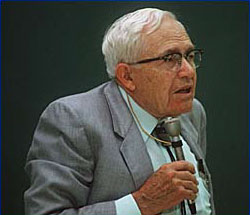 , découvreur de la planète
Pluton, est donné par Menzel (réf. 25). De mes propres discussions avec le Dr. Tombaugh, I confirmed the main outlines
of this incident. At about 10:00 p.m. on 8/20/49, he, his wife, and his mother-in-law were in the yard of his Las
Cruces home, admiring what Tombaugh described as a sky of rare transparency, when Tombaugh, looking almost directly
towards zenith, spotted an array of pale yellow lights moving rapidly across the sky towards the southeast. He called
them to the attention of the two others, who saw them just before they disappeared halfway to the horizon. The entire
array subtended an angle which Tombaugh put at about one degree, and it took only a few seconds to cross 50 or 60
degrees of sky. The array comprised six "windowlike" rectangles of light, formed into a symmetric pattern; they moved
too fast for aircraft, too slowly for a meteor, and made no sound. Menzel quotes Tombaugh as. saying, "I
have never seen .anything like it before or since, and I have spent a lot of time where the night sky could be seen
well."
, découvreur de la planète
Pluton, est donné par Menzel (réf. 25). De mes propres discussions avec le Dr. Tombaugh, I confirmed the main outlines
of this incident. At about 10:00 p.m. on 8/20/49, he, his wife, and his mother-in-law were in the yard of his Las
Cruces home, admiring what Tombaugh described as a sky of rare transparency, when Tombaugh, looking almost directly
towards zenith, spotted an array of pale yellow lights moving rapidly across the sky towards the southeast. He called
them to the attention of the two others, who saw them just before they disappeared halfway to the horizon. The entire
array subtended an angle which Tombaugh put at about one degree, and it took only a few seconds to cross 50 or 60
degrees of sky. The array comprised six "windowlike" rectangles of light, formed into a symmetric pattern; they moved
too fast for aircraft, too slowly for a meteor, and made no sound. Menzel quotes Tombaugh as. saying, "I
have never seen .anything like it before or since, and I have spent a lot of time where the night sky could be seen
well."
Discussion. -- Le Dr. Menzel explique ce phénomène comme résultant du reflet de lumières au sol,
éventuellement les fenêtres allumées d'une maison
réfléchies pas une couche d'inversion ou de
brume en haut. The movement he explains as resulting from a ripple on the haze layer. Such an "explanation" is not
merely difficult to understand; it is incredible. For an "inversion layer" to produce such a near-normal reflection
of window lights would demand a discontinuity of refractive index so enormously large compared with anything known to
occur in our atmosphere as to make it utterly out of the question. However, it has been just such casual ad hoc
explanations as this by which Menzel has, in his writings, used meteorological optics to rationalize case after ease
with no attention to crucial quantitative details. It is a simple matter to show that even inversions of
intensity many orders of magnitude larger than have ever been observed yield reflectivities (at the kind of
near-normal incidence involved in Tombaugh's sighting) that are only a tiny fraction of one per cent (Ref. 36). In
fact, I see no way of accounting for the Tombaugh observation in terms of known meteorological or astronomical
phenomena.
2. Cas 21. Fort Sumner, Nouveau-Mexique, 10 Juillet 1947
Une observation en milieu de journée par un météoricien de l'Université du Nouveau-Mexique, le docteur Lincoln LaPaz , et des membres de sa famille fut résumée par Life magazine il y a des
années de cela (Ref. 87) sans identifier le nom de La Paz. Bloecher (Ref. 8) donne plus de détails et note qu'elle est
officiellement Non Identifiée. (A 16:47 MST le 7 octobre 1947, 4 membres de la famille La Paz remarquent pratiquement
en même temps
, et des membres de sa famille fut résumée par Life magazine il y a des
années de cela (Ref. 87) sans identifier le nom de La Paz. Bloecher (Ref. 8) donne plus de détails et note qu'elle est
officiellement Non Identifiée. (A 16:47 MST le 7 octobre 1947, 4 membres de la famille La Paz remarquent pratiquement
en même temps un curieux objet lumineux presque immobile
bas sur l'horizon Ouest, près d'un ban de nuages.
L'objet est décrit comme elliptique, blanchâtre, et ayant une silhouette nettement distincte. Il vacille un peu alors
qu'il reste stationnaire juste au-dessus de l'horizon, puis s'élève, passant derrière les nuages et ré-émergeant plus
au Nord dans un intervalle de temps que LaPaz estime être si court qu'il appelle des vitesses dépassant celles
d'appareils conventionnels. Il passe devant des nuages sombres et semble
par contraste émaner sa propre lumière. Il disparaît finalement parmi les nuages. LaPaz l'estime être
peut-être à 20 miles de distance, en jugeant d'après les nuages concernés ; et il place sa
longueur à peut-être 100-200 pieds.
Discussion. -- Cette observation est attribuée par Menzel (réf. 24, p. 29) à une sorte de mirage
horizontal, peut-être d'un nuage très brillant luisant comme de l'argent dans la lumière du soleil -- un nuage
qui était lui-même invisible en raison des nuages plus sombres à l'arrière-plan.
Autant que je
puisse comprendre cette explication, elle semble être basée sur la notion qu'un mirage-réfraction peut
précisément se superimposer sur l'image d'un objet distant (ici son "nuage brillant") sur un objet plus
proche dans la distance intermédiaire (ici ses "nuages plus sombres"). C'est une notion fallacieuse. Si
quelques distortions optiques avaient ici amené à voir un nuage brillant distant, il ne serait pas possible
de recevoir à côté des trajets optiques immédiatement une image des nuages intermédiaires. De plus, les
lapse rates extrêment instables typiques des régions désertiques du Sud-West dans des conditions de
l'après-midi produisent des mirages inférieurs, pas supérieurs de type vague invoqués ici par Menzel. Des
déplacements rapides, verticalement et horizontalement, ne sont pas typiques de phénomènes de mirages. Par
conséquent les explications de Menzel ne peuvent être acceptées pour cette observation.
3. Cas 22. Harborside, Me., 8 Juillet 1947
Une observation par un astronome amateur, John F. Cole, signalée aux bureaux d'enquête officiels near the beginning of the period of general public awareness of the UFO problem, involves an erratically maneuvering cluster of about 10 objects, seen near 2:30 p.m. EDT on 7/3/47 on the eastern shore of Penobscot Bay. Hearing a roar overhead, Cole looked up to see the objects milling about like a moving swarm of bees as they traveled northwestward at a seemingly high speed, as nearly as he could judge size and distance. The objects were light-colored, and no wings could be discerned on most, although two appeared to have some sort of darker projections somewhat resembling wings. In 10-15 seconds they passed out of sight
Discussion. This is one of several dozen cases admitted to the Unidentified category in one of the earliest official reports on UFOs (Ref. 6). I have tried, unsuccessfully, to locate J. F. Cole. An account of the case is given by Bloecher (Ref. 8). It might be remarked that "swarming bee" UFO observations have cropped up repeatedly over the years, and from all over the world.
4. Case 23. Ogra, Latvia, July 26, 1965
Un astronome que je connais recently toured a number of observatories in the USSR, and brought back the word that a
majority of Russian astronomers have paid little attention to Russian UFO reports (details of which are quite similar
to American UFO reports, my colleagues established), a frequently-cited reason being that the American astronomer,
Menzel, had given adequate optical explanations of all such sightings. I must agree with Dr. Felix Y. Zigel
who, writing on the UFO problem in Soviet Life (Ref. 38), remarked that Menzel's explanation in terms of atmospheric
optics "does not hold water." It would, for example, be straining meteorological optics to try to account in such
terms for a sighting by three Latvian astronomers whose report Zigel cites in his article. At 9:35 p.m. on 7/26/65
while studying noctilucent clouds, R. Vitolniek and two colleagues visually observed a starlike object drifting slowly
westward. Under 8-power binocular magnification, the light exhibited finite angular diameter, so a telescope was used
to examine it. In the telescope, it appeared as a composite of four smaller objects. There was a central sphere around
which, at a distance of two diameters, were three spheres resembling the one in the center.
The outer spheres
slowly rotated around the central sphere as the array gradually moved across the sky, diminishing in size as if
leaving the Earth. After about 20 minutes' observation, the astronomers noted the outer spheres moving away from the
central object, and by about 10:00 p.m., the entire group had moved so far away that they were no longer visible.
Discussion. -- I have no first-hand information on this report, of course. The group of objects was seen at an angular elevation of about 60 degrees, far too high to invoke any mirage-effects or other familiar refractive anomalies. Furthermore, the composite nature of the array scarcely suggests an optical distortion of the telescope, a possibility also rendered improbable from the observed angular velocity and apparent recessional motion.
5. Cas 24 - Kislovodsk (Caucase) 8 août 1967
Zigel, qui est affilié à l'Institut d'Aviation de Moscou, rapporte dans le même article (réf. 38), une observation à
, le 8 août 1967, faite par l'astronome Anatoli Sazanov et ses collègues travaillant à la Station
Astrophysique de Montagne de l'Académies des Sciences de l'URSS, près de Kislovodsk.
Sazanov et 10 autres membres de l'équipe regardèrent un croissant assymétrique, avec son côté
convexe tourné dans la direction de son mouvement
se déplacer vers l'est à travers le ciel du nord à une élévation
angulaire de 20 ° environ. Juste au-dessus de celui-ci, et se déplaçant avec la même vitesse angulaire se trouvait un
point de lumière comparable à une étoile de la 1ʳᵉ magnitude. L'objet semblable à un croissant était jaune-rougeâtre,
avec une largeur angulaire des 2/3 de celle de la Lune environ, et laissait comme des traînées de
vapeur à l'arrière des extrêmité des cornes du croissant. Alors qu'il reculait, il diminua de taille et ainsi disparut
instantanément.
Discussion. -- If we may accept as reliable the principal features of the sighting, how might we account for it? The "faintly luminous ribbons" trailing from the horns suggest a high-flying jet, of course; but the asymmetry and the reddish-yellow coloration fail to fit that notion. Also, it was an object of rather large angular size, about 20 minutes of arc, so that an aircraft of wingspan, say, 150 feet would have been only about five miles away whence engine-noise would have been audible under the quiet conditions of a mountain observatory. More significant, if it had been an aircraft at a slant range of five miles, and at 20 degree elevation, its altitude would have been only about 9000 ft above the observatory. For the latitude and date. the sun was about ten degrees below the western horizon, so direct sun-illumination on the aircraft at 9000 ft above observatory level would be out of the question. Hence the luminosity goes unexplain . Clearly, satellites and meteors can-be ruled out. The astronomers' observation cannot be readily explained in any conventional terms. Zigel fait remarquer que l'objet fut aussi vu dans la ville de Kislovodsk, et qu'un autre croissant rougeâtre fut observé dans la même région le soir du 17 juillet 1967.
6. Cas 25. Flagstaff (Arizona), 20 mai 1950
Près de midi le 20 mai 1950, le Dr. Seymour Hess observed an object from the grounds of the Lowell Observatory. Although Hess' principal field of interest has been meteorology, we may here consider him an astronomer-by-association, since he was at Lowell doing work on planetary atmospheres, on leave from Florida State University. Spotting an unusual small object moving from SE to NW, he had time to send his son after binoculars, which he used in the later portions of his observation. He said it looked somewhat disc-shaped, or perhaps somewhat like a tipped parachute. It had no wings or visible means of propulsion, Dr. Hess indicated to me that he probably had it in sight a total of about three minutes, during which it passed directly between him and a cloud, before disappearing (into a cloud Hess feels, though this point was not certain). From meteorological data bearing on the cloud-base height, Hess deduced that the cloud bases lay 12,000 ft above terrain (vs. Weather Bureau visual estimate of 6000 ft above terrain). The zenith angle was about 48 degrees, so the slant range would have been 17,000 ft or 8,000 ft, depending on which cloud height is accepted. For its 3 minutes estimated angular diameter (dime at 50 ft Hess estimated), the diameter would then come out of the order of 10 to 15 feet His subjective impression was that it was possibly smaller than that.
Discussion. -- The possibility that this might have been a balloon or some other freely drifting device comes to mind. However, Hess noted carefully that the clouds were drifting from SW to NE, i.e., at right angles to the object's motion.
He estimated its speed to be in the neighborhood of 100 to 200 mph, yet no engine noises of any kind were audible. It appeared dark against the bright cloud background, but bright when it was seen against blue sky. No obvious explanation in conventional terms seems to fit this sighting.
7. Many other sightings by both professional and amateur astronomers could be listed. Vallée (Ref. 17) discusses in
detail a November 8, 1957 observation by J. L. Chapuis of Toulouse Observatory in France of what appeared through a
small telescope to be a yellowish, elliptical body, with distinct outlines, leaving a short trail behind it. It was
seen by other observers in three separate locations, executed maneuvers entirely excluding meteoric origin, and was
regarded as an unexplainable phenomenon by all of the witnesses. Hall (Ref. 10) lists nine examples of astronomer
sightings of unidentified objects, several of which are quite striking. Ruppelt (Ref. 5) remarks that an astronomer
working under contract to the official UFO investigatory program interviewed 45 American astronomers uring the summer
of 1952, of whom five (11 per cent) had seen what they regarded to be UFOs. Although the sample is small, that
percentage is well above the population percentage who say they have seen UFOs, which suggests that perhaps
astronomers may sight more UFOs than they report as such. Indeed, with the recent publication of Ref. 7, further
interesting information on that 1952 poll is now at hand. The contract astronomer wrote at that time (Ref. 7, Rept 8),
... certainly another contributing factor to their desire not to talk about these things is their overwhelming fear
of publicity. One headline in the nation's papers to the effect that 'Astronomer Sees Flying Saucer' would be enough
to brand the astronomer as questionable among his colleagues.
Unfortunately, we scientists are by no means as
open-minded and fearlessly independent as we are sometimes pictured. It is often quite difficult to persuade a
scientist to let his confidential report of a UFO sighting become a fully open UFO report; and my own experience
suggests that perhaps astronomers, as a group, are just a bit more sensitive on this score than other scientists. At
any event, perhaps the above-cited cases will suggest that some astronomers have seen unidentified flying objects.
Les météorologues et observateurs météo regardent souvent le ciel. Pourquoi ne voient-ils pas d'ovnis ?
1. Cas 26. Richmond (Virginie), Avril 1947
To begin an answer to that rhetorical question, we might consider an observation made by a weather observer at the Richmond, Va., U.S. Weather Bureau station, about two months before the first national publicity concerning UFOs. Walter A. Minczewski, whom I located at the same Weather Bureau office where he made the sighting in 1947, was making a pilot balloon observation, when he spotted a silvery object that entered the field of his theodolite (which was trained on the balloon he had released). In the account that Minczewski sent me, he stated that "the bottom was flat and the top was slightly dome-shaped": and when he tried to see it with naked eye, he could not spot it. (Typical pilot balloon theodolites have magnifications of about 20 to 25. and angular fields that are usually about a degree across.) It was a "clear bright morning" when he spotted the object, and it lay to his NNE at an elevation of about 45 degrees. Whether Minczewski really saw the upper surface or formed his mental impressions without realizing that the theodolite may have inverted the image is now unclear, and my questioning did not settle that point.
Discussion. -- A report of this sighting is in the official files, a circumstance which greatly surprised Minczewski, since he had discussed it only with his fellow workers. In the ensuing two decades, he has never again seen anything like it. Clearly, the probability of an object crossing the small angular field of a meteorological theodolite is quite low, if only chance were involved here. He tried to track it but lost it, due to its high angular velocity, after about five or six seconds, he recalled. No obvious conventional explanation suggests itself for this early sighting.
2. Cas 27. Yuma (Arizona), 4 février 1953
Weather Bureau observer S. H. Brown was tracking a pilot balloon at 6000 ft over Yuma at 1:50 p.m. MST on 2/4/53 when first one and then a second unidentified object moved across his theodolite field, somewhat as in the preceding case. I obtained an account of this sighting from V. B. Gotten, Meteorologis in-Charge at the Yuma station. The full account is too long for recapitulation here. Both objects appeared to be of the order of a minute of arc in diameter and appeared "almost round, a solid dull pure white color, with a thin white mist completely edging each object." The first object moved into the optical field and curved upwards to the west, with the theodolite oriented to about 53 degrees elevation, 107 degrees azimuth. About 20 seconds later, a second object entered the field and moved in and out of the field erratically two times, to rejoin the first object. Brown was able to track the pair thereafter, as they jointly changed both azimuth and elevation. Because he had a stopwatch at hand for the balloon observation (which he did not complete because of following the unknown objects), he was able to determine that he followed the pair of objects for five minutes (1350 to 1355), until he lost sight of them against a cirrus cloud deck to the SSW. At the termination of the observation, his instrument was pointed to 29 degrees elevation, 204 degrees azimuth.
Discussion. -- This case is carried as Unidentified in the official files (see Ref. 7 for official summary). At times these objects lay near the sun's position in the sky, which might suggest forward-angle scattering of sunlight by airborne particles. However, initially, the objects were detected at angular distance of about 40 degrees from the solar position, which would not yield appreciable low-angle scattering. Furthermore, if these were airborne scatterers, they would almost certainly be separated by random turbulence within as long a period as five minutes, yet the observer's report indicates that they maneuvered together within angular separations of the order of the roughly one-degree field of such theodolites. The fact that the second object did go out of the field only to return to the vicinity of the first object strains the airborne-particle hypothesis. Thus the official categorization of Unidentified seems reasonable here.
3. Cas 28. Upington (province du Cap), 7 décembre 1954
R. H. Kleyweg, Officer-in-Charge of the Upington Meteorological Station, had just released a balloon for upper-wind measurement and was shielding his eyes from the sun trying to spot the balloon to get his theodolite on it. Seeing an object east of the sun, moving slowly to the west, he thought it was his balloon and got the theodolite on it, only to find that it was white, whereas he had released a red balloon. An account in the Natal Mercury, January 28, 1950, quoted Kleyweg as saying that it seemed "like a half-circle with the sun reflecting off the sloping top." He had no difficulty following it for about three minutes, but then it began to accelerate and, after another minute, he was unable to track fast enough to keep it in optical view (Ref. 10). Discussion. -- Kleyweg was quoted in the cited press source as saying, "I have followed thousands of meteorological balloons. This object was no balloon. " A South African student doing graduate work in my Department, Petrus DuToit, has confirmed this sighting, having had an account of it directly from Kleyweg. An accelerating airborne half-circular object with sloping top seems best categorized as an unidentified flying object.
4. Cas 29. Arrey (Nouveau-Mexique), 24 avril 1949
Charles B. Moore , Jr., was with four enlisted Navy personnel making a pilot balloon
observation preparatory to release of a Skyhook balloon at the White Sands Proving Ground in the middle of the morning
of 4/24/49. The balloon was airborne and was under observation by one of the men when Moore became aware that a white
object which he took to be the balloon was in a part of the sky well away from where the theodolite operator had this
instrument trained. As Moore has explained directly to me in discussing this famous case, he thought the operator had
lost the balloon. Moore took over, swung the 25-power scope onto the "balloon" he had spotted, and found that it was
in fact an ellipsoidal white object moving at a rapid angular velocity towards the NE. With stopwatch and recording
forms at hand, it was possible for the team of five men to secure some semi-quantitative data on this sighting; Moore
disengaged the vernier drives to track manually, and followed the object as it sped from the southwest into the
northeast skies. At its closest approach, it was moving at about 5
degrees/sec. Just before Moore lost it in the distance to the northeast, its angular elevation began to increase, as
if it were climbing, a quite significant point. The object had a horizontal length about two to three times greater
than its vertical thickness. Moore never got a sufficiently clear view to identify any finer details if any were
present. Another balloon was immediately released to check the slim possibility that a high-speed jet from SW to NE
might have carried some airborne object across the sky; but the winds were blowing more or less at right angles to
the object's path to the 93,000 ft level, and were rather weak (Ref. 10). The angular diameter of the object was
estimated at about a minute of arc (which in the 25-power theodolite would appear to Moore as about three-fourths
the apparent size of the moon ).
, Jr., was with four enlisted Navy personnel making a pilot balloon
observation preparatory to release of a Skyhook balloon at the White Sands Proving Ground in the middle of the morning
of 4/24/49. The balloon was airborne and was under observation by one of the men when Moore became aware that a white
object which he took to be the balloon was in a part of the sky well away from where the theodolite operator had this
instrument trained. As Moore has explained directly to me in discussing this famous case, he thought the operator had
lost the balloon. Moore took over, swung the 25-power scope onto the "balloon" he had spotted, and found that it was
in fact an ellipsoidal white object moving at a rapid angular velocity towards the NE. With stopwatch and recording
forms at hand, it was possible for the team of five men to secure some semi-quantitative data on this sighting; Moore
disengaged the vernier drives to track manually, and followed the object as it sped from the southwest into the
northeast skies. At its closest approach, it was moving at about 5
degrees/sec. Just before Moore lost it in the distance to the northeast, its angular elevation began to increase, as
if it were climbing, a quite significant point. The object had a horizontal length about two to three times greater
than its vertical thickness. Moore never got a sufficiently clear view to identify any finer details if any were
present. Another balloon was immediately released to check the slim possibility that a high-speed jet from SW to NE
might have carried some airborne object across the sky; but the winds were blowing more or less at right angles to
the object's path to the 93,000 ft level, and were rather weak (Ref. 10). The angular diameter of the object was
estimated at about a minute of arc (which in the 25-power theodolite would appear to Moore as about three-fourths
the apparent size of the moon ).
Discussion. -- Moore's sighting is carried as Unidentified in official files. Menzel (Ref. 24) says of it:
This incident, kept in the classified files for more than two years, presents no serious difficulty to the person who understands the optics of the earth's atmosphere. The air can, under special conditions, produce formations similar to lenses. And, just as a burning glass can project the sun into a point of light, so can these lenses of air -- imperfect though they are -- form an image. What Moore saw was an out of focus and badly astigmatic image of the balloon above.
It would be interesting to hear Menzel present a quantitative defense of that astonishing disposition of this interesting sighting. Here five witnesses, with aid of a tracking device giving better than rough angular-coordinate information on the movements of an unknown object, observe the object move through an arc of over 90 degrees that took it into a part of the sky about that same large angular distance from the real balloon's location, and Menzel adduces a "lens of air" to explain it away. Astronomers find atmospheric scintillation a very serious observational problem because stellar images are often erratically shifted by tens of seconds of arc from their mean position as a result of atmospheric turbulence effects. In the 5/24/49 Moore sighting, Menzel is proposing that the atmosphere carried a refracted image of the balloon northeastward at a steady rate of excursion that finally totaled several thousand times the magnitude of refractive angular image-displacements known to occur with bad seeing. I feel obliged to repeat an observation I have made before: If the transmission properties of the Earth's atmosphere were as anomalous as Menzel assumes in his handling of UFO observations, he and his colleagues would be out of business. The official categorization of Unidentified for the Moore sighting seems inescapable. It might be added that, over the years, there have been very many UFO observations of significant nature from the vicinity of White Sands Proving Ground, many involving instrumental tracking, many made by experienced observers. A long and impressive list of them could easily be compiled, yet all have been slowly lost from official cognizance by a process that is characteristically at the heart of response to the UFO problem.
5. Cas 30. Admiralty Bay (Antarctique), 16 mars 1961
This listing of UFO sightings by meteorologists could be extended very considerably by drawing on my file of such cases. To cite just one more that also indicates the global .scale of the UFO phenomena, a very unusual luminous unidentified aerial object seen by a meteorologist and others aboard the U.S.S. Glacier at about 6:15 p.m. on 3/16/61 in the Antarctic will be mentioned. I have quite recently received, through French UFO investigator Rene Fouere, a rather detailed summary of this sighting by Brazilian meteorologist Rubens J. Villela, whose earlier account I had seen but paid little attention to (Ref. 10). The point I had missed, prior to reading Villela'a detailed description of the circumstances of the sighting, was the very important feature of a low cloud overcast present at about 1500 ft above the sea. With three shipmates on the flying bridge, Villela suddenly saw
a multicolored luminous object crossing the sky,
an object which for a moment they took to be an unusual meteor.
It was egg-shaped, colored mainly reddish at first, and traveled slowly from NE to SW at about 50 degrees above the horizon, on a straight horizontal trajectory. From its frontal part, several multicolored, perfectly straight 'rays' extended backwards, diverging outwards at an angle; the colors of these rays changed continually, predominantly green, red, and blue. Most striking of all, it left a long trail of orange color in the form of a perfectly straight tube which gave the distinct impression of being hollow, faintly comparable to a neon light,
Villela stated in his summary.
Then, suddenly the object divided in two. It was not an explosion, it was a controlled division in two equal parts, one behind the other, each egg-shaped as before and each radiating outwards its V-shaped lateral rays. Then the object shone with a slightly stronger light, changing color to blue and white, and disappeared completely. That's it -- just disappeared, abruptly.
His account emphasizes that the boundaries of the object (s) were definite and sharp, not diffuse. Villela's account indicates that a total of six persons were above-decks and saw this striking phenomenon. It is to be emphasized that, in the estimated 10 seconds that this lasted, the object was moving below a cloud deck that lay only about 1500 feet above the sea, so that, for the reported elevation angle of about 50 degrees, the slant range from observers to object was perhaps of the order of 2000 ft. Villela had the subjective impression that the egg-shaped initial form was about as big as a small airplane.
Discussion. -- In a recent book aimed at showing that a majority of the most interesting UFOs are an atmospheric-electrical plasma related to ball lightning, Philip J. Klass (Ref. 39)) cites the preceding case as a good example of the port of observation which he feels he can encompass in his "plasma-UFO" hypothesis. To the extent that he treats only the breakup into two parts, he has some observational basis for trying to interpret this as something akin to ball lightning. But almost at that point the similarity ends as far as meteorologically recognized characteristics of ball lightning go. The highly structured nature of the object and its rays, its size, its horizontal trajectory, its presence in a foggy area with low stratiform clouds free of thunderstorm activity scarcely suggest anything like ball lightning. Nor does this account suggest any meteoric phenomenon at sub-cloud altitudes. I would regard this as just one more of a baffling array of inexplicable aerial phenomena which span so wide a range of characteristics that it is taxing to try to invent any single hypothesis to rationalize them all. The full spectrum of UFO phenomena will, I predict, come as a shock to every scientist who takes the necessary time to look into the wealth of reports accumulated in various archives over the past two decades and more. Official assertions to the effect that UFO reports in no way defy explanation in terms of present scientific and technological knowledge are, in my opinion, entirely unjustified. The Villela sighting seems a case in point. And meteorologists do see UFOs, as the foregoing cases should suggest.
Les ballons méteo et de recherche n'expliquent-ils pas de nombreux ovnis ?
Probablement la déclaration la plus catégorique jamais faite attribuant les observations d'ovnis aux ballons apparut dans un article du magazine Look par Richard Wilson en février 1951, intitulé, "A Nuclear Physicist Exposes Flying Saucers." Dr. Urner Liddel. then affiliated with the Navy cosmic ray research program using the large Skyhook balloons, was quoted as saying, "There is not a single reliable report of an observation (of a UFO) which is not attributable to the cosmic balloons." When one considers the large number of UFO reports already on record by 1951 in which reliable airlines pilots, military personnel, and other credible witnesses have observed unidentified objects wholly unlike a high-altitude, slowly drifting pear-shaped Skyhook balloon, that assertion appears very curious. Nevertheless, that many persons have misidentified Skyhook balloons and even the smaller weather balloons used in routine meteorological practice is unquestioned. A Skyhook seen against the twilight sky with back-illumination yields a strangely luminous, hovering object which many observers, especially if equipped with binoculars, were unprepared to identify correctly in the 1946-51 period when Skyhook operations were tied up with still-classified programs. To this extent, Liddel's point is reasonable; but his sweeping assertion fails to fit the facts, then or now.
Actually, in official case-evaluations, one finds Skyhook balloons invoked relatively infrequently compared with "weather balloons," But in many of the latter cases, the balloon hypothesis is strained beyond the breaking point. The official criterion used is extremely loose:
If an object is reported near a balloon launch site within an hour after the scheduled launch times, it is classed as a balloon.
with no specification of heights, shapes, distances, etc. Using such a criterion, it is easy to see why so many "balloon" explanations figure in the official summaries. There are even "balloon" UFOs whose speed, when inferred from the report, comes out supersonic! The tiny candles or flashlight bulbs hung on pilot balloons for night tracking have been repeatedly made the basis for explanations of what witnesses described as huge luminous objects at close range. Within only days of this writing, I have checked out such a case near Tucson where four adult witnesses saw, on July 2, 1968, a half-moon-shaped orange-red object hovering for several minutes at what they estimated to be a few hundred feet above terrain and perhaps a few miles away over open desert. They watched it tip once, right itself, then accelerate and rise over a mountain range and pass off into the distance in some ten seconds. Because a weather balloon had been released earlier (actually about an hour and forty-five minutes earlier) from the Tucson airport Weather Bureau station, the official explanation, published in the local press, was that the witnesses had seen a "weather balloon". A pilot balloon of the small type (30-gram) used in this instance rises at about 600 ft/min, the tiny light on it becomes invisible to the naked eye beyond about 10 000 ft slant-range, and the upper-level winds weren't even blowing toward the site in question. Also the angular size estimated for the observed reddish half-moon was about twice the lunar diameter, and some said about four times larger. A pilot balloon light would have to be within about 20-30 feet to appear this large. Yet such a case will enter the files (if even transmitted to higher echelons) as a "balloon", swelling the population of curious balloon-evaluations in official files.
1. Cas 31. Ft. Monmouth (New Jersey), 10 septembre 1951
It is clear from Ruppelt's discussions (Ref. 5) that a series of radar and visual sightings near Ft. Monmouth on 9/10/51 and the next day were of critical importance in affecting official handling of the UFO problem in the ensuing two-year period. Many details from the official file on these sightings are now available for scientific scrutiny (Ref. 7). Here, a sighting by two military airmen flying in a T-33 near Ft. Monmouth will be selected from that series of events because the sighting was eventually tagged as a weather balloon. As with any really significant UFO case, it would require far more space than can be used here to spell out adequately all relevant details, so a very truncated account must be employed. While flying at 20,000 ft from a Delaware to a Long Island airbase, the two men in the T-33 spotted an object "round and silver in color" which at one stage of the attempted intercept appeared flat. The T-33 was put into a descending turn to try to close on the object but the latter turned tightly (the airmen stated) and passed rapidly eastward towards the coast of New Jersey and out to sea. A pair of weather balloons (probably radiosonde balloons but no information thereon given in the files) had been released from the Evans Signal Laboratory near Ft. Monmouth, and the official evaluation indicates that this is what the airmen saw.
However, it is stated that the balloons were released at 1112 EDST, and the sighting began at about 1130 EDST with the T-33 over Point Pleasant, N.J. In that elapsed time, a radiosonde balloon, inflated to rise at the 800-900 ft/min rate used for such devices, would have attained an altitude of about 17-18 000 ft, the analysis notes. From this point on, the official analysis seems to be built on erroneous inferences. The airmen said that, as they tried to turn on the object, it appeared to execute a 120-degree turn over Freehold, N.J., before speeding out over the Atlantic. But from the upper winds for that day, it is clear that the Ft. Monmouth balloon trajectory would have taken it to the northeast, and by 1130, it would have been about over the coast in the vicinity of Sea Bright. Hence, at no time in the interval involved could the line of sight from T-33 to balloon have intersected Freehold, which lies about 15 miles WSW of the balloon release-point. Instead, had the airmen somehow seen the radiosonde balloon from Pt. Pleasant, it would have lain to about their N or NNE and would have stayed in about that sector until they passed it. Furthermore, the size of the balloon poses a serious difficulty for the official analysis. Assuming that it had expanded to a diameter of about 15 feet as it ascended to about the 18,000-ft level, it would have subtended an arc of only 0.6 min, as seen from the T-33 when the latter passed over Pt. Pleasant. This angular size is, for an unaided eye, much too small to fit the airmen's descriptions of what they tried to intercept. In a press interview (Ref. 40), the pilot, Wilbert S. Rogers of Columbia, Pa., said the object was ''perfectly round and flat" and that the center of the disc was raised "about six feet" and that it appeared to be moving at an airspeed of the order of 900 mph. The entire reasoning on which the balloon evaluation is elaborated fails to fit readily established points in the official case-summary.
Discussion. -- The possibility that a pilot can be misled by depth-perception errors and coordinate-reference errors to misconstrue a weather balloon as a fast-maneuvering object must always be kept in mind. But in the Ft. Monmouth instance, as in many others that could be discussed in detail, there is a very large gap between the balloon hypothesis and the facts. The basic sighting-report here is quite similar to many other daytime sightings by airborne observers who have seen unconventional disc-like objects pass near their aircraft.
2. Cas 32. Odessa (Washington), 10 décembre 1952
According to an official case-summary (Ref. 7, Rept 10), two airmen in an F94 "made visual and radar contact with a
large, round white object larger than any known type of aircraft" near 1915 PST on 12/10/52 near Odessa. The radar
operator in the F-94 had airborne radar contact with the object for 15 minutes, and during that same interval,
ground radar was also tracking it. The summary states that l'objet appeared to be level with the intercepting
F-94 at 26 000 to 27 000 ft,
and it is pointed out that a dim reddish-white light came from
the object as it hovered, reversed direction almost instantaneously and then disappeared.
It is stated that
the skies were clear above 3000 ft The official evaluation of this incident is "Possible Balloon", although the
report notes that no upper-air research balloon was known to be in the area on this date. The principal basis for
calling it a balloon was the observers' description of large, round and white and extremely large
, and
it was remarked that the instrument package on some balloon flights is capable of yielding a radar return.
Discussion. -- To conclude that this was a "Possible Balloon" just on the basis of the description, large,
round and white and extremely large
, and thereby to ignore the instantaneous course reversal and the
inability of a 600-mph jet to close with it over a period of 15 minutes seems unreasonable. We may ignore questions
of wind speeds at the altitude of the object and the F-94 because both would enjoy the same "tail-wind effect". In
15 mn, the F-94 would be capable of moving 150 miles relative to any balloon at its altitude. On the other hand,
airborne radar sets of that period would scarcely detect a target of cross-section represented by the kinds of
instrument packages hung on balloons of the Skyhook type, unless the aircraft were within something like 10 or 15
miles of it Yet it is stated that the F-94 was pursuing it under radar contact for a time interval corresponding to
an airpath ten times that distance. Clearly, categorizing this unknown as a "balloon" was incompatible with the
reported details of the case.
On the other hand, there seems no reason to take seriously Menzel's evaluation of this Odessa F-94 sighting (Ref. 25, p. 62). Menzel evidently had the full file on this case, for he adds a few details beyond those in Ref. 7, details similar to those in Ruppelt's account of the case (Ref. 5) :
Dim reddish-white lights seemed to be coming from windows and no trail or exhaust was visible. The pilot attempted to intercept but the object performed amazing feats—did a chandelle in front of the plane, rushed away, stopped, and then made straight for the aircraft on a collision course at incredible speed.
He indicates that after the pilot banked to avoid collision he could not again locate it visually, although another brief radar contact was obtained. Having recounted those and other sighting details, Menzel then offers his interpretations:
In the east, Sirius was just rising over the horizon at the exact bearing of the unknown object. Atmospheric refraction would have produced exactly the phenomenon described. The same atmospheric conditions that caused the mirage of the star would have caused anomalous radar returns.
Now stars just above the viewer's horizon do scintillate and do undergo turbulent image-displacement, but one must consider quantitative matters. A refractive excursion of a stellar image through even a few minutes of arc would be an extremely large excursion. To suggest that a pilot would report that Sirius did a chandelle is both to forget realities of astronomy and to do injustice to the pilot. In fact, however, Menzel seems to have done his computations incorrectly, for it is easily ascertained that Sirius was not even in the Washington skies at 19 h 15 (PST) on 12/10/52. It lay at about 10 degrees below the eastern horizon. A further quite unreasonable element of Menzel's explanation of the Odessa case is his easy assertion that the radar returns were anomalous results of the "atmospheric conditions". Aircraft flying at altitudes of 26 000 pieds do not get ground returns on level flight as a result of propagation anomalies. These extreme forcings of explanations recur throughout Menzel's writings; one of their common denominators is lack of attention to relevant quantitative factors.
3. Cas 33. Rosalia (Washington). 6 février 1953
Another official case-summary of interest here is cited by Menzel (Ref. 25, p. 46). Keyhoe (Ref. 4), who studied the
case-file on it much earlier, gives similar information, though in less detail. A B-36, bound for Spokane was over
Rosalia, Wash., at 1:13 a.m. when, as Menzel describes it, the pilot *** sighted a round white light below
him, circling and rising at a speed estimated at 150 to 200 knots as it proceeded on a southeast course.
Menzel states that the B-36 made a sharp descending turn toward the light, which was in view for a period of
three to five minutes.
The light was blinking, and Keyhoe mentions that the blink-interval was estimated at about 2 seconds.
Menzel concurs in the official evaluation of this as a "weather balloon", noting that a pilot balloon had been
released at Fairchild AFB at 1:00 a.m., and remarking that the winds aloft at altitudes of 7000 to 10 000
ft. were from the northwest with a speed of about fifty knots.
He says that computations showed that the existing winds would have carried the balloon to the southeast, and
it would have been over Rosalia, which is 12,5 nautical miles southeast of Fairchild, in about fifteen
minutes.
In fact, Rosalia lies 33 statute miles SSE of Fairchild, or about twice as far as Menzel indicates. The net drift of the balloon cannot be deduced simply from the winds in the 7-10 000 pieds layer; and, in fact, an examination of the upper-wind data for that area on February 6 indicates that the winds at lower levels were blowing out of the southwest. The trajectory of the balloon would have taken it initially east-northeast, then east, and finally curving back to the southeast as it got up to near the 10000-ft. levels. By that time, it would have been already east of Spokane, nowhere near Rosalia.
The small light (candle or flashlight bulb) used on night pibal runs is almost invisible to the naked eye beyond a few miles' distance. (A 1-candle source at 3000 pieds is equivalent to a star of about the first magnitude. At 6 miles, then, one finds that the same source equals the luminosity of a sixth-magnitude star, the limit of human vision under the most favorable conditions. For a pilot, looking out of a cockpit with slight inside glare to spot a 1-candle source against a dark background would require that the source be only a few miles away.) At some 30 miles, the B-36 pilot could not have seen the small light on a balloon east of Spokane.
Menzel states that the balloon carried white running lights which accounted for the blinking described, and the
circling climb of the UFO is typical of a balloon's course.
Neither inference is supportable. The light used on pilot balloons is a steady source; only if one were right above
it, with its random swing causing intermittent occultation, would one ever perceive blinking. But then, flying at B-36
speeds, the pilot would have swept over the sector of perceptible occultation in only a matter of seconds. Yet here
the pilot watched it for a reported 3-5 minutes. Furthermore, "circling climb" cannot be called typical of a
balloon's course
. The balloon trajectory is controlled by the ambient wind shears and only with unusually strong
directional shears would a pilot flying a straight course perceive a pilot balloon to be "circling."
In all, there appear to be so many serious difficulties with the balloon explanation for the Rosalia sighting that it is not possible to accept Menzel's statement:
Thus all the evidence supports ATIC's conclusion that the UFO was a weather balloon.
4. Cas 34. Boston (Massachussetts), 1er juin 1954
A 09 h 30 (EDST), un Constellation de la TWA en vol de Paris à New York passe près de Boston lorsque
l'équipage du cockpit repère au-dessus un grand objet de couleur blanche à l'apparence de disque
. Le capitaine Charles J. Kratovil, le copilote W. R. Davis et l'ingénieur de vol
Harold Raney le regardent tous pendant une durée totale de 10 mn alors qu'ils volent sur leur propre trajectoire
sud-ouest vers New York. Ils le perdront par moments derrière les nuages surplombants. Sachant qu'ils volaient par
vents contraires, ils concluèrent qu'il ne pouvait s'agir d'un type de ballon, et appelèrent donc par radio la tour de contrôle de
l'aéroport de Boston, qui l'informa que des jets furent envoyés et virent l'objet, mais ne purent s'en rapprocher.
Après avoir atterri à New York, le capitaine Kratovil fut informé que les portes-parole officiels avaient attribué
l'observation à un ballon météo
lâché depuis la base
aérienne de Grenier, dans le New Hampshire.
Discussion. -- Je suis toujours en train d'essayer de localiser Kratovil pour confirmer les détails de
l'observation ; mais le fait que 4 récits de journaux ce jour-là donnent les mêmes informations sur les points majeurs
justifie probablement l'acceptation de ces points. D'après les données upper-wind for that area and time, I have
confirmed the presence of fairly strong flow from the WSW aloft, whence Kratovil's press comment, If this was a
weather balloon, it's the first time I ever saw one traveling against the wind
, seems reasonable. The cruising
speed of a Constellation is around 300 mph, so during the reported 10 mn duration of the crew's sighting, they moved
about 50 miles relative to the air, so it would have been impossible for them to have kept a weather balloon in sight
for this long. Furthermore, it was about 1,5 h after scheduled balloon-release time, so that even a small balloon
would have either burst or passed to altitudes too high to be visible. Finally, with flow out of the southwest sector
from surface to above 20 000 pieds, any balloon from Grenier AFB would have been carried along a trajectory nowhere
near where the TWA crew spotted the large, white-colored, disc-like object
overhead.
5. Dans mes fichiers se trouvent de nombreux autres cas de "ballons" from the past twenty years, cases that ought never have been so labeled, had the evaluators kept relevant quantitative points in mind. To ignore most of the salient features of a sighting in order to advance an easy "balloon" explanation is only one more of many different ways in which some very puzzling UFO observations have been shoved out of sight.
Pourquoi les ovnis ne sont-ils pas repérés par radar ?
Le sceptique qui pose cette question, et de nombreux le font, pose une question très raisonnable. Avec tant d'équipements radar déployés dans le monde entier, et particulièrement aux Etats-Unis, il semble censé de s'attendre à ce que, s'il existe des appareils aériens manoeuvrant dans notre espace aérien, ils doivent se montrer sur les radar once in a while. Ils le font en fait, et l'ont fait pendant les 2 décades où le radar a été utilisé de manière généralisée. Ici, comme avec nombre d'autres erreurs de conceptions générales sur le véritable état du problème ovni, nous rencontrons de manière dérangeante de grandes quantités de mauvaises informations. Comme pour d'autres catégories d'informations erronées sur les ovnis, la seule correction adéquate est une discussion détaillée de grands nombres de cas individuels. Seules les limitations d'espace empêche la discussion de douzaines d'incidents radar frappants impliquant des ovnis, ici comme à l'étranger ; ils existent bien.
1. Cas 35. Fukuoka (Japon), 15 Octobre 1948
A very early radar-UFO case, still held as an official Unidentified, involved an attempted interception of the
unknown object by an F-61 flying near Fukuoka, Japan, at about 23 h 00 local time on 10/15/48. The official file on
this incident is lengthy ; only the highlights can be recounted here. The F-61
(with pilot and radar operator) made six attempts to close with the unknown, from which a radar return was
repeatedly obtained with the airborne radar. Each time the radarman would get a contact and the F-61 pilot tried to
close, the unknown would accelerate and pass out of range. Although the radar return seemed comparable to that of a
conventional aircraft, the radar observer estimated that on three of the sightings, the object traveled seven
miles in approximately twenty seconds, giving a speed of approximately 1200 mph.
In another passage, the official case-file remarks that when the F61 approached within 12,000 feet, the target
executed a 180° turn and dived under the F-61
adding that the F-61 attempted to dive with the target
but was unable to keep pace.
The report mentions that the unknown could go almost straight up or down out of radar elevation
limits
and asserts further that this aircraft seemed to be cognizant of the whereabouts of the
F-61 at all times...
The F-61 airmen, 1st Lt. Oliver Hemphill (pilot) and 2d Lt. Barton Halter (radarman) are described in the report as
being of excellent character and intelligence and are trained observers.
Hemphill, drawing on his combat experience in the European theater, said that the only aircraft I can
compare our targets to is the German ME-163.
The airmen felt obliged to consider the possibility that their six attempted intercepts involved more than one
unknown. Hemphill mentions that, in the first attempted intercept, the target put on a tremendous "burst of
speed and dived so fast that we were unable to stay with it.
After this head-on intercept, Hemphill did a chandelle back to his original 6000-ft altitude and tried a stern
interception, but the aircraft immediately outdistanced us. The third target was spotted visually by
myself,
Hemphill's signed statement in the case-file continues.
I had an excellent silhouette of the target thrown against a very reflective undercast by a full moon. I
realized at this time that it did not look like any type aircraft! was familiar with, so I immediately contacted my
Ground Control Station ...
which informed him there were no other known aircraft in the area. Hemphill's statement adds further that the
fourth target passed directly over my ship from stern to "bow at a speed of roughly twice that of my aircraft, 200
mph. I caught just a fleeting glance of the aircraft; just enough to know he had passed on. The fifth and sixth
targets were attempted radar interceptions, but their high rate of speed put them immediately out of our range.
(Note the non-committal terminology that treats each intercept target as if it might have been a separate object.) A
sketch of what the object looked like when seen in silhouette against the moonlit cloud deck is contained in the
file. It was estimated to be about the size of a fighter aircraft, but had neither discernible wings nor tail
structures. It was somewhat bullet-shaped, tapered towards the rear, but with a square-cut aft end. It seemed to
have a dark or dull finish.
Discussion. -- Ground radar stations never detected the unknown that was seen visually and contacted by airborne radar. The report indicates that this may have been due to effects of "ground, clutter", though the F-61 was seen intermittently on the ground units. The airmen stated that no exhaust flames or trail were seen from this object with its "stubby, clean lines". The total duration of the six attempted intercepts is given as 10 mn. We deal here with one of many cases wherein radar detection of an unconventional object was supported by visual observation. That this is carried as Unidentified cannot surprise one; what is surprising is that so many other comparable instances are on record, yet have been ignored as indicators of some scientifically intriguing problem demanding intensive study.
2. Cas 36. Nowra (Australie), septembre 1954
The first UFO case to command general press attention in the Australian area seems to have been a combined radar-visual sighting wherein the pilot of a Hawker Seafury from Nowra Naval Air Station visually observed two unknown objects near him as he flew from Canberra to Nowra . Press descriptions revealed only that the pilot said "the two strange aircraft resembling flying saucers" were capable of speeds much beyond his Seafury fighter. He saw them flying nearby and contacted Nowra radar to ask if they had him on their scope; they informed him that they had three separate returns, at which juncture he described the unidentified objects. Under instructions from the Nowra radar operator, he executed certain maneuvers to identify himself on the scope. This confirmed the scope-identity of his aircraft vs. the unknowns. As he executed the test maneuvers, the two unknowns moved away and disappeared. No explanation of this incident was offered by Naval authorities after it was widely reported in Australian and New Zealand papers about three months after it occurred.
Discussion. -- It is mildly amusing that the press accounts indicated that the pilot, fearing that
he might be ragged in the wardroom on his return if he abruptly reported flying saucers, called Nowra by radio and
asked whether the radar screen showed his aircraft.
Only after getting word of three, not one, radar blips in his locality did he radio the information on the unknowns, whose configuration was not publicly released. This is in good accord with my own direct experience in interviewing Australian UFO witnesses in 1967; they are no more willing than Americans to be ridiculed for seeing something that is not supposed to exist.
3. Cas 37. Capetown (Afrique du Sud), 23 mai 1953
En Novembre 1958, the South African Air Force released a brief announcement concerning radar-tracking of six successive passes of one or more unknown high-speed objects over the Cape. On January 1, 1967, in a transoceanic shortwave broadcast from South Africa, the authenticity of this report was confirmed, though no additional data beyond what had been cited earlier were presented. In the six passes, the target's altitude varied between 5000 and 15 000 ft, and its closest approach varied between 7 and 10 miles. Speeds were estimated at over 1200 mph, well beyond those of any aircraft operating in that area at that time.
Discussion. -- This report, on which the available information is slim, is cited to indicate that not only visual sightings but also radar sightings of seemingly unconventional objects appear to comprise a global phenomenon. By and large, foreign radar sightings are not readily accessible, and not easily cross-checked. Zigel briefly mentions a Russian incident in which both airborne and ground-based radar tracked an unidentified in the vicinity of Odessa, le 4 avril 1966, the ground-based height-finding radar indicating altitudes of well over 100 000 pieds. Such reports, without accessory information, are not readily evaluated, of course.
4. Cas 38. Washington, (D.C.), 19 juillet 1952
By far the most famous single radar-visual sighting on record is the one which occurred late in the evening of July 19, and early on 20 juillet 1962, in the vicinity of Washington, D.C. . A curiously similar incident occurred just one week later. The official explanation centered around atmospheric effects on radar and light-propagation. Just before midnight on July 19/20, CAA radar showed a number of unidentified targets which varied in speed (up to about 800 mph) in a manner inconsistent with conventional aircraft A number of experienced CAA radarmen observed these returns, and, at one juncture, compatible returns were being received not only at the ARTC radar but also on the ARS radar in a separate location at Washington National Airport, and on still a third radar at Andrews AFB. Concurrently, both ground and airborne observers saw unidentifiable lights in locations matching those of the blips on the ground radar.
Discussion. -- I have interviewed five of the CAA personnel involved in this case and four of the commercial airline pilots involved, I have checked the radiosonde data against well-known radar propagation relations, and I have studied the CAA report subsequently published on this event Only an extremely lengthy discussion would suffice to present the serious objections to the official explanation that this complex sighting was a result of anomalous radar propagation and refractive anomalies of the mirage type. The refractive index gradient, even after making allowance for instrument lag, was far too low for "ducting" or "trapping" to occur; and, still more significant, the angular elevations of the visually observed unknowns lay far too high for radar-dueling under even the most extreme conditions that have ever been observed in the atmosphere. Some of the pilots, directed by ground radar to look for any airborne objects, saw them at altitudes well above their own flight altitudes, and these objects were maneuvering in wholly unconventional manner. One crew saw one of the unknown luminous objects shoot straight up, and simultaneously the object's return disappeared from the ARTC scope being watched by the CAA radar operators. The official suggestion that the same weak (1.7° C) low-level "inversion" that was blamed for the radar ducting could produce miraging effects was quantitatively absurd, even if one overlooks the airline-pilot sightings and deals only with the reported ground-visual sightings. From the CAA radar operators I interviewed, as well as from the pilots I talked to about this case, I got the impression that the propagation-anomaly hypothesis struck them as quite out of the question, then and now. In fact, CAA senior controller Harry G. Barnes, who told me that the scope returns from the unknowns.
were not diffuse, shapeless blobs such as one gets from ground returns under anomalous propagation
but
were strong, bright pips, said that anomalous propagation never entered our heads as an explanation.
Howard S. Conklin, who, like Barnes, is still with FAA, was in the control tower that night, operating an entirely independent radar (short-range ARS radar). He told me that what impressed him about the sighting that night was that they were in radio communication with airlines crewmen who saw unidentified lights in the air in the same area as unknowns were showing up on his tower radar, while simultaneously he and Joseph Zacko were viewing the lights themselves from the tower at the D.C. Airport James M. Ritchey, who was at the ARTC radar with Barnes and others, confirmed the important point that simultaneous radar fixes and pilot-sightings occurred several times that night He shared Barnes' views that the experienced radar controllers on duty that night were not being fooled by ground returns in that July 19 incident. Among the airlines crewmen with whom I spoke about this event was S. C. Pierman, then flying for Capitol Airlines. He was one of the pilots directed by ground radar to search in a specific area for airborne objects. He observed high speed lights moving above his aircraft in directions and locations matching what the CAA radar personnel were describing to him by radio, as seen on their radars. Other airline personnel have given me similar corroborating statements. I am afraid it is difficult to accept the official explanations for the famous Washington National Airport sightings.
5. Cas 39. Port Huron (Michigan), 29 juillet 1952
Many of the radar cases for which sighting details are accessible date back to 1953 and preceding years. After 1953, official policies were changed, and it is not easy to secure good information on subsequent cases in most instances. A radar case in which both ground-radar and airborne-radar contact were involved occurred at about 9:40 p.m. CST on 7/29/52 . From the official case summary one finds that the unknown was first detected by GGI radar at an Aircraft Control and Warning station in Michigan, and one of three F-94s doing intercept exercises nearby was vectored over towards it. It was initially coming in out of the north , at a speed put at over 600 mph. As the F-94 was observed on the GCI scope to approach the unknown, the latter suddenly executed a 180° turn, and headed back north. The F-94 was by then up to 21 000 pieds, and the pilot spotted a brilliant multicolored light just as his radarman got a contact. The F-94 followed on a pursuit course for 20 minutes but could never close with the unknown as its continued on its northbound course. At the time of first radar lockon, the F-94 was 20 miles west of Pt. Huron, Mich. The GCI scope revealed the unknown to be changing speed erratically, and at one stage it was moving at a speed of over 14 000 miles/h, according to Menzel , who evidently drew his information from the official files. Ruppelt states that when the jet began to run low on fuel and turned back to its .base, GGI observed the unknown blip slow down, and shortly after it was lost from the GGI scope.
Discussion. -- This case is still carried as an official unknown. The case summary (Ref. 7) speculates
briefly on whether it could have been a series of coincident weather phenomena affecting the radar
equipment and sightings of Capella, tut this is stretching probabilities too far.
Menzel, however, asserts that the pilot did see Capella, and that the airborne and ground radar returns were
merely phantom returns caused by weather conditions.
No suggestion is offered as to how any given meteorological condition could jointly throw off radar at the ground and radar at 21 000 pieds, no suggestion is offered to account for 180° course-reversal exhibited by the blip on the GCI scope just as the F-94 came near the unknown, no suggestion of how propagation anomalies could yield the impression of a blip moving systematically northward for 20 minutes (a distance of almost 100 miles, judging from reported F-94 speeds), with the F-94 return following along behind it. With such ad hoc explanations, one could explain away almost any kind of sighting, regardless of its content. I have examined the radiosonde sounding for stations near the site and time of this incident, and see nothing in them that would support Menzels interpretations. I have queried experienced military pilots and radar personnel, and none have heard of anything like "ground returns" from atmospheric conditions with aircraft radar operated in the middle troposphere. If Menzel is not considering ground-returns, in the several cases of this type which he explains away with a few remarks about "phantom radar returns", then it is not clear what else he might be thinking of. One does have to have some solid target to get a radar return resembling that of an aircraft. Refractive anomalies of the "angel" type have very low radar cross-section and would not mislead experienced operators into confusing them with aircraft echoes.
6. De nombreux autres cas peuvent être cités où des ovnis sont apparus sur radar dans des conditions où aucune explication conventionnelle n'existe. La Réf. 7 en possède un certain nombre. Hall lias près de 60 cas dans lesquels observations radar et visuelles étaient toutes deux impliquées. Un cas du 19 décembre 1964 à la rivière Patuxent NAS est un de ceux que j'ai sélectionné. Il implique 3 passages successifs d'un objet inconnu se déplaçant à des vitesses estimées à près de 7000 miles/h. C'est un cas intéressant, qui vit le jour pour des raisons plutôt curieuses. Un plafond nuageux bas empêchait toutes observations visuelles par le personnel de la tour de contrôle, et il ne s'agit donc pas d'un cas radar-visuel. Je n'ai trouvé aucune explication conventionnelle pour l'expliquer.
Il doit être stressed qu'il existe de nombreuses possibilités où de faux retours peuvent être vus sur des écrans radar, résultant non seulement de canalisation des retours du sol mais aussi de l'interférence d'autres radars proches, de signaux électroniques internes dans l'ensemble radar, d'anges et d'insectes (retours faibles), etc. Ainsi chaque cas doit être examiné indépendamment. Après avoir étudié un certain nombre d'évaluation officielles de cas radar d'ovnis, j'ai l'impression qu'il y aurait probablement plus d'Inconnus radar s'il y avait moins tendance à les expliquer rapidement par des arguments qualitatifs qui overlook quantitative matters pertinents. Even at that, il y a trop d'inconnus concédés dans les dossiers officiels pour qu'ils soient ignorés.
Un cas fameux dans les annales ufologiques impliqua un B-29 au-dessus du Golfe du Mexique, où plusieurs
inconnus furent suivis sur les écrans aériens embarqués et furent vu simultanément par des aviateurs, se déplaçant
sous l'appareils alors qu'ils passaient . Celui-ci est toujours marqué
comme Non-Identifié dans les dossiers officiels. Au autre cas fameux de combiné radar-visuel, que Hynek a qualifié
d'un des cas les plus troublants que j'aie étudié,
eut lieu entre Rapid City et Bismarck le 5
Août 1953. Il impliquait à la fois des radars au sol et aériens embarqués et et des
observations visuelles au sol et aériennes, mais est trop long et trop complexe à recapituler ici.
Peut-être ce qui vient d'être décrit suffit à indiquer que les ovnis sont parfois vus sur radar et l'ont été pendant de nombreuses années. La question de savoir pourquoi nous n'entendons pas grand chose de ces observations, en particulier avec de nouveaux radars de surveillance plus élaborés, est une question raisonnable. Des réponses à cela sont posées par la déclaration du Dr. Robert M. L. Baker, Jr., dans ces proceedings. D'autres parties de la réponse doivent être omises ici.
Pourquoi n'y a-t-il pas de nombreuses photos d'ovnis s'ils existent vraiment ?
Voici une question à laquelle je considère que les réponses disponibles restent insatisfaisantes. Je concède qu'il semble raisonnable de s'attendre à ce qu'il doive, au-delà des 20 dernières années, y avoir substantiellement plus de bonnes photos qu'on en connait exister. Bien que je ne considère pas ce mystère comme expliqué de manière satisfaisante, neither do I think that it can be safely concluded that the paucity of good photos disproves the reality of the UFOs. Many imponderables enter into consideration of this question.
1. Quelques considérations générales
If one had reliable statistics on the fraction of the population that carried loaded cameras with them at any randomly selected moment (I would guess it would be only of the order of one per cent) and had figures bearing on the probability that a UFO witness would think of taking a photo before his observation terminated, then these might be combined with available information on numbers of sightings to attempt crude estimates of the expected number of UFO photos that should have accumulated in 20 years. Then one would need to weight the data for likelihood that any given photo would find its way to someone who would make it known in scientific circles, and then this figure might be compared with the very small number of photos that appear to stand the test of the exceedingly close scrutiny photos demand.
A general rule among serious UFO investigators with whom I have been in touch is that the UFO photo is no better than the photographer (Hall). De nombreuses canulars photographiques ont été brought forth. A UFO photo can be sold; this attracts hoax and fraud to an extent not matched in anecdotal accounts. Many photos have been clearly established as fraudulent in nature; far larger numbers seem so suspicious on circumstantial grounds that no serious investigator gives them more than casual attention.
An interesting, even if very crude check on the likelihood of securing photos of UFOs from the general populace is afforded by fireball events. Le 25 avril 1966, a fireball, rated at about magnitude -10, arced northward across the northeastern U.S. From the total geographic area over which this fireball was visually detected, the population count is about 40 million persons. According to one account (Ref. 43), 200 visual accounts were turned in, and I infer that only 6 photos were submitted. The fireball was visible for a relatively long time as meteors go, about 80 seconds, and was, of course, at a great altitude (25 to 110 km). That 6 photos were submitted (at time of publication of the cited article) from a potential population of sighters of 40 million might seem to argue that perhaps we really cannot expect to get many photos of UFOs. However, one of the principal reasons for citing the foregoing is to bring out the difficulties in drawing any firm conclusions. A phenomenon lasting 30 seconds scarcely permits the observer time to collect his wits and to swing into photographic action if he does have a loaded camera. UFO sightings have often extended over much longer than 30 seconds, by contrast, affording far better opportunity to think of snapping a photo. But, on the other hand, sighting a UFO in daytime at close range, judging from my own witness-interviewing experience, is a far more disconcerting and astonishing matter than viewing a brilliant meteor. Thus one can go back and forth, with so little assurance of meaningfulness of any of the relevant weight factors that the end result is not satisfactory. I simply do not know what to think about the paucity of good UFO photos, though I do feel uncomfortable about it.
2. Cas 40. Corning (Californie), 4 juillet 1967
Un cas qui pourrait shed at least a bit of light on the paucity of photos involves a multiple-witness sighting near dawn at Corning, Calif., on 7/4/67. I have interviewed four witnesses who sighted the object from two separate locations involving lines of sight at roughly right angles, serving to confirm the location of the object as almost directly over Highway 5 just west of Corning. Jay Munger, proprietor of an all-night bowling alley, was having coffee with two police officers, Frank Rakes and James Overton, when he spotted the object through the front window of his place. All three rushed out to the parking lot to observe what they described as a large flattened sphere or possibly un objet en forme de ballon de rugby [football américain], with a brilliant light shining upward from the top and a dimmer light shining down from the underside. The dawn light was such that the object was visible by reflected light even though the object's beams were discernible. It appeared at first to be hovering almost motionless at a few hundred feet above ground, and all three felt it lay about over Hwy. 5 (which estimate proved correct from sightings made on the highway by the independent witnesses). Their estimates of size varied from a diameter of maybe 50 feet to about 100 ft. It was silent, and the three men all emphasized to me that the quiet morning would have permitted hearing any kind of conventional aircraft engines. All three said they had never before seen anything like it. Munger decided to phone his wife to have her see the thing, and by the time he came back out from phoning, the object had moved southward along the highway by about a quarter of a mile or so. At about that juncture, it began to accelerate, and moved off almost horizontally, passing out of sight to the south in an additional time estimated at about 10-20 seconds.
This case is relevant to the photo question since Officer Overton was on duty and had in his patrol car both binoculars and a loaded camera. When I asked him why he didn't try to get a picture of the object, he admitted that he was so astonished by the object that he never even thought of dashing for the camera. I asked Munger to go through the motions that would yield a time estimate of the period he was inside phoning, to get a rough notion of how long Overton, along with Rakes, looked at it without thinking of the camera. The time was thus estimated by Munger as about a minute and a half, possibly two minutes.
Discussion. — It may be hazardous to try to draw any conclusions from such a case. but I do think it suggests the uncertainty we face in trying to assess the likelihood of any given witness getting a photo of a UFO he happens to see. A colleague of mine at the University of Arizona was out photographing desert flowers on a day when a most unusual meteorological event occurred nearby — a tornado funnel came down from a cloud. Despite having the loaded camera at hand, despite having just been taking other pictures, and despite the great rarity of Arizona tornadoes, that colleague conceded that it wasn't till much later that the thought of getting a photo rose to consciousness, by which time the funnel was long since dissipated.
In the Trinidad, Colo. case of March 23, 1966 (Cas 14 above), Mrs. Frank R. Hoch pointed out to me that she had loaded still and movie cameras inside the house, yet never thought about getting a photo. Again, the reason cited was the fascination with the objects being viewed. I think this "factor of astonishment" would have to be allowed for in any attempt to estimate expected numbers of hotos, but I would be quite unsure of just how to evaluate the factor quantitatively.
3. Cas 41. Edwards AFB, 3 mai 1957
Occasionnellement, one could argue, UFOs ought to come into areas where there were persons engaged in photographic work, who were trained to react a bit faster, and who would secure some photos. One such instance evidently occurred at Edwards AFB on the morning of 5/3/57. I have managed to locate and interview three persons who saw the resultant photos. The two who observed the UFO and obtained a number of photos of it were James D. Bittick and John R. Gettys, Jr, both of whom I have interviewed. They were at the time Askania cameramen on the test range, and spotted the domed-disc UFO just as they reached Askania #4 site at Edwards, a bit before 8:00 a.m. that day. They immediately got into communication with the range director, Frank E. Baker, whom I have also interviewed, and they asked if anyone else was manning an Askania that could be used to get triangulation shots. Since no other camera operators were on duty at other sites, Baker told them to fire manually, and they got a number of shots before the object moved off into the distance. Bittick estimated that the object lay about a mile away when they got the first shot, though when first seen he put it at no more than 500 yards off. He and Gettys both said it had a golden color, looked somewhat like an inverted plate with a dome on top, and had square holes or panels around the dome. Gettys thought that the holes were circular not square. It was moving away from them, seemed to glow with its own luminosity, and had a hazy, indistinct halo around its rim, both mentioned. The number of shots taken is uncertain; Gettys thought perhaps 30. The object was lost from sight by the time it moved out to about five miles or so, and they did not .see it again. They drove into the base and processed the film immediately. All three of the men I interviewed emphasized that the shots taken at the closer range were very sharp, except for the hazy rim. They said the dome and the markings or openings showed in the photos. The photos were shortly taken by Base military authorities and were never seen again by the men. In a session later that day, Bittick and Carson were informed that they had seen a weather balloon distorted by the desert atmospheric effects, an interpretation that neither of them accepted since, as they stated to me, they saw weather ballons being released frequently there and knew what balloons looked like. Accounts got into local newspapers, as well as on wire services (Ref. 44). An Edwards spokesman was quoted in the Los Angeles Times as saying, "This desert air does crazy things," An INS wire-story said, "intelligence officers at Edwards ... would say almost nothing of the incident."
Discussion. -- I have not seen the photos alleged to have been taken in this incident, I have only interviewed the two who say they took them and a third person who states that he inspected the prints in company with the two Askania operators and darkroom personnel. I sent all of the relevant information on this case to the University of Colorado UFO project, but no checks were made as a result of that, unless done very recently. It would be rather interesting to see the prints.
4. Photographic sky-survey cameras might be expected to get photos of UFOs from time to time. However, one finds that, in many sky-photography programs in astronomy, tracks that do not obviously conform to what is being sought, say meteor-tracks, are typically ignored as probable aircraft. Indeed, a very general pattern in all kinds of monitoring programs operates to bias the system against seeing anything but what it was built to see. Nunn-Baker satellite cameras are only operated when specific satellites are computed to be due overhead, and then the long axis of the field is aligned with the computed trajectory. Anything that crosses the field and leaves a record on the film with an orientation markedly different from the predicted trajectory is typically disregarded. Photographic, radar, and visual observing programs have a large degree of selectivity intentionally built into them in order not to be deluged with unwanted "signals". Hence one must be rather carefnl in suggesting that our many tracking systems surely ought to detect UFOs. There's much evidence to suggest that, if they did, the signal would be ignored as part of a systematic rejection of unwanted data. Even in the practices of the GOC, some units received instructions to report nothing but unidentified aircraft. (But, for examples of some UFOs that did get into the GOC net, see Hall, Ref. 10.)
Although I am aware of a few photos allegedly showing UFOs, for which I have no reason at present to doubt the authenticity (for example a series of snapshots taken by a brother and sister near Melbourne, Australia, showing a somewhat indistinct disc in various positions), I must emphasize that the total sample is tiny. Compared with that, I have seen dozens of alleged UFO photos which I regard as of dubious origin. Other UFO photos of which I am aware are still in process of being checked in one way or another. To summarize, I do have the impression that we ought to have more valid UFO photos than the small number of which I am aware.
Si les ovnis sont réels, ne devraient-ils pas produire de véritables effets physiques ?
Again, the answer is that they do. There are rather well-authenticated cases spanning a wide variety of "physical effects." Car-stopping cases are one important class. UFOs have repeatedly been associated with ignition failures and light-failures of cars and trucks which came near UFOs or near which the UFOs moved. I would estimate that one could assemble a list of four or five dozen such instances from various parts of the world. Interference with radios and TV receptions have been reported many times in connection with UFO sightings. There are instances where UFOs have been reported as landing, and after departure, holes in the ground, or depressions in sod, or disturbed vegetation patterns have been described. In many such instance's, the evident reliability of the witnesses is high, the likelihood of hoax or artifice small. A limited number of instances of residues left behind are on record, but these are not backed up by meaningful laboratory analyses, unfortunately.
A physical effect that does not typically occur under conditions where the description of events might seem to call for it, relates to sonic booms. Although there are on record a few cases where fast-moving UFOs were accompanied by explosive sounds that might be associated with sonic booms, there are far more instances in which the reported velocity corresponded to supersonic speeds, yet no booms were reported. A small fraction of these can be rationalized by noting that the reporting witnesses were located back within the "Mach cone" of the departing UFO; but this will not suffice to explain away the difficulty. One feels that if UFOs are solid objects, capable of leaving depressions in soil or railroad ties when they land, and if they can dash out of sight in a few seconds (as has been repeatedly asserted by credible witnesses), they should produce sonic booms. This remains inexplicable; one can only lamely speculate that perhaps there are ways of eliminating sonic booms that we have not yet discovered; perhaps the answer involves some entirely different consideration.
If we include among "physical effects" those that border on the physiological, then there appear to be many odd types. Repeatedly, tingling and numbness have been described by witnesses who were close to UFOs; in many instances outright paralysis of a UFO witness has occurred. These effects might, of course, be purely psychological, engendered by fear; but in some instances the witnesses seem to have noted these effects as the first indication that anything unusual was occurring. A number of instances of skin-reddening, skin-warming, and a few instances of burns of very unusual nature are on record. These physiological effects are sufficiently diverse that caution is required in attempting generalization. Curiously, a peculiar tingling and paralysis seem to be reported more widely than any other physiological effects. A person who is almost unaware of the ramifications of the UFO evidence may think it absurd to assert that people have been paralyzed in proximity to UFOs; the skeptic might find it inconceivable that such cases would go unnoticed in press and medical literature. Far from it, I regret to have to say, on the basis of my own investigations. I have encountered cases where severe bodily damage was done, or where evident hazard of damage was involved, yet the witness and his family found ridicule mounting so much faster than sympathy that it was regarded wiser to quietly forget the whole thing. At an early stage of my investigations I would have regarded that as quite unbelievable; UFO investigators with longer experience than mine will smile at that statement, but probably they will smile with a degree of understanding. I could cite specific illustrations to make all this much clearer, but will omit them for space-limitations, except for a few remarks in the next section.
Y a-t-il quelque indice de danger ou d'hostilité dans les phénomènes ovnis ?
Official statements have emphasized, for the past two decades, that there is no evidence of hostility in the UFO phenomena. To a large degree, this same conclusion seems indicated in the body of evidence gathered by independent investigators. The related question as to potential hazard is perhaps less clear. There are on record a number of cases (I would say something like a few dozen cases) wherein persons whose reliability does not seem to come into serious question have reported mild, or in a very few instances, substantial injury as the result of some action of an unidentified object. However, I know of only two cases for which I have done adequate personal investigation, in which I would feel obliged to describe the actions as "hostile". That number is so tiny compared with the total number of good UFO reports of which I have knowledge that I would not cite "hostility" as a general characteristic of UFO phenomena.
One may accidentally kick an anthill, killing many ants and destroying the ants' entrance, without any prior "hostility" towards the ants. To walk accidentally into a whirling airplane propeller is fatal, yet the aircraft held no "hostility" to the unfortunate victim. In the UFO phenomena, we seem to confront a very large range of unexplained, unconventional phenomena and if among them we discern occasional instances of hazard, it would be premature to adjudge hostility. Yet, as long as we remain so abysmally ignorant of over-all nature of the UFO problem, it seems prudent to make all such judgments tentative. If UFOs are of extraterrestrial origin, we shall need to know far more than we now know before sound conclusions can be reached as to hazard-and-hostility matters. For-this reason alone, I believe it to be urgently important to accelerate serious studies of UFOs.
In the remainder of this section, I shall briefly cite a number of types of cases that bear on questions of hazard:
1. Cas d'arrêt de voitures
Dans une période de 2 h près de minuit, du 2 au 3 novembre 1957, 9 véhicules differents all exhibited ignition failures, and many suffered headlight failures as objects described as about 100-200 ft long, glowing with a general reddish or bluish glow, were encountered on roads in the vicinity of the small community of Levelland, Tex. . This series of incidents became national headline news until officially explained in terms of ball lightning and wet ignitions. However, on checking weather data, I found that there were no thunderstorms anywhere close to Levelland that night, and there was no rain capable of wetting ignitions. Although I have not located any of the drivers involved, I have interviewed Sheriff Weir Clem of Levelland and a Levelland newspaperman, both of whom investigated the incidents that night. They confirmed the complete absence of rain or lightning activity. The incidents cannot be regarded as explained.
Cette classe d'effet d'ovnis n'est en aucun cas rare. En France dans la vague d'observations d'ovnis de 1954, Michel a décrit many such cases involving ignition-failure in motorbikes, cars, etc. Similar instances were encountered in my checks on Australian UFO cases. There are probably of the order of a hundred cases on record n2(see Ref. 10 for a list of some dozens). In only a very few cases has there been any permanent damage to the vehicle's electrical system. In the Levelland case, for example, as soon as the luminous object receded from a given disturbed vehicle, its lights came back on automatically (in instances where the switches had been left on), and the engines were immediately restartable. The latter point in itself makes the "wet ignition" explanation unreasonable, of course.
It is unclear how such effects might be produced. One suggestion that has been made as to ignition-failure is that very strong magnetic fields might so saturate the iron core of the coil that it would drive the operating point up onto the knee of the magnetization curve, so that the input magnetic oscillations would produce only very small output effects. Only a few oersteds would have to be produced right at the coil to accomplish this kind of effect, but when one back-calculates, allowing for shielding effects and typical distances, and assumes an inverse-third-power dipole field, the requisite H-values within a few feet of the "UFO dipole" end, to speak here somewhat loosely, come out in the megagauss range. Curiously, a number of other back-calculations of magnetic fields end up in this same range; but obviously terrestrial technologies would not easily yield such intensities. Clear evidence for residual magnetization that might be expected in the foregoing hypothesis does not exist, so far as I know. The actual mechanism may be quite unlike that mentioned.
How lights are extinguished is even less clear, although, in some vehicles, relays in the lighting circuits might be magnetically closed. The lights pose more mystery than the ignition. Such cases do not constitute very disturbing questions of hazard or hostility. One might argue that highway accidents could be caused by lighting and ignition failures; however, more serious highway-accident dangers are implicit in other UFO cases where no electrical disturbance was caused. Many motorists have reported nearly losing control of vehicles when UFOs have swooped down over them; this hazard is distinctly more evident than hazard from the car-stopping phenomenon. Indeed, the number of instances of what we might term "car-buzzing" instances that have involved road-accident hazards is large enough to be mildly disturbing, yet I know of no official recognition of this facet of the UFO problem either. An incident I learned of in Australia involved such fright on the part of the passengers of the "buzzed''' vehicle that they jumped out of the car before it had come to a stop, and it went into a ditch. A similar instance occurred not long ago in the U.S. For reasons of space-limitations, I shall not cite other such cases, though it would not be difficult to assemble a list that would run to perhaps a few dozen.
2. Mild radiation exposure
By "radiation" here, I do not mean exposure to radioactivity or to other nuclear radiations, but skin irritations comparable to sunburn, etc. I have interviewed a number of persons who have experienced skin-reddening from exposure to (visible) radiations near UFOs. Rene Gilham, of Merom. Indiana, watched a UFO hovering over his home-area on the evening of Nov. 6. 1957, and received mild skin-burns, for example. I found in speaking with him that the symptoms were gone in a matter of days, with no after-effects. The witnesses in a car-stopping incident at Loch Raven Dam, Md., on the night of Oct. 26, 1958, who were close to a brightly luminous, blimp-sized object after getting out of their stopped car, experienced skin-reddening for which they obtained medical attention. Without citing other such instances, I would say that these cases are not suggestive of any serious hazard, but they warrant scientific attention.
3. More serious physical injuries
James Flynn, of Ft. Myers. Fla., in a case that has been rather well checked by both APRO and NICAP investigators, reportedly suffered unusual injuries and physical effects when he sought to check what he had taken to be a malfunctioning test vehicle from Cape Canaveral that had come down in the Everglades, Mar 15, 1965. I have spoken with Flynn and others who know him and believe that his case deserved much more than the superficial official attention it received when he reported it to proper authorities. He was hospitalized for about a week, treated for a deep hemorrhage of one eye (without medical evidence of any blow), and suffered loss of all of the principal deep-tendon reflexes for a number of days, according to his physician's statement, published by APRO (Ref. 45).
An instance of more than mere skin-reddening, associated with direct contact with a landed unidentified object, reportedly occurred in Hamilton, Ontario, March 29, 1966. Charles Cozens, then age 13, stated to police and to reporters (and recounted to me in a telephone interview with him and his father) that he had seen two rather small whitish, luminous objects come down in an open field in Hamilton that evening. He moved towards them out of curiosity, and states that he finally moved right up beside them, and touched the surface of one of them to see what it felt like. It was not hot, and seemed unusually smooth. One of the two small (8 ft by 4 ft plan form, 3-4 feet high) bun-shaped objects had a projection on one end that the boy thought might have been some kind of antenna, so he touched it. only to have his hand flung back as a spark shot out from the end of the projection into the air. He ran, thinking first to go to a nearby police substation. But on looking over his shoulder after getting to the edge of the field and seeing no objects there, he decided the police might not believe him and ran to his home. His parents, after discussing the incident at some length with the frightened boy, notified police, which is how the incident became public knowledge. Two others in Hamilton saw that night seemingly similar objects, but airborne rather than on the ground. Cozens was treated for a burn or sear on the hand that had been in contact with the projection at the moment the spark was emitted. On questioning both the boy and his father, I was left with the impression that, despite the unusual nature of the report, it was described with both straightforwardness and concern and that it must be given serious consideration. Clearly one would prefer a number of adult witnesses to an individual boy; yet I believe the case will stand close scrutiny.
There are a few other such reports of moderate injury reportedly sustained in direct physical contact with landed aerial objects for which I do not set feel satisfied with the available degree of authentication. It would be very desirable to conduct far more thorough investigations of some foreign cases of this type, to check the weight of the evidence involved. That only a very small number of such cases is on record should be emphasized.
4. Rares cas suggérant une hostilité ouverte
De ma propre expérience d'enquêtes, je ne connais que 2 cas de blessures suffered under what might be describable as overt hostility, and for which present evidence argues authenticity. There are other reports on record that might be construed as overt hostility, but I cannot vouch for them in terms of my own personal investigations.
In Beallsville, Ohio, on the evening of March 19, 1968, a boy suffered moderate skin burns in an incident of puzzling nature. Gregory Wells had just stepped out of his grandmother's house to walk a few tens of yards to his parents' trailer when his grandmother and mother heard his screams, ran out and found him rolling on the ground, his jacket burning. After being treated at a nearby hospital, he described to parents, sheriff's deputies, and others what he had seen. Hovering over some trees across the highway from his location, he had seen an oval-shaped object with some lights on it. From a central area of the bottom, a tube-like a endage emerged, rotated around, and emitted a flash that coincided with ignition of his jacket. He had just turned away from it and so the burn was on the back of his upper arm. In the course of checking this case, I interviewed a number of persons in the Beallsville area, some of whom had seen a long cylindrical object moving at very low altitude in the vicinity of the Wells' property that night. There is much more detail than can be recapitulated here. My conversations with persons who know the boy, including his teacher, suggest no reason to discount the story, despite its unusual content.
After checking the Beallsville incident, I checked another report in which burn-injuries of a more serious nature were sustained in a context even more strongly indicative of overt hostility. I prefer not to give names and explicit citation of details here, but I remark that there appears to me, on the basis of my present information and five interviews with persons involved, to be basis for accepting the incident as real. Partly because of its unparalleled nature, and partly because some of the evidence is still conflicting, I shall omit details and state only that the case, taken together with other scattered reports of injuries in UFO encounters, warrants no panic response but does warrant far more thorough investigation than any that has been conducted to date.
5. Ovnis et autres perturbations électromagnétiques
Il y a tant de cas dans lesquels le passage rapproché d'un objet volant non-identifié a débouché sur une perturbation radio et télévision que ce mode particulier d'effet électromagnétique des ovnis semble incontestabl. Il ne faudrait rien de plus qu'un bruit électromagnétique de large spectre pour expliquer ces cas, bien sûr.
Il existe un nombre plus réduit de cas, dont certains ont été vérifiés par mes soins, dans lesquels le courant has failed only within an individual home coincident with nearby passage of a UFO. Magnetic saturation of the core of a transformer might conceivably account for this phenomenon.
Then there are scattered instances in which substantial power distribution systems have failed at or very near the time of observation of aerial phenomena similar, broadly speaking, to one or another UFO phenomenon. I have personally checked on several such instances and am satisfied that the coincidence of UFO observation and power outage did at least occur. Whether there is a casual connection here, and in which direction it may run, remains quite uncertain. Even during the large Northeast blackout, November 9, 1965, there were many UFO observations, several of which I have personally checked. I have inquired at the Federal Power Commission to secure data that might illuminate the basic question of whether these are merely fortuitous, but the data available are inadequate to permit any definite conclusions. In other parts of the world, there have also been reports of system outages coincident with UFO sightings. Again, the evidence is quite unclear as to casual relations.
There is perhaps enough evidence pointing towards strong magnetic fields around at least some UFOs that one might hypothesize a mechanism whereby a UFO might inadvertently trigger a power outage. Perhaps a UFO, with an accompanying strong magnetic field, might pass at high speed across the conductors of a transmission line, induce asymmetric current surges of high transient intensity, and thereby trip circuit breakers and similar surge-protectors in such a way as to initiate the outage. There are some difficulties with that hypothesis, of course; but it could conceivably bear some relation to what has reportedly occurred in some instances.
I believe that the evidence is uncertain enough that one can only urge that competent scientists and engineers armed both with substantial information on UFO phenomena and with relevant information on power-system electrical engineering, ought to be taking a very close look at this problem. I am unaware of any adequate study of this potentially important problem. Note that a problem, a hazard, could exist in this context without anything warranting the label of hostility.
Mauvaises applications de la physique atmosphérique dans les explications d'ovnis par le passé
1. Commentaires généraux
Le gros des signalements d'ovnis impliquant des objets qui auraient été vus dans les airs, il n'est pas surprenant que de nombreuses tentatives pour les expliquer aient invoqué les principes de la physique atmosphérique. Au cours des 20 dernières années, nombre des explications officielles d'observations d'ovnis importantes ont été basées sur la supposition que les observateurs identifiaient ou interprétaient mal des phénomènes atmosphériques naturels. Le Dr. D. H. Menzel, ancien directeur de l'Observatoire de Harvard, dans 2 livres sur les ovnis , s'est reposé très fortement sur la physique atmosphérique et particulièrement l'optique météorologique pour tenter d'expliquer des signalements d'ovnis. Plus récemment, M. Philip J. Klass, Rédacteur Senior en Avionique de Aviation Week, a écrit un livre prétendant montrer que la plupart des signalements vraiment intéressants d'ovnis sont le résultat de plasmas atmosphériques inhabituels semblables à la foudre en boule. Au fil des années, de nombreux autres ont fait des suggestions semblables selon lesquelles l'explication finale des ovnis impliquera un phénomène encore mal compris de physique atmosphérique.
En tant que scientifique principalement préoccupé par le domaine de la physique atmosphérique, j'ai accordé une grande attention à ces suggestions. Il est vrai qu'une très petite fraction de l'ensemble des signalements bruts implique des phénomènes atmosphériques mal identifiés. Il est aussi vrai que de nombreux observateurs lay interprètent vraiment mal des phénomènes astronomiques (en particulier météoriques) comme étant des ovnis. Mais, à mon avis, comme cela a été souligné ci-dessus et va être développé ci-dessous, nous ne pouvons pas expliquer les ovnis d'un revers de main sur une base météorologique ou astronomique. Pour rendre ce point quelque peu plus clair, je ferais des remarques, dans ce qui suit, sur certaines tentatives passées de baser des explications d'ovnis sur l'optique météorologique, électricité atmosphérique et anomalies de propagation radar.
2. Explication optique météorologique
Les mirages, faux-soleils, sous-soleils et divers phénomènes de reflet et de réfraction associés aux cristaux de glace, inversions, couches de brume et nuages ont été invoqués de temps à autre dans une tentative d'expliquer les observations d'ovnis. From my study of the past history of the UFO problem and from an examination of recent ''re-evaluations" of official UFO explanations, I have the strong impression that many alterations of explanations for classic UFO cases that have been made in the official files in the last few years reflect the response to the writings of Menzel (especially Ref. 25). I have elsewhere (Ref. 2) discussed a number of specific examples of what I regard as unreasonable applications of meteorological optics in Menzel's writings. Some salient points will be summarized here.
A principal difficulty with Menzel's mirage explanations is that he typically overlooks completely stringent quantitative restrictions on the angle of elevation of the observer's line of sight in mirage effects. Mirage phenomena are quite common on the Arizona desert, but both observation and optical theory are in good accord in showing that mirage effects are confined to lines of sight that do not depart from the horizontal by much more than a few tens of minutes of arc. Under some extremely unusual temperature conditions in the atmosphere (high latitude regions, for example), one may get miraging at elevation angles larger than a degree, but these situations are extremely rare, it must be emphasized. In Menzel's explanations and in certain of the official explanations, however, mirages are invoked to account for UFOs when the observer's line of sight may depart from the horizontal by as much as five to ten degrees or even more. I emphasize that this is entirely unreasonable. If it were the case that all UFOs were reported essentially at the observer's horizon, then one would have to be extremely suspicious that we were dealing with some unusual refraction anomalies. However, as has been shown by many cases cited above and has been long known to serious investigators of UFO phenomena, no fixed correlation exists. Some of the most interesting UFOs have been seen at close range directly overhead, quite obviously ruling out mirage explanations. The 1947 sighting by nold near Mt. Rainier is explained officially and by Menzel as a mirage, yet the objects which he saw (nine fluttering discs) changed angular elevation, moved across his view through an azimuthal range of about 90 degrees, and were seen by him during the period when he was climbing his own plane through an altitude interval that he estimates to be of the order of 500 to 1000 ft. Anyone familiar with mirage optics would find it utterly unreasonable to claim that such an observation was satisfactorily explained as a mirage. Similarly, as has been noted above, the 1948 sighting by Eastern Airlines pilots Chiles and Whitted, once explained by Menzel as a "mirage", involves quantitative and observational factors that are not even approximately similar to known mirage effects. There are some extremely rare and still not well-explained refractive anomalies in the atmosphere, such as those that have been discussed by Minnaert, but good UFO observations are so much more numerous than those types of rare anomalies that it is quite out of the question of explain the former by the latter.
Sundogs, or parhelia, are a quite well-understood phenomenon of meteorological optics. Retractions of the sun's rays on horizontally falling tabular ice crystals produce fuzzy, brownish-colored luminous spots at about 22 degrees to the left and right of the sun when suitable ice-crystal clouds are present. Rarer phenomena, produced by the moon rather than the sun, are termed paraselenae. Sundogs are relatively common, but it is probably true that many laymen are not really conscious of them as a distinct optical phenomenon. For this reason, it might seem sensible to suggest that some observers have been misled by thinking that sundogs were UFOs. However, anyone with the slightest knowledge of meteorological optics talking directly to such a witness would, within only a few moments of questioning, establish what was involved. Instead of dealing with anything like a sharp-edged "object", one would quickly find that the observer was describing a very vague spot of light which he saw to the left or right of the sun, probably very near the horizon. To blandly suggest, as Menzel has done, that Waldo Harris in the 10/2/61 sighting near Salt Lake City was fooled by a sundog is to ignore either all of the main features of the report or to ignore all of what is known about sundogs.
Undersuns, sub-suns, can be seen rather frequently when flying in jet aircraft at high altitudes. They are a reflection phenomenon produced by horizontally floating ice crystals, which reflect an image of the sun (or at night the moon) and can give surprisingly sharp solar images in still air where turbulence does not cause appreciable tilting of the ice crystals. Here again, it is probably true that many laymen may be sufficiently unaware of this optical phenomenon that they could be confused when they see one. But, as with sundogs, the stringent quantitative requirements on the location of this optical effect relative to the sun would permit any experienced investigator to quickly ascertain whether or not an undersun was involved in this specific sighting. The effect involves specular reflection of the sun's rays, whence the undersun is always seen at a negative angle of elevation in which the observer's line of sight to the undersun is just as far below the horizon as the sun momentarily lies above that same observer's horizon. Clearly, many of the UFO cases that have been cited in examples given above do not come anywhere near satisfying the angular requirements for an undersun. In my own experience, I have already come across two or three reports, out of thousands that I have examined, where I was led to suspect that the observer was fooled by an undersun.
"Reflections off clouds" have been referred to repeatedly in Menzel's writings, never with any quantitative discussion of precisely what he means. But the impression is clearly left that many observers have been and are continuing to be fooled by some kind of cloud-reflections. Aside from the above-described undersun, I am unaware of any "cloud-reflection phenomenon" that could produce anything remotely resembling a distinct object. Clouds of droplets or ice crystals do not provide a source of specular reflection (except in the case of horizontally-floating ice crystals observed from above with a bright luminary, such as sun or moon, in the distance—undersun). What Menzel could possibly have in mind when he talks loosely about such cloud reflections (and he does so in many different places in his books), I cannot imagine.
Inversions are invoked by Menzel, and in official evaluations, to account for certain UFO sightings. Inversions produced by radiational cooling or by atmospheric subsidence are relatively common meteorological phenomena. In some cases, quite sharp inversions with marked temperature differences in rather small vertical distances are known to occur. It is such inversion layers that are responsible for some of the most striking desert mirages of the looming type.
To experience a looming mirage, the observer's eye must be located in the atmospheric layer wherein the temperature anomalously increases with height (inversion layer), and the miraged target in the object-field must also lie in or near the inversion layer. Inversion layers are essentially horizontally, and the actually-encountered values of the inversion lapse rates are such that refraction anomalies are confined to very small departures from the horizontal, as noted above under remarks on mirages. All of these points are well-understood principles of meteorological optics. However, Menzel has attempted to account for such UFOs as Dr. Clyde Tombaugh saw overhead at Las Cruces in August 1949 in terms of "inversion" refraction or reflection effects. Since I have discussed the quantitative unreasonableness of this contention elsewhere, I will not here elaborate the point, except to say that if inversions were capable of producing the optical disturbances that Menzel has assumed, astronomers would long since have given up any attempt to study the stars by looking at them through our atmosphere. Other atmospheric-optical anomalies have been adduced by Menzel in his UFO discussions. He has repeatedly suggested that layers of haze or mist cause remarkable enlargement of the apparent images of stars and planets. By enlargement, he makes very clear that he means radial enlargements in all directions such that the eye sees not a vertical streak of the sort well-known to astronomers as resulting from near-horizon refraction effects, but rather a circular image of very large angular size. Menzel even describes a sighting that he himself made, over Arctic regions in an Air Force aircraft, in which the image of Sirius was enlarged to an angular size of over ten minutes of arc (one-third of lunar diameter). I have discussed that sighting with a number of astronomers, and not one is aware of anything that has ever been seen by any astronomer that approximates such an instance. In fact, it would require such a peculiar axially-symmetric distribution of refractive index, which miraculously followed the speeding aircraft along as it moved through the atmosphere, that it seems quite hopeless to explain what Menzel has reported seeing in terms of refraction effects.
Since Dr. Menzel's writings on UFO's have evidently had, in some quarters, a marked effect on attitudes towards UFOs, I regard that effect as deleterious. If I felt that we were dealing here with just a slight difference of opinion about rather controversial scientific matters on the edge of present knowledge. I would withhold strong comment. However, I wish to say for the record, that I reward the majority of Dr. Menzels purported meteorological-optical UFO explanations as simply scientifically incorrect. I could, but shall not here, enlarge upon similar critique of official explanations that have invoked such arguments.
3. Electricité atmosphérique
Un phénomène dans le domaine de l'électricité atmosphérique auquel il a été fait appel depuis les premières années d'enquête sur les phénomènes d'ovnis et celui de la foudre en boule. Par exemple, un discussion assez étendue de la foudre en boule a été préparée par le Bureau Météo U.S. pour être incluse dans le rapport de 1949 du projet Grudge . Il fut conclut dans ce rapport que la foudre en boule était peu probable en tant qu'explication d'aucun des cas qui furent considérés dans ce rapport (250 environ). Périodiquement, dans les années qui suivirent, un auteur ou l'autre est venu avec cette même idée que peut-être les gens qui signalent des ovnis voient en fait de la foudre en boule. Personen n'a jamais essayé de poursuivre cette idée très loin, jusqu'à ce que P. J. Klass commence à écrire dessus. Bien que ses idées aient reçu une attention dans les magazines, there is little enough scientific backup to his contentions that they are quite unlikely to have the same measure of effect that Menzel's previous writings have had. For that reason, I shall not here elaborate on my strong objections to Klass' arguments. I spelled them out in considerable detail in a talk presented last March at a UFO Symposium in Montreal held by the Canadian Aeronautics and Space Institute. Klass has ignored most of what is known about ball lightning and most of what is known about plasmas and also most of what is known about interesting UFOs in developing his curious thesis. It cannot be regarded as a scientifically significant contribution to illumination of the UFO problem.
4. Anomalies de propagation radar
In the past twenty years, there have been many instances in which unidentified objects have been tracked on radar, many of them with concurrent visual observations. Some examples have been cited above. It is always necessary to approach a radar unidentified with full knowledge of the numerous ways in which false returns can be produced on radar sets. The Physique of "ducting" or "trapping" is generally quite well understood. As with mirages, the allowed angle of elevation of the radar beam can only depart from zero by a few tens of minutes of arc for typically occurring inversions and humidity gradients. Ducting with beam angles in excess of a degree or so would require unheard of atmospheric temperature or humidity gradients. Care must be taken in interpreting that statement, since beam-angles have to be distinguished from angles of elevation of the beam axis. For the latter reason, a beam-axis elevation of, say, two degrees still involves emission of some radar energy at angles so low that some may be trapped, yielding "ground returns" despite the higher elevation of the axis. All such points are well described in an extensive literature of radar propagation Physique.
In addition to trapping and ground return effects, spurious returns can come from insects, birds, and atmospheric refractive-index anomalies that generate radar echoes termed "angels". These are low-intensity returns that no experienced operator would be likely to confuse with the strong return from an aircraft or ther large metallic object.
Also, other peculiar radar effects such as interference with other nearby sets, forward scatter from weak tropospheric discontinuities (see work of Atlas and others), and odd secondary reflections from ground targets need to be kept in mind.
When one analyzes some of the famous radar-tracking cases in the UFO literature, none of these propagation anomalies seem typical as accounting for the more interesting cases. (Several examples have already been discussed. (cases 32, 35, 36, 37, 38, and 39).)
Synthèse et recommandations
En résumé, je souhaiterai souligné que ma propre étude du problème ovni m'a convaincu que nous devons rapidement escalate une attention scientifique sérieuse à ce mystère extraordinairement intriguant.
Je pense que la communauté scientifique a été sérieusement mal informée depuis 20 ans concernant l'importance potentielle des ovnis. Je ne souhaite pas développer ici ma propre interprétation de l'histoire derrière cette longue période de mauvaise information ; je souhaite seulement recommander au Commité sur la Science et l'Astronautique de prendre les étapes quelles qu'elles soient en leur pouvoir pour changer cette situation sans autre délai.
Le présent Symposium est une excellente étape dans cette dernière direction. J'incite fortement votre Comité à ce que d'autres efforts dans la même direction soient faits dans un futur proche. Je pense que des auditions étendues devant votre Comité, as well as before other Congressional committees having concern with this problem, are needed.
The possibility that the Earth might be under surveillance by some high civilization in command of a technology far beyond ours must not be overlooked in weighing the UFO problem. I am one of those who lean strongly towards the extraterrestrial hypothesis. I arrived at that point by a process of elimination of other alternative hypotheses, not by arguments based on what I could call "irrefutable proof." I am convinced that the recurrent observations by reliable citizens here and abroad over the past twenty years cannot be brushed aside as nonsense, but rather need to be taken extremely seriously as evidence that some phenomenon is going on which we simply do not understand. Although there is no current basis for concluding that hostility and grave hazard lie behind the UFO phenomenology, we cannot be entirely sure of that. For all of these reasons, greatly expanded scientific and public attention to the UFO problem is urgently needed.
The proposal that serious attention be given to the hypothesis of an extraterrestrial origin of UFOs raises many intriguing questions, only a few of which can be discussed meaningfully. Une question très standard du scepticisme est "Pourquoi aucun contact ?" Ici, la meilleure réponse est simplement une remarque cautionary that one would certainly be unjustified in extrapolating all human motives and reasons to any other intelligent civilization. It is conceivable that an avoidance of premature contact would be one of the characteristic features of surveillance of a less advanced civilization; other conceivable rationales can be suggested. All are speculative, however; what is urgently needed is a far more vigorous scientific investigation of the full spectrum of UFO phenomena, and the House Committee on Science and Astronautics could perform a very significant service by taking steps aimed in that direction.
Références
- NICAP Special Bulletin, May, 1960: Admiral Hillenkoeter was a NICAP Advisory Board member at the time of making the quoted statement
- McDonald, J. E., 1967: Unidentified Flying Objects: Greatest Scientific Problem of our Times, published by UFO Besearch Institute, Suite 311, 508 Grant Street, Pittsburgh, Pennsylvania, 15219.
- Keyhoe, D. E., 1950 : Flying Saucers Are Real, Fawcett Publications, New York, 175 pp.
- Keyhoe, D. E., 1953 : Flying Saucers From Outer Space, New York, Henry Holt & Co., 276 pp.
Keyhoe, D. E., 1955 : Flying Saucer Conspiracy, New York, Henry Holt & Co., 315 pp.
Keyhoe, D. E., 1960 : Flying Saucers: Top Secret, New York, G. P. Putnam's Sons, 283 pp. - Ruppelt, E. J., 1956 : The Report on Unidentified Flying Objects, Garden City, New York, Doubleday & Co., 243 pp. (Paperback edition. Ace Books, 319 pp.)
- Projet Grudge, 1949: Unidentified Flying Objects, Report n° 102 AC 49/15-100, Project XS-304, publié en août 1949. I am indebted to Dr. Leon Davidson for making available to me his copy of this declassified report.
- NICAP, 1968 : USAF Projects Grudge and Bluebook Reports 1-12 (1951-1958), date de déclassification 9 septembre 1960. Publié par le NICAP en tant que rapport spécial, 235 pp.
- Bloecher, T., 1967: Report on the UFO Wave of 1947, disponible via le NICAP.
- Cruttwell, N. E. G., 1960: Flying Saucers Over Papua, A. Report on Papuan urndentified Flying Objects, 45 pp., reproduced for limited distribution; parts of this report have been reproduced in a number of issues of the APRO Bulletin.
- Hall, R. H., 1964: The UFO Evidence, Washington, D.C., NICAP, 184 pp.
- Olsen, P. M., 1966: The reference for Outstanding UFO Sighting Reports, Riderwood, Maryland, UFO Information Retrieval Center, Inc., P. 0. Box 57.
- Fuller, J. G., 1966: Incident at Exeter, New York, G. P. Putnam's Sons, 251 pp. (Berkeley Medallion paperback, 221 pp.)
- Lorenzen, Coral E., 1966: Flying Saucers, New York, Signet Books, 278 pp.
Lorenzen, C. E. and L. J., 1967: Flying Saucer Occupants, New York, Signet Books, 215 pp.
Lorenzen, C. E. and L. J., 1968: UFOs Over the Americas, New York, Signet Books, 254 pp. - Michel, A., 1958: Flying Saucers and the Straight-Line Mystery, New York, Criterion Books, 285 pp.
Michel, A., 1967: The Truth About Flying Saucers, New York, Pyramid Books, 270 pp. (Paperback edition of an original 1966 book.) - Stanway, R. H., and A. R. Pace, 1968: Flying Saucers, Stoke-on-Trent, Bngland, Newchapel Observatory, 85 pp.
- Vallée, J., 1965: Anatomy of a Phenomenon, Chicago, Henry Regnery Co., 210 pp. (Paperback edition. Ace Books, 255 pp.)
- Vallée, J., and J. Vallee, 1966: Challenge to Science, Chicago, Henry Regnery Co., 268 pp. (Also in paperback)
- Lore, G. I. R., Jr., and H. H. Denault, Jr., 1968: Mysteries of the Skies, Englewood Cliffs, New Jersey, Prentice-Hall Inc., 237 pp.
- Fort, C., 1941: The Books of Charles Fort, New York, Henry Holt & Co., 1125 pp.
- Stanton, L. J., 1966: Flying Saucers: Hoax or Reality?, New York, Belmont Books, 157 pp.
- Young, M., 1967: UFO: Top Secret, New York, Simon & Schuster, 156 pp.
- Time Magazine, July 14, 1947, p. 18.
- Fuller, C., 1950: The Flying Saucers -- Fact or Fiction?, Flying Magazine, July 1950, p. 17.
- Menzel, D. H., 1953: Flying Saucers, Cambridge, Harvard University Press, 319 pp.
- Menzel, D. H., and L. G. Boyd, 1963: The World of Flying Saucers, Garden City, New York, Doubleday & Co., 302 pp.
- Shalett, S., 1949: What You Can Believe About Flying Saueers, Saturday Bvening Post, April 30, 1949, and May 7, 1949.
- CSI Newsletter, No. 11, February 29, 1956 (Civilian Saucer Intelligence of New York).
- Flying, June 1951, p. 23.
- Davidson, L., 1966: Flying Saucers: An Analysis of the Air Force Project Bluebook Special Report n° 14, Ramsey, New Jersey, Ramsey-Wallace Corp.
- American Society of Newspaper Editors, 1967: Problems of Journalism, Proceedings of the 1967 Convention of the ASNE, April 20-22, 1967, Washington, D.C., 296 pp.
- Keyhoe, D. E., "1950: Flight 117 and the Flying Saucer", True Magazine, août 1950, p. 24.
- Salt Lake Tribune, Tuesday, October 3, 1961, p. 1.
- UFO Investigator, Vol. 3, No. 11, Jan.-Feb. 1967.
- LANS, 1960: Report on an Unidentified Flying Object Over Hollywood, California, Feb. 5, 1960 and Feb. 6, 1960, Los Angeles NICAP Subcommittee, 21 pp., mimeo.
- UFO Investigator, Vol. 1, No. 12, April 1961.
- McDonald, J. E., 1968: UFOs -- An International Scientific Problem, paper presented at a Symposium on Unidentified Flying Objects, Canadian Aeronautics and Space Institute, Montreal, Canada, March 12, 1968.
- Darrach, H. B., Jr., and Robert Ginna, 1952: "Have We Visitors from Space?", Life Magazine, April 7, p. 80 ff.
- Zigel, F., 1968: "Unidentified Flying Objects" Soviet Life, February, 1968, No. 2 (137), pp. 27-29.
- Klass, Philip J., 1968: UFOs -- identified, New York, Random House, 290 pp.
- International News Service, datelined Sept 12, 1951, Dover, Del.
- New York Times, June 2, 1954; New York World Telegram, June 1, 1954; New York Post, June 1, 1954; New York Daily News, June 2, 1954.
- Official file on October 15, 1948 Fukuoka case, Project Bluebook.
- Melbourne (Australia) Sun, December 16, 1954; Melbourne Herald, December 16, 1954; Auckland Star, December 16, 1954.
- Los Angeles Times, May 9, 1957; New York Journal-American, May 10, 1957.
- Bulletin de l'APRO, mai-juin 1965, p. 1-4.
Notre prochain participant est le Dr. Carl Sagan.
Dr. Sagan est professeur associé d'astronomie au Département d'Astronomie et Centre de RadioPhysique et de Recherche Spatiale de l'Université de Cornell, venant juste de quitter l'Université de Harvard. Il est l'auteur de plus de 100 publications scientifiques, et plusieurs articles pour l'Encyclopedia Britannica, Americana. Il est co-auteur de plusieurs livres. Dr. Sagan, nous sommes ravis de votre participation à nos côtés à ce symposium ce matin et vous pouvez poursuivre.